Wednesday, March 30, 2016

21 Paintings by the Orientalist Artists, with foot notes, 5

John Frederick Lewis, ALBANIAN GUARDS IN BURSA, TURKEY
ALBANIAN GUARDS IN BURSA, TURKEY
By John Frederick Lewis
Watercolour over pencil, heightened with bodycolour, black chalk
Premium Access - Upgrade Now >>
19.69 X 14.57 in (50 X 37 cm)

John Frederick Lewis RA (London 14 July 1804 – 15 August 1876) was an Orientalist English painter. He specialized in Oriental and Mediterranean scenes in exquisitely detailed watercolour or oils. Lewis lived for several years in a traditional mansion in Cairo, and after his return to England in 1851 he specialized in highly detailed works showing both realistic genre scenes of Middle Eastern life and more idealized scenes in upper class Egyptian interiors with no traces of Western cultural influence yet apparent.


His very careful and loving representation of Islamic architecture, furnishings, screens, and costumes set new standards of realism, which influenced other artists, including the leading French Orientalist painter Jean-Léon Gérôme in his later works. Unlike many other Orientalist painters who took a salacious interest in the women of the Middle East, he "never painted a nude", and his wife modelled for several of his harem scenes. These, with the rare examples by the classicist painter Lord Leighton, imagine "the harem as a place of almost English domesticity, ... [where]... women's fully clothed respectability suggests a moral healthiness to go with their natural good looks" More

John Frederick Lewis, SEATED ARAB MERCHANT AT SUEZ
SEATED ARAB MERCHANT AT SUEZ
By John Frederick Lewis
Watercolour over black chalk, heightened with bodycolour and gum arabic
13.78 X 17.32 in (35 X 44 cm)

John Frederick Lewis, AN OLD SULIOTE
AN OLD SULIOTE
By John Frederick Lewis
Watercolour, black chalk and bodycolour on buff-coloured paper
14.96 X 10.83 in (38 X 27.5 cm)

John Frederick Lewis, INTERIOR OF SULTANAHMET CAMII (THE BLUE MOSQUE), CONSTANTINOPLE
INTERIOR OF SULTANAHMET CAMII (THE BLUE MOSQUE), CONSTANTINOPLE
By John Frederick Lewis
Watercolour over pencil
21.26 X 14.76 in (54 X 37.5 cm)

John Frederick Lewis, OUTDOOR GOSSIP, CAIRO
OUTDOOR GOSSIP, CAIRO, c. 1873
By John Frederick Lewis
Oil on board
12.01 X 7.87 in (30.5 X 20 cm)

John Frederick Lewis, The Doubtful Coin
THE DOUBTFUL COIN, c. 1869
After John Frederick Lewis
Watercolour and gouache
8.07 X 9.37 in (20.5 X 23.8 cm)

THE WADI AT BOU SAADA, c1893
By Eugène-Alexis Girardet
Oil on canvas
26.77 X 42.91 in (68 X 109 cm)

Eugène Alexis Girardet (31 May 1853, Paris - 5 May 1907, Paris) was a French Orientalist painter. He came from a Swiss Huguenot family. His father was the engraver Paul Girardet (1821-1893). He studied at the École des Beaux-arts and in the studios of Jean-Léon Gérôme, who encouraged him to visit North Africa in 1874.

In all, he made eight trips to Algeria after 1879, especially to the south, around the oases of Biskra, El Kantara and Bou Saâda, where he worked with Étienne Dinet. In 1898, he visited Egypt and Palestine, producing many works depicting the lives of desert nomads.

He exhibited regularly at the Salon and with the Société des Peintres Orientalistes Français (of which he was one of the founding members), with major shows at the Exposition Universelle (1900) and the Exposition Coloniale de Marseille of 1906.

In addition to several museums in France, his works may also be seen at the Dahesh Museum of Art and the National Museum of Fine Arts of Algiers. More

Eugène-Alexis Girardet, The Passing Caravan
THE PASSING CARAVAN
By Eugène-Alexis Girardet
Oil on board
 27 X 43.5 in (68.58 X 110.49 

Eugène-Alexis Girardet, LE CORDONNIER
LE CORDONNIER, c. 1887
By Eugène-Alexis Girardet
Oil on board
13.19 X 15.16 in (33.5 X 38.5 cm)

Eugène Alexis Girardet 
Le marchand de fruits, 1874
Oil on canvasSize:55 x 38 cm. (21.7 x 15 in.)

Alberto Pasini, Marketplace at the Entrance to a Bazaar, Constantinople
MARKETPLACE AT THE ENTRANCE TO A BAZAAR, CONSTANTINOPLE
By Alberto Pasini
Oil on linen
15.25 X 18.25 in (38.74 X 46.36 cm)

Alberto Pasini (Busseto, 3 September 1826 – Cavoretto, 15 December 1899) was an Italian painter. He is best known for depicting Orientalist subjects in a late-Romantic style. His father was a commissioner for his district, a post analogous to a sub-prefect. But orphaned of father in 1828, his mother moved to Parma, where enrolled at the age of 17 years, in the Academy of Fine Art of Parma, studying landscape painting and drawing. In Parma, he was helped early on by Alberto's uncle, the painter and manuscript illuminator, Antonio Pasini, who painted for the local nobility and collaborated with the publishing house established by Giovanni Battista Bodoni. By 1852, he exhibited a series of thirty designs, made into lithographs, depicting various castles around Piacenza, Lunigiana and Parma. He was noticed by the artist Paolo Toschi, who encouraged Pasini to travel to Paris, where Pasini first joined the workshop of Charles and Eugène Ciceri, of the so-called School of Barbizon.

In 1853 his lithograph of The Evening gained him admittance to the Paris Salon, and to the workshop of the famous Théodore Chassériau. The eruption of the Crimean War offered a new opportunity, when in February 1855, this latter painter recommended Pasini to replace him on the entourage of the French plenipotentiary minister Nicolas Prosper Bourée to Persia. Pasini accompanied him, returning through the north of Persia and Armenia before reaching the port of Trebizond. In subsequent trips, he visited Egypt, the Red Sea, Arabia, Istanbul, and Persia. Pasini parlayed his exposures during this trip into numerous highly detailed paintings of orientalist subjects. He left again for Istanbul in October 1867, summoned by the French Ambassador Bourée. He returned to Turkey in 1876 to execute the four paintings commissioned by Sultan Abdul Aziz. He was about to return to Istanbul the next year, when his patron, the Sultan, died.


In 1865, he spent some time in Cannes, painted landscapes of the Riviera. During the Franco-Prussian War of 1870, he returned to Italy, settling in Cavoretto, on the hills around Turin. He continued to travel, closer to his home, with trips to Venice and two sojourns in Spain in 1879 and 1883. More
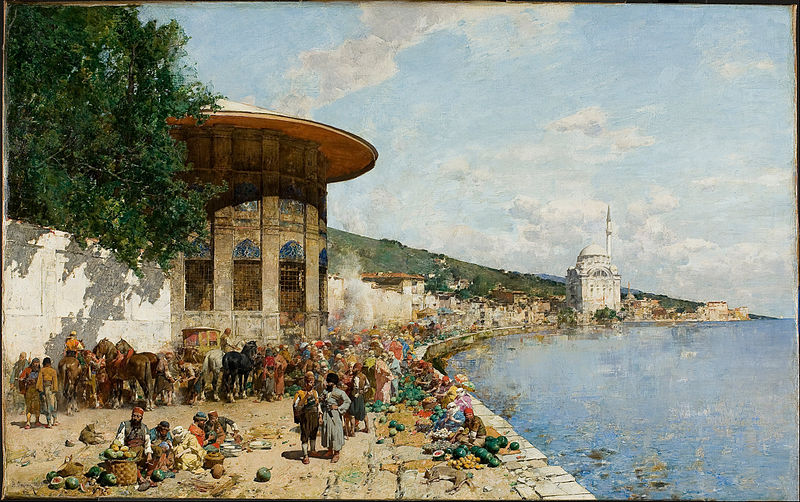
File:Alberto Pasini - Market Day in Constantinople - Google Art Project.jpg
Alberto Pasini, (1826/1899)
Market Day in Constantinople, c. 1877
Berkshire Museum,  Pittsfield, MA, United States

File:Alberto Pasini - Horse market, Syria - Google Art Project.jpg
Alberto Pasini, (1826 - 1899)
Horse market, Syria
Oil on canvas
Height: 840 mm (33.07 in). Width: 1,030 mm (40.55 in).
Art Gallery of New South Wales
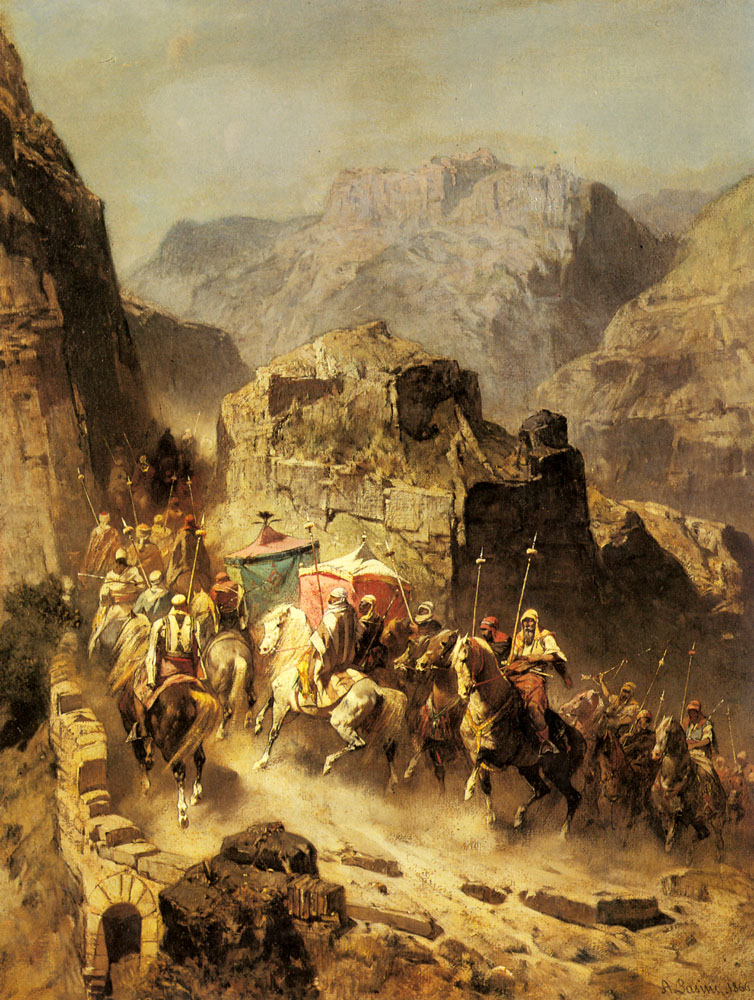
Alberto Pasini, (1826 - 1899)
Arab Caravan, c. before 1899
Oil on canvas

Alberto Pasini, BY THE FOUNTAIN, CONSTANTINOPLE
Alberto Pasini, 1826 - 1899
BY THE FOUNTAIN, CONSTANTINOPLE, c. 1882
Oil on canvas
46 by 38.5cm., 18 by 15¼in.

Delacroix Eugene
Arab Riders on Scouting Mission
Oil Painting on Canvas
36” inches wide by 18” inches high
Hermitage Museum

Ferdinand Victor Eugène Delacroix (French: 6 April 1798 – 13 August 1863) was a French Romantic artist regarded from the outset of his career as the leader of the French Romantic school.

As a painter and muralist, Delacroix's use of expressive brushstrokes and his study of the optical effects of colour profoundly shaped the work of the Impressionists, while his passion for the exotic inspired the artists of the Symbolist movement. A fine lithographer, Delacroix illustrated various works of William Shakespeare, the Scottish writer Walter Scott and the German writer Johann Wolfgang von Goethe.

In contrast to the Neoclassical perfectionism of his chief rival Ingres, Delacroix took for his inspiration the art of Rubens and painters of the Venetian Renaissance, with an attendant emphasis on colour and movement rather than clarity of outline and carefully modelled form. Dramatic and romantic content characterized the central themes of his maturity, and led him not to the classical models of Greek and Roman art, but to travel in North Africa, in search of the exotic. Friend and spiritual heir to Théodore Géricault, Delacroix was also inspired by Lord Byron, with whom he shared a strong identification with the "forces of the sublime", of nature in often violent action.

However, Delacroix was given to neither sentimentality nor bombast, and his Romanticism was that of an individualist. In the words of Baudelaire, "Delacroix was passionately in love with passion, but coldly determined to express passion as clearly as possible. More
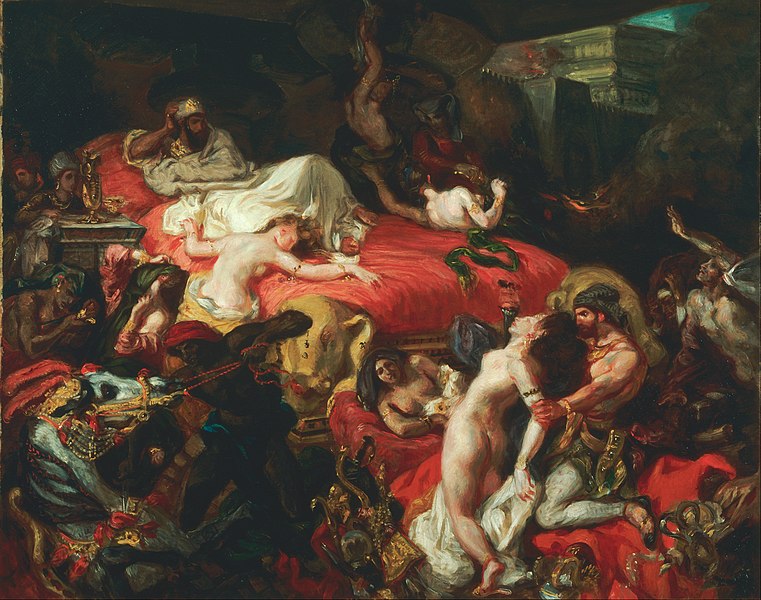
File:Ferdinand-Victor-Eugène Delacroix, French - The Death of Sardanapalus - Google Art Project.jpg
Eugène Delacroix (1798–1863)
Death of Sardanapalus, c. 1844
Oil on canvas
73.71 × 82.47 cm (29 × 32.5 in)
Philadelphia Museum of Art

The painting's most dominant feature is a large divan, with its golden elephants, on which a nude prostrates herself and beseeches the apathetic Sardanapalus for mercy. Sardanapalus had ordered his possessions destroyed and concubines murdered before immolating himself, once he learned that he was faced with military defeat.

The Death of Sardanapalus is based on the tale of Sardanapalus, the last king of Assyria, from the historical library of Diodorus Siculus, the ancient Greek historian, and is a work of the era of Romanticism. This painting uses rich, vivid and warm colours, and broad brushstrokes. It was inspired by Lord Byron's play Sardanapalus (1821). More


Eugène Delacroix (1798–1863)
The Lion Hunt, c. 1885
Oil on canvas

Nationalmuseum, Stockholm, Sweden

File:Eugène Ferdinand Victor Delacroix 021.jpg
Eugène Delacroix (1798–1863)
The Combat of the Giaour and Hassan, c. 1826
Oil on canvas
58 × 71 cm (22.8 × 28 in)
Art Institute of Chicago

The Combat of the Giaour and Hassan, was inspired by a poem by Lord Byron, The Giaour. 

Byron wrote the poem during his Grand Tour during 1810 and 1811. While in Athens, he became aware of the Turkish custom of throwing a woman found guilty of adultery into the sea wrapped in a sack. "Giaour" (Turkish: Gâvur) is an offensive Turkish word for infidel or non-believer, and is similar to the Arabic word "kafir". 

The main story is of Leila, a member of her master Hassan's harem, who loves the giaour and is killed by being drowned in the sea by Hassan. In revenge, the giaour kills him and then enters a monastery due to his remorse. The design of the story allows for contrast between Christian and Muslim perceptions of love, sex, death and the afterlife. More

File:Bride of abydos 1857 950px.jpg
Ferdinand Victor Eugène Delacroix (1798 - 1863)
The Bride of Abydos, c. 1843
28 x 36 cm (10,8 x 14,0 inches)
Oil on canvas

Paris, Musée du Louvre

The Bride of Abydos is from another poem by Lord Byron in 1813. One of his earlier works, it is considered to be one of his "Heroic Poems", along with The Giaour, Lara, The Siege of Corinth, The Corsair and Parisina. These poems contributed to his poetic fame at the time in England.

After an initial description of the Turkish setting, the story opens with the ruler Giaffir rebuking his supposed son, Selim. Selim professes his love for his half-sister, Zuleika, Giaffir's daughter. Angered, the Pasha refuses Selim a key to the royal harem and upbraids him with insults.

Zuleika herself appears, radiant in beauty, and soon she is forbidden to marry Selim; she tacitly complies. Later, she exclaims her love to Selim and mourns her fate that would be without him. He, in turn, decries Giaffir's judgment as well and vows vengeance. 

The second canto again opens with a chthonic description of the Turkish lands and the grotto where the two lovers meet. Cloak thrown aside, Selim is dressed as a dashing pirate and declares that Zuleika is not his sister. She is surprised and listens as Selim relates how Giaffir had killed Abdallah, Selim's father and Giaffir's brother. Selim's story continues as he tells her that he learned of his true identity from one of his father's loyal servants, Haroun, and that since Selim himself as raised by Giaffir, he was detested and maltreated.

He became a pirate so that he could gather a posse for revenge, and asserts his lust for Giaffir's blood; the silence at the end of Selim's tale is interrupted by the reports of weapons belonging to Giaffir's men. Selim, wishing to kiss his love one last time, tarries to leave the cave and soon falls, dying on beach, the fatal blow administered by Giaffir himself. The second canto thus ends with Zuleika dying in sorrow for Selim and Giaffir is forced to live out the rest of his life in solitude. More

Eugène Delacroix (French, 1798 - 1863)
Episode from "The Corsair" by Lord Byron, French, about 1831, 
Watercolor, brown ink, touches of gouache, over graphite underdrawing
24.3 x 19.2 cm (9 9/16 x 7 9/16 in.)
J. Paul Getty Museum

The Corsair was also inspired by another tale in verse by Lord Byron published in 1814, which was extremely popular and influential in its day, selling ten thousand copies on its first day of sale. The Corsair, published in 1814, tells the story of Conrad, a wild and ruthless Aegean pirate whose only virtue is the love he feels for the gentle Medora. There is nothing remarkable about his appearance, Byron tells us, but beneath the quiet exterior there is passion, pride and a defiant, calculated callousness, characteristics that set him apart from other men. Brutalised by childhood ill-treatment, detested and feared, Conrad is a lonely tragic hero who is destined never to enjoy peace or happiness. The Corsair was an immediate success, confirming Byron’s importance as the most popular and influential poet of his generation. More


 Images are copyright of their respective owners, assignees or others


Saturday, March 26, 2016

13 Paintings, Orientalist Artists, 4

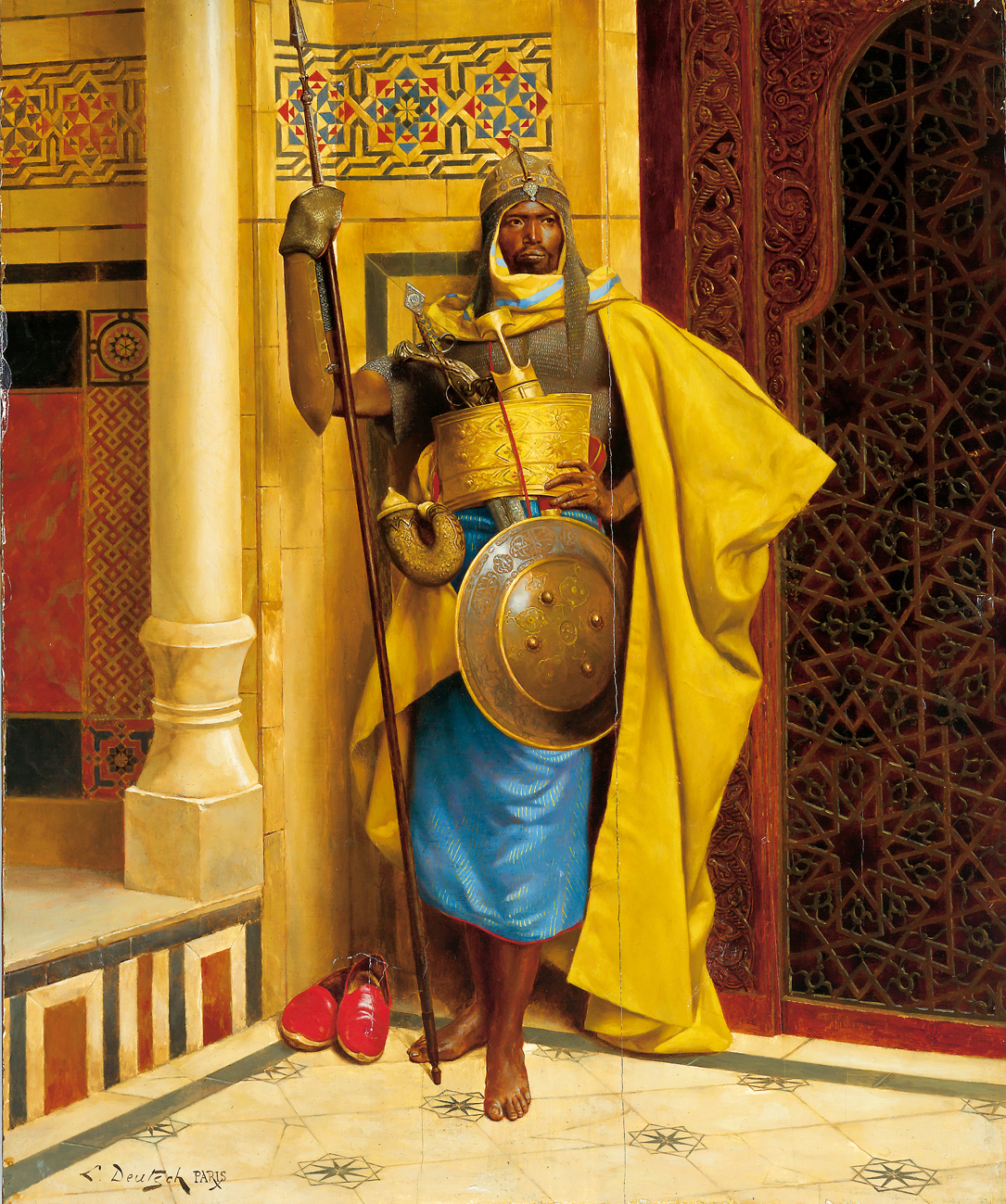
Ludwig Deutsch
MORNING PRAYERS
Dimensions:  25.59 X 20.28 in (65 X 51.5 cm)
Medium:  oil on panel
Creation Date:  1902
Signed

Ludwig Deutsch (Vienna, 1855 - Paris, 1935) was an Austrian painter who settled in Paris. He studied at the Vienna Academy of Fine Arts 1872-1875, then, in 1878, moved to Paris where he became strongly associated with Orientalism. He was on good terms with another Austrian Orientalist in Paris, Rudolf Ernst. More

Ludwig Deutsch (1855–1935)
The Nubian Palace Guard
Oil on canvas

Ludwig DeutschLudwig Deutsch (1855-1935)
A Nubian Guard, c. 1895
Oil on panel
50.5 x 33 cm
(19.88" x 12.99")

File:Ludwig Deutsch - The Sahleb Vendor Cairo, 1886.jpg
Ludwig Deutsch (1855–1935)
The Sahleb Vendor, Cairo, c. 1886
Oil on canvas

File:Ludwig Deutsch - The Smoker, 1903.jpg
Ludwig Deutsch (1855–1935)
The Smoker, Cairo, c. 1903
Oil on canvas

Ludwig Deutsch (1855 - 1935), At Prayer
Ludwig Deutsch, (1855 - 1935)
At Prayer
Oil on Panel, Signed and dated 1923
Image size: 22 x 17 1/2 inches (56 x 44.5cm)

El Azhar Arab University of Cairo, Ludwig Deutsch
Ludwig Deutsch, (1855 - 1935)
El Azhar Arab University of Cairo, c. 1890 
Oil on canvas 
73.5x99.5cm

Eduard Charlemont, Austrian, 1848 - 1906
The Moorish Chief, c. 1878
Oil on panel
59 1/8 x 38 1/2 inches (150.2 x 97.8 cm)
Philadelphia Museum of Art

Standing in front of an arch that closely resembles the architecture of the Alhambra in Spain, the Moorish chief exudes power and mystery. This painting was probably shown at the Paris Salon exhibition of 1878 with the title Le Gardien du serail (The Harem Guard). More

Eduard Charlemont (1848–1906) was an Austrian painter, born in Vienna, capital of the Austrian Empire in 1848. His father, Matthias Adolf Charlemont, was also a painter, specializing in painting miniature portraits. His younger brother Hugo Charlemont (1850–1939) was an equally famous impressionist painter. At the age of fifteen Charlemont exhibited his works for the first time at the Academy of Fine Arts Vienna, where he studied fine arts. At the same age Eduard Charlemont was also hired by a girls' school to teach drawing.

After graduating from the Academy of Fine Arts Vienna, Charlemont traveled to many countries in central Europe and finally settled in Paris, where he lived for the next thirty years. In Paris, several times he won the first prize of the Paris Salon, an annual exhibition held by the French Academy of Fine Arts (French: Académie des Beaux-Arts).[1] The most famous work of Charlemont is The Guardian of the Seraglio, widely known as The Moorish Chief, depicting a Moorish swordsman guarding a seraglio (part of a typical wealthy Arabic villa, where women stayed when strangers entered the house). In 1899 he won the gold medal at the Exposition Universelle, a World's Fair held in Paris. Charlemont was also known for his murals. He painted three of the murals of the Burgtheater (the Austrian National Theatre in Vienna and one of the most important German language theatres in the world) totaling a length of about 55 meters. He died in Vienna in 1906.


Today, reproductions of his painting The Moorish Chief are the best-selling items in the museum store of the Philadelphia Museum of Art. More

Rudolf Ernst (Austrian, 1854–1932)
The captured lion
Oil on Panel
71.1 x 90.2 cm. (28 x 35.5 in.)

Captured Lion by Rudolf Ernst:
Rudolf Ernst (Austrian, 1854–1932)
The captured lion, Detail
Oil on Panel

Rudolf Ernst (14 February 1854, Vienna - 1932, Fontenay-aux-Roses) was an Austro-French painter, printmaker and ceramics painter who is best known for his orientalist motifs. He exhibited in Paris under the name "Rodolphe Ernst".

He was the son of an architect and, encouraged by his father, began studies at the Academy of Fine Arts Vienna at the age of fifteen. He spent some time in Rome, copying the old masters, and continued his lessons in Vienna with August Eisenmenger and Anselm Feuerbach.

In 1876, he settled in Paris. The following year, he participated in his first artists' salon. He later made trips to Spain, Morocco, Egypt and Istanbul to study and document what he saw there.


In 1905, he moved to Fontenay-aux-Roses where he set up a shop to produce faience tiles with orientalist themes. He decorated his home in Ottoman style and lived a reclusive life. His exact date of death was apparently not recorded. More

VERNET Emile Jean Horace, 1789-1863 (France)
La chasse au lion dans le désert. c. 1836
Engraving

VERNET Emile Jean Horace, 1789-1863 (France)
La chasse aux sangliers dans la plaine de Sahara, 1835
Engraving

Émile Jean-Horace Vernet (30 June 1789 – 17 January 1863) was a French painter of battles, portraits, and Orientalist Arab subjects.

Vernet was born to Carle Vernet, another famous painter, who was himself a son of Claude Joseph Vernet. He was born in the Paris Louvre, while his parents were staying there during the French Revolution. Vernet quickly developed a disdain for the high-minded seriousness of academic French art influenced by Classicism, and decided to paint subjects taken mostly from contemporary culture. Therefore, he began depicting the French soldier in a more familiar, vernacular manner rather than in an idealized, Davidian fashion. Some of his paintings that represent French soldiers in a more direct, less idealizing style, include Dog of the Regiment, Trumpeter's Horse, and Death of Poniatowski.

He gained recognition during the Bourbon Restoration for a series of battle paintings commissioned by the duc d'Orleans, the future King Louis-Philippe. Critics marvelled at the incredible speed with which he painted.[2] Many of his paintings made during this early phase of his career were "noted for their historical accuracy as well as their charged landscapes."[3] Examples of paintings in this style include the Battle of Valmy, the Battle of Jemappes, and the Battle of Montmirail.

Over the course of his long career, Horace Vernet was honoured with dozens of important commissions. King Louis-Philippe was one of his most prolific patrons.[2] His depictions of Algerian battles, such as the Capture of the Smahla and the Capture of Constantine, were well-received, as they were vivid depictions of the French army in the heat of battle. After the fall of the July Monarchy during the Revolution of 1848, Vernet discovered a new patron in Napoléon III of France. He continued to paint representations of the heroic French army during the Second Empire and maintained his commitment to representing war in an accessible and realistic way. He accompanied the French Army during the Crimean War, producing several paintings, including one of the Battle of the Alma, which was not as well received as his earlier paintings. One well known and possibly apocryphal anecdote maintains that when Vernet was asked to remove a certain obnoxious general from one of his paintings, he replied, "I am a painter of history, sire, and I will not violate the truth," hence demonstrating his fidelity to representing war truthfully.


Vernet died in his hometown of Paris in 1863. More


Images are copyright of their respective owners, assignees or others.

Thursday, March 24, 2016

12 Paintings, Orientalist Art 3

Léon François Comerre (French 1850-1916)
An oriental beauty holding a pink fan 

signed 'Léon Comerre' (upper left)
oil on canvas
46 3/4 x 30 1/2in (119 x 77.5cm)

Léon François Comerre. Born on October 10, 1850, Comerre grew up in the city of Lille, where he began his formal art training at an early age. In 1868 he moved to Paris and enrolled in the studio of Alexandre Cabanel, who introduced him to exotic orientalist subjects and voluptuous nudes. He quickly distinguished himself as a talented painter and was recognized as a most promising student, thus gaining access to the prestigious Ecole des Beaux-Arts.

Comerre started exhibiting at the Paris Salon in 1871 and won the coveted Prix-de-Rome in 1875. That year marked a turning point in his career, with another gold medal awarded to him by the city of Lille and an additional medal from the Salon for a second painting. The official recognition brought financial rewards for the young painter, and his skills as society portraitist were in high demand.

By the end of 1875, Comerre embarked on a tour of the Lowlands and a four year sojourn in Rome. Upon his return from Rome, Comerre continued to have a successful career, with mural commissions from the city of Paris and Lyon, and an expansion of his client base into the United States. He also exhibited at the Royal Academy, the Royal Society of Portrait Painters, and the Glasgow Institute of the Fine Arts. He became a Knight of the Legion of Honour in 1903. 

Like many of his fellow painters, Comerre catered to the Orientalist taste of his contemporaries that was fueled by an all-encompassing European infatuation with the Near East. Although he never traveled beyond Europe, Comerre made use of the most common attributes of Orientalist paintings, such as intricate tile motifs and ornate silver jewelry, which he successfully incorporated into his portrait commissions.

While the sitter of the present painting is unknown, unlike Commere's commissioned portrait paintings, the model, her dress and the tiled wall are motifs employed in a few other of the artist's orientalist-themed paintings. His mastery of the craft is clearly apparent in the delicate treatment of the fan and the intricate wall carvings, as well as the subtle, varied hues of pink that dominate the composition.

Stanislaus von Chlebowski (Polish, 1835-1884) The prayer 17 3/4 x 11 1/2in (45 x 29.5cm)
Stanislaus von Chlebowski (Polish, 1835-1884)
The prayer 
signed and dated 'A. Chlebowski 1879' (lower right)
oil on panel
17 3/4 x 11 1/2in (45 x 29.5cm)

Stanisław Chlebowski (1835–1884) was a Polish painter with Russian and Turkish connections. He was a renowned specialist in Oriental themes. He was born in Podole, and learned drawing in Grekov Odessa Art school. Between 1853-1859, he studied at the Academy of Fine Arts in St. Petersburg, and then on a scholarship for six years in Paris as the pupil of the French Orientalist painter Jean-Léon Gérôme. Chlebowski traveled to Spain, Italy, Germany, and Belgium. His first success was selling his painting Joanne d’Arc in Amiens Prison to Napoleon III of France.

In the years 1864-1876 Chlebowski was master painter for Sultan Abdülaziz and took up residence in Constantinople. During his services, he had obtained permission to bring with him a large icon of Mother of God Leading Our Way having been rescued from the Hodegon Monastery in 1453. He had come across it in one of the magasins with old relics, unheeded by the Ottoman keeper. This account is certified in a letter by the Comité National Polonais à Constantinople, dated June 27, 1938.

In 1876 he moved to Paris. In 1881 he returned permanently to Krakow. The subject matter of his watercolors and oil paintings is diverse. He painted images of historical battles related to the history of Turkey, oriental genre scenes, landscapes, and portraits of sultans. He died near Poznań, in Kowanówko at age 49.

Chlebowski lived abroad for a long time and as a result his paintings were very rare in Poland. The National Museum in Krakow houses some of his other important Orientalist works such as Entrée de Mahomet II à Stamboul. More

Jean-Léon Gérôme 1824 - 1904 FRENCH PRIÈRE DANS LA MOSQUÉE signed J. L. GEROME (lower right)  oil on canvas 16 by 13 in. 40.6 by 33 cm:
Jean-Léon Gérôme
1824 - 1904
FRENCH
PRIÈRE DANS LA MOSQUÉE
signed J. L. GEROME (lower right)
oil on canvas
16 by 13 in.
40.6 by 33 cm

Jean-Léon Gérôme (11 May 1824 – 10 January 1904) was a French painter and sculptor in the style now known as Academicism. The range of his oeuvre included historical painting, Greek mythology, Orientalism, portraits and other subjects, bringing the Academic painting tradition to an artistic climax. He is considered one of the most important painters from this academic period, and in addition to being a painter, he was also a teacher with a long list of students. More

Henri Emilien Rousseau (French, 1875-1933) A caravan at rest 18 1/8 x 21 5/8in (46 x 55cm)
Henri Emilien Rousseau (French, 1875-1933)
A caravan at rest 
signed 'Henri Rousseau' and illegibly dated (lower right)
oil on panel
18 1/8 x 21 5/8in (46 x 55cm)

Henri Rousseau Henry said Emilien Rousseau (Cairo 1875 - Aix-en-Provence in 1933) was an orientalist painter. A student of Jean-Léon Gérôme at the Beaux-Arts in Paris, he won the second Grand Prix de Rome in 1900 and a travel grant at the Salon of French Artists. He travels the Belgium , the Netherlands , the North Africa , then to Spain and Italy where he admired the great masters ( Rubens , Rembrandt , Velasquez , Murillo , the Titian , Raphael etc ...)

After this initiatory journey, he settled in Versailles and set up his studio at the Villa des Arts in Paris. In 1919 he moved to Aix en Provence with his large family (seven children). For a Chevalier of the Legion of Honour on the arts, it was a notable of the area. He mainly travelled to Tunisia , the Algeria and especially Morocco. Provence and the Camargue remained his anchors. His success with the middle-class and wealthy clientele is punctuated with numerous exhibitions in Paris, Brussels , Stockholm , Marseille . More

Fabio Fabbi (Italian, 1861-1946) The new slave girl 38 3/4 x 29in (98.5 x 73.5cm)
Fabio Fabbi (Italian, 1861-1946)
The new slave girl 
signed 'F. Fabbi' (lower left)
oil on canvas
38 3/4 x 29in (98.5 x 73.5cm)

Fabio Fabbi was born in Bologna, Italy in 1861. As a young man, he enrolled at the Accademia Di Belle Arti in Florence and studied sculpture and painting in the 1880s, winning prizes in both categories. After his studies, he travelled to Paris, Munich, and finally Egypt. Upon his return to Italy, he dedicated himself solely to painting and was honoured with the distinction of professorship at the Accademia.

Fabbi painted prolifically images of odalisques and bazaars which were well-received by the public. His images were commercial for his day, and thus he succeeded in painting more works than many of his contemporaries in Italy. From 1884 onward, Fabbi regularly participated in exhibitions in Turin, Milan and Florence, gaining popularity and laud mostly because his works were colourful and amusing. Although the subject matter was not novel to his audience at this point in time, his impressionist technique and the movement of his figures were quite appealing, as in the present lot. More

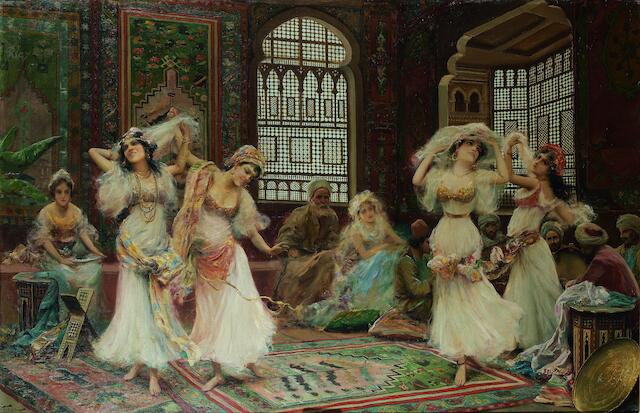
Fabio Fabbi (Italian, 1861-1946) Dancing girls in the harem
Fabio Fabbi (Italian, 1861-1946)
Dancers in the harem 
signed 'F. Fabbi' (lower left)
oil on canvas
90 x 140cm (35 7/16 x 55 1/8in)

Dancers in the Harem, a work most likely inspired by a visit to Cairo, shows the Fabbi's versatility and skill. The backdrop of the room, the carpets and windows are clearly painted with clean lines, articulated and realistic. The dancers, however, are painted with visible brushstrokes, giving the impression that they are moving and dancing to the music. Fabbi's unique ability to mix the two techniques makes the work both interesting and believable. 

The present scene depicts one of Fabbi's favourite themes: Raks Baladi, the popular folk dance of Egypt which is believed to have mothered all Oriental dance. During his trip to Egypt in 1886, Fabbi would have witnessed the skilful women performing Raks Baladi as it was enjoyed at festivals, in the home, and in the living quarters for casual entertainment. The depiction of the dancers is true to what Fabbi would have seen in Cairo. The women don long, simple robes indigenous to Egypt with some ornamentation around the bust and scarves accentuating the hips. This costume differed greatly from region to region in the Middle East, verifying Fabbi's interaction with the Egyptians. 

Fabbio Fabbi
Fabbio Fabbi (1861-1946)
Slave Auction
Oil On Canvas
40.6 x 70.5 cm, (15.98" x 27.76")

Adolf Schreyer 1828-1899 GERMAN THE ADVANCE signed AD Schreyer oil on canvas 41 1/2 by 68 in. 105.4 by 173 cm:
Adolf Schreyer, 1828-1899
GERMAN
THE ADVANCE
signed AD Schreyer
oil on canvas
41 1/2 by 68 in.
105.4 by 173 cm

Adolf Schreyer (July 9, 1828 Frankfurt-am-Main – July 29, 1899 Kronberg im Taunus) was a German painter, associated with the Düsseldorf school of painting. He studied art first at the Städel Institute in his native town, and then at Stuttgart and Munich. He painted many of his favourite subjects in his travels in the East. He first accompanied Maximilian Karl, 6th Prince of Thurn and Taxis through Hungary, Wallachia, Russia and Turkey; then, in 1854, he followed the Austrian army across the Wallachian frontier. In 1856 he went to Egypt and Syria, and in 1861 to Algiers. In 1862 he settled in Paris, but returned to Germany in 1870; and settled at Cronberg near Frankfurt, where he died.

Schreyer was, and is still, especially esteemed as a painter of horses, of peasant life in Wallachia and Moldavia, and of battle incidents. His work is remarkable for its excellent equine draughtsmanship, and for the artist's power of observation and forceful statement; and has found particular favour among French and American collectors. Of his battle-pictures there are two at the Schwerin Gallery, and others in the collection of Count Mensdorff-Pouilly and in the Raven Gallery, Berlin. His painting of a Charge of Artillery of Imperial Guard was formerly at the Luxembourg Museum. The Metropolitan Museum, New York owns three of Schreyer's oriental paintings: Abandoned, Arabs on the March and Arabs making a detour; and many of his best pictures are in the Rockefeller family, Vanderbilt family, John Jacob Astor, William Backhouse Astor, Sr., August Belmont, and William Walters collections. At the Kunsthalle in Hamburg is his Wallachian Transport Train, and at the Staedel Institute, Frankfort, are two of his Wallachian scenes. More
Edwin Lord Weeks 1849 - 1903 AMERICAN FIGURES IN AN INTERIOR WITH GARDEN OF PALMS BEYOND signed E.L. Weeks (lower right) oil on canvas 32 by 39 1/2 in. 81.3 by 100.3 cm:
Edwin Lord Weeks, 1849 - 1903
AMERICAN
FIGURES IN AN INTERIOR WITH GARDEN OF PALMS BEYOND
signed E.L. Weeks (lower right)
oil on canvas
32 by 39 1/2 in.
81.3 by 100.3 cm

After years of travel through Europe, North Africa, the Middle East and India, the American artist Edwin Lord Weeks remained captivated by the sights he encountered abroad and towards the end of his career he began an ambitious series of paintings based on A Thousand and One Nights. From this series, he exhibited Man Waking from Sleep in 1898 and L’histoire de Noureddin et la belle Persane a year later at the Paris Salon of 1899. A series of four paintings of The Porter of Baghdad were sold in the artist’s estate sale of 1905 (one of which was shown at the Paris Salon of 1901). Given the scale and subject, the present painting is almost certainly one from this series, although, like lot xx, it has remained undocumented until now.

In Figures in an Interior with Garden of Palms Beyond, Weeks presents an interesting combination of imagery. Weeks documented his travels through sketches, paintings and photographs, which provided source material for the present scene. Additionally, architectural elements reminiscent of Weeks’ Indian paintings of the 1880s and 1890s now reappear as the background and decorative elements. 

Two figures sit in a sheltered, sun-dappled courtyard overlooking a lush forest of swaying palms, Weeks is careful to render the architecture of the scene, complete with its delicately carved stone latticework, as well as the costumes of the two figures. The lounging girl is swathed in elaborately embroidered sheer red silks, reminiscent of the Nautch dancing girls which Weeks had painted in India  More

Edwin Lord Weeks
The Doctor's Visit (from A Thousand and One Night series) (1903) 

Edwin Lord Weeks exhibited Man Waking from Sleep in 1898, at the Paris Exposition of that year, and L'histoire de Noureddin et la belle Persane, a year later at the Paris Salon of 1899. A series of four paintings of The Porter of Bagdad were sold in the artist's estate sale of 1905; Number 3 of that series was shown at the Paris Salon of 1901. The present painting, The Doctor's Visit, bears a label in Weeks' own hand, sending it to the Universal Exposition in St. Louis in 1904. Weeks, like most artists, sent only recent paintings to major exhibitions, thus enabling us to date The Doctor's Visit to circa 1903, the year of his untimely death.

The Doctor's Visit achieved the highest price among the "1001 Nights" paintings at the artist's estate sale of 1905. Curiously, The Doctor's Visit exploits an interesting combination of imagery, visually rooted in India and Persia to recount a story rooted in Arabic literature. In this work, Weeks has extracted architectural elements from his Indian paintings of the 1880s and 1890s and recombined them into a fantasy of form and pattern as a setting for the Doctor to visit his patient lying upon a marble plinth in the shadow of early morning sunshine. The setting overlooks the azure Lake of Udaipur, India; in the distance are the semi-arid purple hills surrounding the Lake and Palace of Udaipur. Weeks has fashioned an imagined portion of this famed island palace as the open-air lounging spot of bright white marble for his Princess, who lies upon the cushions for her back and the stone for her outstretched legs.

She rests, seductively, in airy white silk halter and gown, accented in gold, falling around her thighs and lower legs to form a mound of ripples in front of her. Her gold tiara and multi-stranded necklace frame her youthful face with wide, dark eyes, slight smile and long, raven hair: her features all tell of Persian ancestry, as do those of the Doctor. Yet the Doctor's costume of embroidered peach-colored silk, tight about the torso and flaring wide–almost to the floor–is purely Indian in style. The gorgeous shimmer of the material has a coarse, dark seam starting at the waist and ending just above the curious upturned toe of his shoes. In its backlit beauty, this fabulously-rendered robe appears royal in nature. The entire costume, from head to foot, begins a dialogue with the form and pattern of the slim, marble column to the left. Weeks has used both elements, figure and column lit in sunshine, to frame the space occupied by the lounging princess. The narrative of The Doctor's Visit is contained within these two beautifully-designed elements by this extremely skillful painter at the end of his career. More

Moorish Girl Lying On A Couch Rabat, Morocco - Edwin Lord Weeks
Edwin Lord Weeks
Moorish Girl Lying On A Couch, Rabat, Morocco
Oil on Board
Material: board
48.2 x 72.4 cm
Private Collection

Edwin Lord Weeks (1849-1903) - Nautch Girl Resting
Edwin Lord Weeks (American, 1849–1903)
Nautch girl resting , ca. 1895–1900
Oil on canvas
91.4 x 154 cm. (36 x 60.6 in.)

In North India, Nautch is one of several styles of popular dance, performed by girls known as Nautch girls. 


Acknowledgement: Bonhams, Sothebys

Saturday, September 5, 2015

7 Artists Embedded with Napoleon's Navy in the Indian Ocean. 1803

Charles-Alexandre Léon Durand, Comte de Linois (27 January 1761 – 2 December 1848) was a French admiral during the time of Napoleon Bonaparte. In 1803 Napoleon appointed him to command the French forces in the Indian Ocean and, flying his flag aboard the 74-gun-ship Marengo (ex-Jean-Jacques Rousseau), he harried British merchant ships across the ocean and into the China Seas.


the Achille
Model, first quarter of the 1800s. Made following plans by Jacques-Noël Sané
1/33rd-scale model of the Achille
Musée national de la Marine

The Achille, sister-ship of French ship Marengo (1810).

Jean-Jacques Rousseau was a Téméraire class 74-gun ship of the line of the French Navy. In October 1796, under Captain Racord, she was part of the Villeneuve's squadron that sailed from Toulon to Brest. On 2 December 1802, she was renamed to Marengo (reflecting the political change from the Revolutionary Republic inspired by Jean-Jacques Rousseau to the advent of General (soon to be Emperor) Napoleon).


In 1803 she sailed to the Indian Ocean as Linois' flagship, notably taking part in the Battle of Pulo Aura and the Battle of Vizagapatam.

File:East Indiamen in a Gale.jpg
Charles Brooking (1723–1759)
This is a portrait of an East Indiaman in the foreground, in port-quarter view. The ship in the distance to the left approaches in starboard-bow view, heeling on the port tack under fore and main-course. 
Date circa 1759
National Maritime Museum, Greenwich

East Indiaman was a general name for any sailing ship operating under charter or licence to any of the East India Companies of the major European trading powers of the 17th through the 19th centuries. The term is therefore used to refer to vessels belonging to the Danish, Dutch, English, French, Portuguese, or Swedish East India companies. 

During the French Revolutionary and Napoleonic Wars they were often painted to resemble warships; an attacker could not be sure if gunports were real or merely paint, and some Indiamen carried sizable armaments. The Royal Navy acquired several East Indiamen, turning them into fourth rates (e.g., HMS Weymouth and HMS Madras, described above), maintaining the confusion for military ships seeking merchant ships as prizes of war. More

Charles Brooking (c.1723–59) was an English painter of marine scenes. Brooking became much more widely known in 1754, when he was commissioned to paint A Flagship Before the Wind Under Easy Sail. This painting is a huge sea piece intended to "match" another painting, whereabouts unknown, said to be of a “Fleet in the Downs”, by Peter Monamy.


Brooking is said to have died of consumption on 25 March 1759, reportedly leaving his family destitute

File:John Cleveley the Elder - The East Indiaman 'Princess Royal'.jpg
John Cleveley the Elder circa 1712 - 1777
The East Indiaman‚ Princess Royal, c. 1770
Oil on canvas
75 × 111.5 cm (29.5 × 43.9 in)
National Maritime Museum

Princess Royal, launched in 1786, was an East Indiaman. She made two complete trips to India for the British East India Company and was on her third trip, this one to China, when French privateers or warships captured her on 27 September 1793. The French Navy took her into service in the Indian Ocean as a 34-gun frigate under the name Duguay Truin. The Royal Navy recaptured her and she returned to British merchant service. In 1797 she performed one more voyage for the EIC. She received a letter of marque in July 1798 but then disappears from readily available records. More

John Cleveley the Elder (c.1712 – 21 May 1777) was an English marine artist. He was born in Southwark. His father set him up as a carpenter or shipwright in around 1742. Continuing his work in that area throughout his life. From about 1745 he also worked as a painter, mostly ship portraits, dockyard scenes of shipbuilding and launches, and some other marine views. They combined his knowledge of shipbuilding with accurate architectural and topographical detail. Apparently mostly self-taught, it is possible that dockyard ship-painters also gave him some training in this area. He toured East Anglia, and produced some paintings from notes made on that trip. More

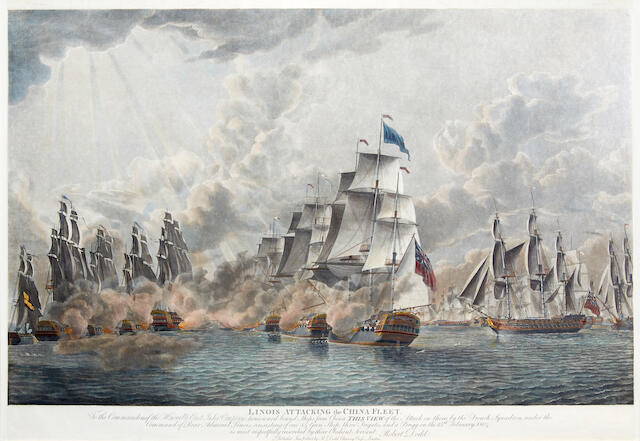
A pair of prints relating to the China Fleet action (2)
After Robert Dodd (British, 1748-1816)
Linois attacking the China Fleet
19-1/2 x 28-3/4 in. (49.53 x 73 cm.)
January 1805
Collections of the National Maritime Museum

Inscribed: "To the Commander of the Honorable East India Company's homeward bound Ships from China THIS VIEW of the Attack on them by the French Squadron...on 15th February 1804..."

After Robert Dodd (British, 1748-1816)
Repulse of the Linois by the China Fleet
19-1/2 x 28-3/4 in. (49.53 x 73 cm.)
January 1805
Collections of the National Maritime Museum

Inscribed: "This View, comprising Portraits of the several Ships in the Fleet, on that memorable day, making Sail in pursuit of the retreating enemy; Is with the greatest respect Inscribed to the respective Commanders, by their Obed.t Servant Rob.t Dodd."

At the Battle of Pulo Aura in 1804, a squadron of French naval ships commanded by Linois encountered the British China Fleet of lightly armed merchant ships. The British ships outnumbered Linois' forces, manoeuvred as though preparing to defend themselves, and some flew naval ensigns. The tactics of the convoy commodore Nathaniel Dance fooled Linois into believing that the British fleet was defended by naval escorts and he retired without attacking the virtually defenceless British.

Sir Nathaniel Dance (20 June 1748 – 25 March 1827) was an officer of the Honourable East India Company who had a long and varied career on merchant vessels and the the fleets of East Indiamen. His greatest achievement came during the Napoleonic Wars, when having been appointed commodore of one of the company's fleets, he came across a French squadron under Rear-Admiral Comte de Linois, which was raiding British shipping in the area.  He fooled Linois into believing that the British fleet was defended by naval escorts and he retired without attacking the virtually defenceless British.. Dance was hailed as a hero, lavishly rewarded with money and a knighthood, and spent the last years of his life in comfortable retirement.

Robert Dodd (1748–1815) was a British marine painter and aquatint engraver. He is known for his works on the French Revolutionary Wars. Living in Wapping, London, he had plenty of material to hand in the way of ships, docks and wharfs, and much of his work includes scenes of the River Thames and naval dockyards. Other themes include battles and actions of the French Revolutionary Wars and the American War of Independence. Much of his work was subsequently engraved by other artists. His use of light effects, particularly the contrasts between the sun's rays and the dark clouds, or the fire against the smoke of battle, convey the drama and activity of a sea battle. Although technically accurate and meticulous, his artistic talents were somewhat eclipsed by the greatest of his peers, and it is his contribution to the historical record that is his greatest legacy. More


William Daniell (1769–1837)
The fleet of the East India Company homeward bound from China engaging and repulsing a French squadron near the Straits of Malacca, on 15 February 1804.
20 September 1804

This painting: Commodore Dance's Indiamen (centre), protecting the merchant fleet (right), engage Admiral Linois's squadron (left)

Preview
Unknown
19th century
Etching
98 mm x 172 mm
National Maritime Museum, Greenwich, London

Inscribed: The Gallant Commodore Dance beating off Admiral Linois' Squadron

Preview
Francis Sartorius (1734 – 5 March 1804)
Action between the China Fleet and a French squadron
William Barnard [engraver]
February 15th 1804
Aquatint, coloured
492 mm x 742 
National Maritime Museum, Greenwich, London

Inscribed: 'To The Honorable... East India Company. This Print of the Action between the China Fleet... & a Squadron of French Ships of War... Linois, in the China Sea, on the 15th Feby 1804 representing the Commencing of the Attack led on by Capt. I.F. Timmins in the Royal George is... dedicated by... George Andrews'.

Francis Sartorius (1734 – 5 March 1804). Francis was the son and pupil of John Sartorius. He was a prolific and popular painter. Francis contributed 38 works for exhibition at various London galleries including twelve to the Royal Academy, 7 to the Society of Artists and 20 to the Free Society of Artists. He lived in London during the years he was exhibiting, finally residing in Soho, London. He died on 5 March 1804, in his 70th year. More

Preview
Action between the China Fleet and a French squadron
February 15th 1804

Inscribed: The China fleet heavily laden commanded by Commodore Sir Nathaniel Dance beating off Admiral Linois and his squadron the 15 February 1804
National Maritime Museum, Greenwich, London

Linois's officers and the Emperor Napoleon personally castigated the French admiral for his failure to press the attack against a weaker and extremely valuable enemy. Although he remained in command of the squadron for another two years and had some minor success against undefended merchant ships, he suffered a string of defeats and inconclusive engagements against weaker British naval forces.

William Daniell (1769–1837)
Defeat of Adml. Linois by Commodore Dance, Feb. 15th. 
Thomas Sutherland (engraver)
20 September 1804
coloured aquatint
150 mm x 221 mm
Collections of the National Maritime Museum

William Daniell RA (1769–1837) was an English landscape and marine painter, and engraver. He travelled extensively in the Far East, helping to produce one of the finest illustrated volumes of the period – Oriental Scenery. He also travelled around the coastline of Britain to paint watercolours for the equally ambitious book A Voyage Round Great Britain. His work was exhibited at the Royal Academy and the British Institution and he became a Royal Academician in 1822

Defence of the Centurion in Vizagapatam Road
Sir James Lind
Defence of the Centurion in Vizagapatam Road, Septr. 15th 1804
Engraving by Thomas Sutherland, c. 1818
National Maritime Museum

The Battle of Vizagapatam was a minor naval engagement fought in the approaches to Vizagapatam harbour in the Coastal Andhra region of British India on the Bay of Bengal on 15 September 1804 during the Napoleonic Wars. A French squadron under Contre-Admiral Charles-Alexandre Durand Linois in the ship of the line Marengo attacked the British Royal Navy fourth rate ship HMS Centurion and two East Indiaman merchant ships anchored in the harbour roads. 

Since Pulo Aura, Linois had been cruising the Indian Ocean, and during August and September 1804 had seized a number of valuable merchant ships as his squadron travelled north from Ceylon along the Indian coast of the Bay of Bengal. Linois learned of the presence of the East Indiamen at Vizagapatam and determined to attackt. Arriving off the port at 06:00, Linois advanced on the convoy, causing one of the East Indiamen to drive ashore in panic. The other merchant vessel failed to support the outnumbered Centurion and was captured, but Centurion continued fighting alone. After an engagement lasting four hours Marengo withdrew, the badly damaged Centurion attempting to pursue but without success. Linois's squadron was forced to return to Île de France in the aftermath of the engagement, where Marengo required six months of repairs.


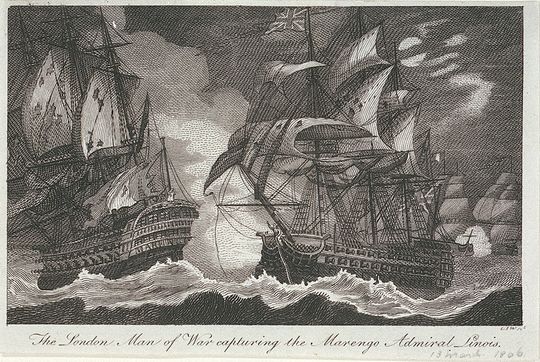
Capture of Marengo by HMS London

The capture of the French ship Marengo by HMS London on 13 March 1806.
Nineteenth century
National Maritime Museum


Marengo was taken into British service as HMS Marengo. She was used as a prison hulk from 1809 until she was broken up in 1816.

Returning to France, Linois encountered with the division of Vice-Admiral Sir John Warren, with seven ships of the line (including the 108-gun London, the 82-gun Ramillies and Repulse, and the 80-gun Foudroyant), two frigates (including the 48-gun Amazon) and one corvette. After a fierce duel with London, Marengo struck her colours; Belle Poule battled against Amazon and later against Ramilles, and had to surrender as well., Linois was wounded and captured. Napoleon had ended the practice of exchanging officers and Linois remained a prisoner of war until Napoleon fell in 1814. In 1810, while held by the British, Linois was named comte de Linois by Napoleon.


John Cleveley the elder
HMS 'Brune' Captures French Ship 'L'oiseau'
Oil on canvas, 74.5 x 119.8 cm
Southampton City Art Gallery


AcknowledgmentWikipedia