Showing posts with label Orientalists. Show all posts

Friday, April 22, 2016

20 Paintings by 19th Century Swiss, German and French Orientalist Artists, with foot notes #6

Philippe-Jacques van Bree, ANTWERP 1786 - 1871 BRUSSELS, BELGIUM SCHOOL
PHILIPPE-JACQUES VAN BREE; GIOVANNI BELLINI IN MAHOMET II'S COURT
Oil heightened with gold on panel 
58.5 x 73.5 cm; 23 by 29 3/4 in
Private collection

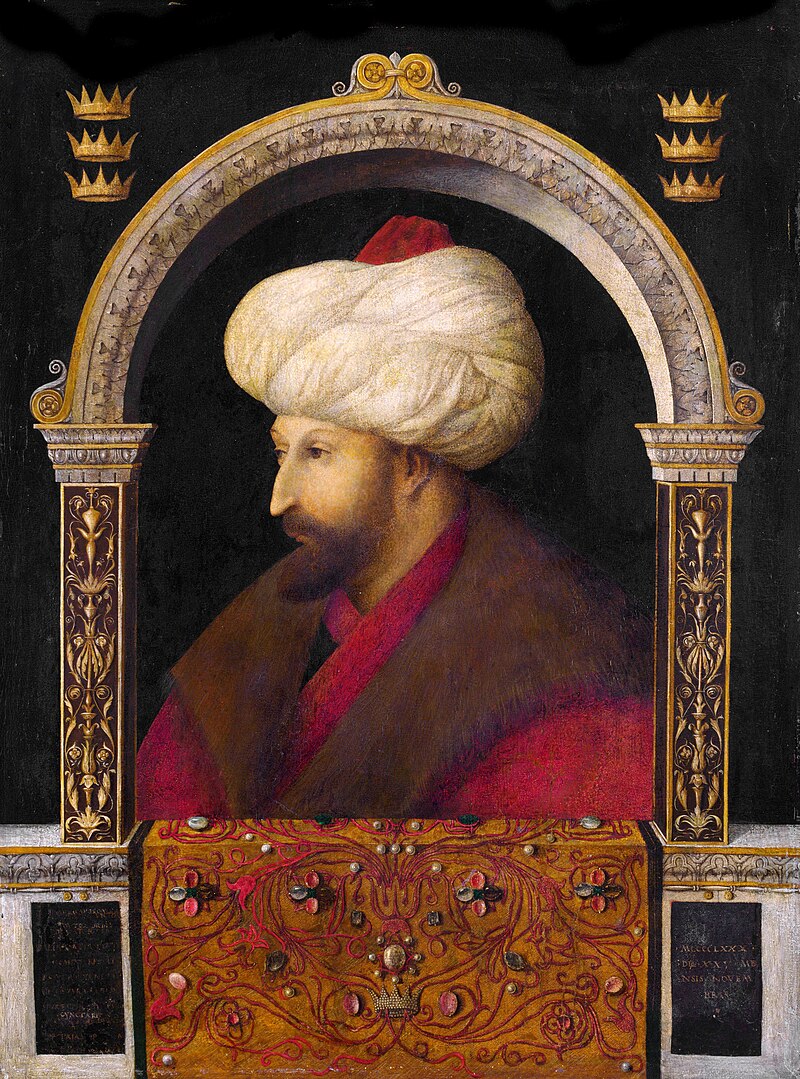
Sultan Mohammed II, famous conqueror who besieged and captured Constantinople in 1453, was an avid collector of works of art. He brought the famous Venetian painter Gentile Bellini (circa 1429-1507) in Constantinople, on the occasion of the peace agreements signed between the Republic of Venice and the Ottoman Empire in 1479. On that occasion, the famous Bellini executed portrait Mahomet II, now preserved in the National Gallery in London. More, (See below)

Philippe-Jacques van Bree (1786 - 1871), scholar of his brother Mattheas, was born at Antwerp in 1786. He studied at Antwerp, in Paris (where he became a scholar of Girodet), and at Rome; and also visited Germany and England. He employed himself on historical, fancy, and architectural subjects. Of the last, the Belgian Government purchased his 'View of the Interior of the Church of St. Peter at Rome,' and presented him with a gold medal in addition to the price. He was made conservator of the Museum at Brussels, where he died in 1871. More on Philippe-Jacques van Bree

Portrait de Mehmed II par Gentile Bellini (1479).
Gentile Bellini (1429–1507) 
The Portrait of Ottoman Sultan Mehmed the Conqueror by İtalian painter Gentile Bellini, c. 1480.
Oil on canvas
Height: 69.9 cm (27.5 in). Width: 52.1 cm (20.5 in).
National Gallery 

The attribution to Bellini is not proved, but the sitter is reasonably identified as Mehmet II (1432 - 1481). Gentile Bellini visited his court in Constantinople. There is insufficient evidence for deciding whether the picture is a copy or a very damaged original."

Mehmed II, byname Fatih Sultan Mehmed (Turkish: Sultan Mehmed the Conqueror), (born March 30, 1432, Adrianople, Thrace, Ottoman Empire—died May 3, 1481, Hunkârçayırı, near Maltepe, near Constantinople), Ottoman sultan from 1444 to 1446 and from 1451 to 1481. A great military leader, he captured Constantinople and conquered the territories in Anatolia and the Balkans that constituted the Ottoman Empire’s heartland for the next four centuries. More on Mehmed II

Giovanni Bellini (c. 1430 – 26 November 1516) was an Italian Renaissance painter, probably the best known of the Bellini family of Venetian painters. His father was Jacopo Bellini, his brother was Gentile Bellini (who was more highly regarded than Giovanni during his lifetime, although the reverse is true today), and his brother-in-law was Andrea Mantegna. He was considered to have revolutionized Venetian painting, moving it towards a more sensuous and colouristic style. Through the use of clear, slow-drying oil paints, Giovanni created deep, rich tints and detailed shadings. His sumptuous coloring and fluent, atmospheric landscapes had a great effect on the Venetian painting school, especially on his pupils Giorgione and Titian. More on Giovanni Bellini

FRENCH SCHOOL OF NINETEENTH CENTURY FEMMES ET ENFANTS DANS UNE COUR INTÉRIEURE *** DURAND; WOMEN AND CHILDREN IN A COURTYARD; SIGNED LOWER RIGHT; WATERCOLOR ON PAPER; SEE ILLUSTRATION ON THE NEXT PAGE Signed lower right Durand Watercolour on paper  48 x 39.5 cm; 18 7/8 by 15 1/2 in:
Jean-Baptiste Henri Durand-Brager
FRENCH SCHOOL OF NINETEENTH CENTURY
WOMEN AND CHILDREN IN A COURTYARD
Watercolour on paper 
48 x 39.5 cm; 18 7/8 by 15 1/2 in
Private collection

Art historian Marion Vidal-Bue was born and lived in Algiers until its independence. She comes from a family of builders established in the country in 1832. She has written books on painters of Algeria, especially to witness the artistic importance and influence of her native country at the time of the French presence. 

She participated in the artistic illustration of the works of the Scientific Exploration of Algeria, published in 1844-1867, commissioned by the Minister of War in 1837. These watercolours form a rare and interesting set which shows scenes of life in Algiers 1830-1840 years; in the early days of the arrival of the French in Algeria. 

ECOLE FRANÇAISE DU XIXE SIÈCLE FEMMES DANS UN INTÉRIEUR AVEC UNE NOURRICE S'OCCUPANT D'UN BÉBÉ *** DURAND; WOMEN IN AN INTERIOR WITH A SITTER NURSING A BABY; SIGNED LOWER LEFT; WATERCOLOR ON PAPER; SEE ILLUSTRATION ON THE NEXT PAGE Signé en bas à gauche Durand Aquarelle sur papier 48 x 39,5 cm ; 18 7/8 by 15 1/2 in:
Jean-Baptiste Henri Durand-Brager
WOMEN IN AN INTERIOR WITH NURSE CONCERNED FOR A BABY 
Watercolour on paper 
48 x 39.5 cm; 18 7/8 by 15 1/2 in
Private collection

Jean-Baptiste Henri Durand-Brager (1814–1879) was a French painter, noted for his marine scenes and Orientalist works.

Durand-Brager, a French marine painter, was born at Dol in Brittany in 1814. He studied under Gudin and Eugène Isabey.

He was a naval officer who rose to the rank of captain. In 1840, he accompanied the fleet which repatriated Napoleon's remains from St. Helena, which island afforded him subjects for various pictures. He spent much of his time in travelling; he went to Buenos Aires with the squadron, Montevideo in 1841–42 aboard a French warship, and explored Uruguay and Brazil; he accompanied the expeditions to Tangiers and Mogador, and to Madagascar. He painted views of the places he visited, and also naval combats and sea-pieces. He died in 1879.

In the 1850s, he was in the Crimea during the war with Russia, where he turned his hand to photography as well as painting. He was one of about fifteen photographers, including Felice Beato, Roger Fenton and James Robertson, who photographed soldiers, barracks, camp life and battlefields and were the first to record a major war on film. Later, he returned to Constantinople where he made photographs of the landscape, monuments and the people.

He was a versatile painter, producing naval scenes, genre works, costumbrismo works, landscapes and works with Orientalist themes. There are several of his works in the galleries of Versailles. More on Jean-Baptiste Henri Durand-Brager

Durand FRENCH SCHOOL OF NINETEENTH CENTURY SCÈNE DE CAFÉ *** DURAND; SCENE IN A CAFE; SIGNED LOWER LEFT; WATERCOLOR ON PAPER Signed lower left Durand Watercolour on paper  48 x 39.5 cm; 18 7/8 by 15 1/2 in:
FRENCH SCHOOL OF NINETEENTH CENTURY
SCENE IN A CAFE
Watercolour on paper 
48 x 39.5 cm; 18 7/8 by 15 1/2 in
Private collection

Durand FRENCH SCHOOL OF NINETEENTH CENTURY DANSEUSE ET MUSICIENNES *** DURAND; DANCER AND MUSICIANS; SIGNED, SITUATED AND DATED LOWER LEFT ALGER 1840 (?); WATERCOLOR ON PAPER; SEE ILLUSTRATION ON PREVIOUS PAGE Signed, located and dated lower left Durand Algiers in 1840 (?)  Watercolour on paper  48 x 39.5 cm; 18 7/8 by 15 1/2 in:
FRENCH SCHOOL OF NINETEENTH CENTURY
DANCER AND MUSICIANS
Watercolour on paper 
48 x 39.5 cm; 18 7/8 by 15 1/2 in
Private collection

Durand FRENCH SCHOOL OF NINETEENTH CENTURY FÊTE DE NUIT DANS UN PALAIS *** DURAND; RECEPTION BY NIGHT IN A PALACE; SIGNED LOWER LEFT; WATERCOLOR ON PAPER. SEE ILLUSTRATION ON PREVIOUS PAGE. Signed lower left Durand Watercolour on paper  48 x 39.5 cm; 18 7/8 by 15 1/2 in:
FRENCH SCHOOL OF NINETEENTH CENTURY
RECEPTION BY NIGHT IN A PALACE
Watercolour on paper 
48 x 39.5 cm; 18 7/8 by 15 1/2 in
Private collection

Durand ECOLE FRANÇAISE DU XIXE SIÈCLE MUSICIENS ET DANSEUSES AFRICAINES DANS LA COUR D'UN PALAIS *** DURAND; MUSICIANS AND AFRICAN DANCERS IN THE COURTYARD OF A PALACE; WATERCOLOR ON PAPER Aquarelle sur papier 48 x 39,5 cm ; 18 7/8 by 15 1/2 in:
FRENCH SCHOOL OF NINETEENTH CENTURY 
MUSICIANS AND AFRICAN DANCERS IN THE COURTYARD OF A PALACE
Watercolor on paper 
48 x 39.5 cm; 18 7/8 by 15 1/2 in
Private collection

Durand ECOLE FRANÇAISE DU XIXE SIÈCLE LES ACROBATES *** DURAND; ACROBATS; SIGNED LOWER RIGHT; WATERCOLOR ON PAPER Signé en bas à droite Durand Aquarelle sur papier 25,5 x 40 cm ; 10 by 15 3/4 in:
19th-century French School
ACROBATS, Signed lower right Durand
Watercolour on paper 
25.5 x 40 cm; 10 by 15 3/4 in
Private collection

Artwork produced in 19th-century France that reflects the teachings of the École des Beaux-Arts, the Parisian state-sponsored art academy. Prioritizing draftsmanship over painting, the school taught students to employ fine line work and soft, blended shading in their drawings. Jean-Auguste-Dominique Ingres’s drawings, such as his portrait of Mrs. Charles Badham, epitomize the Academic style, which is characterized by close attention to detail, near-invisible brushstrokes, and an emphasis on realistic modeling and shading. Academic painters often depicted scenes from history, literature, the Bible, or classical mythology, although this style can also be seen in pastoral scenes. Many of the French Impressionist painters were trained in the Academic style, though they later rejected it in favor of their trademark loose, expressive brushwork and scenes of modern life. More on 19th-century French School

Jean-Leon Gerome VESOUL 1824 - 1904 PARIS STUDY FOR A MOORISH BATH, TURKISH WOMAN IN BATH  JOHN LEON GÉRÔME; STUDY FOR A Moorish BATH, TURKISH WOMAN BATHING; SIGNED AND DEDICATED LOWER LEFT HIS FRIEND BOURGAIN GÉRÔME JL; OIL ON CANVAS Signed and dedicated lower left To his friend Bourgain JL Gérôme Oil on canvas  50.5 x 40.5 cm; 20 by 16 in:
Jean-Leon Gerome
VESOUL 1824 - 1904 PARIS
STUDY FOR A MOORISH BATH, TURKISH WOMAN IN BATH 
Oil on canvas 
50.5 x 40.5 cm; 20 by 16 in
Private collection

This study is a preparatory sketch for the large painting (81,5 x 65,5cm) A Moorish bath, Turkish woman bathing, painted in the 1870s and kept in a private collection (See Below). There are some other known preparatory studies: a drawing of the same composition and the same dimensions as our sketch and two oil sketches, larger format than the one presented here.

For Gérôme, a good academician, the creative process was primarily intellectual. He reflected on a conception of the final composition, which he then seized on an initial study that was the basis for the further work. This  is probably the first study of a Turkish bath, a Turkish woman bathing, which explains its freshness and spontaneity.
Gérôme worked hard on the silhouette and the attitude of the nude bather.

In all known studies to a Turkish bath, a Turkish woman bathing, the African servant is outlined. It is only in the finished work that the face appears clearly. 

Gérôme tried to create an intense psychological relationship between bather's surprise at a specific time of her dress, and her maid; he is leaning over the basin, hands resting on the edge, tense, waiting impatiently for the moment when she will feel, just out of the bath, the delicious sensation of cold foam soap.

Studies and sketches of Gerome oils were often completed by other painters, to make them more commercial. Our sketch was lucky to escape the retouching and remain intact, unaltered and entirely Gérôme's hand. More on this painting

Jean-Léon Gérôme (11 May 1824 – 10 January 1904) was a French painter and sculptor in the style now known as Academicism. The range of his oeuvre included historical painting, Greek mythology, Orientalism, portraits and other subjects, bringing the Academic painting tradition to an artistic climax. He is considered one of the most important painters from this academic period, and in addition to being a painter, he was also a teacher with a long list of students. More on Jean-Léon Gérôme

Jean-Leon Gerome
VESOUL 1824 - 1904 PARIS
A MOORISH BATH, TURKISH WOMAN IN BATH, 1885
The final painting
Private collection

Frederik-Jan-Pieter Portielje AMSTERDAM 1829 - 1895 ANTWERP, DUTCH SCHOOL JEUNE FILLE EN COSTUME MOYEN-ORIENTAL JAN-FREDERICK-PIETER PORTIELJE; YOUNG LADY WEARING A MIDDLE-EASTERN COSTUME; SIGNED LOWER RIGHT; OIL ON PANEL Signed lower right Portielje Oil on panel  59 x 48 cm; 23 1/4 by 18 7/8 in:
Frederik-Jan-Pieter Portielje, AMSTERDAM 1829 - 1895 ANTWERP, DUTCH SCHOOL
YOUNG LADY WEARING A MIDDLE-EASTERN COSTUME
Oil on panel 
59 x 48 cm; 23 1/4 by 18 7/8 in
Private collection

Jan Frederik Pieter Portielje (Amsterdam, 1829 - 1908) was a Dutch-Belgian painter. He was the tenth child by Gerrit Portielje, bookseller and publisher in Amsterdam, and Jacoba Zeegers. He studied at the Academy of Amsterdam from 1842 to 1849 with, among others, Valentine Bing and Jan von Braet Uberfeldt. Between 1851 and 1853 he stayed several times for extended periods of time in Paris, possibly during the summer months when the Academy was closed due to holidays. He also worked as a portraitist and as such had a growing clientele in Brussels and Antwerp.

His oeuvre includes portraits, scenes of elegant ladies in gardens, parks, or luxurious interiors. The interiors are either heavy or elegant neo-Baroque Napoleon III. He painted Western and Southern or Oriental women, often adorned with jewels. His painting are realistic, with an eye for detail and texture, intended as an elegant genre painting without much depth.

On some paintings he collaborated with another artist. There are paintings known, together with Frans Lebret (1820-1909) and Eugène Remy Maes (1849-1931).

After his studies Portielje remained in Antwerp. He married there in 1853. More on Jan Frederik Pieter Portielje

Emile Régnault de Maulmain LONS-LE-SAUNIER 1836 - 1897 NEVY-SUR-SEILLE SCÈNE DE MARCHÉ DANS UNE RUE EMILE RÉGNAULT DE MAULMAIN; MARKET SCENE IN A STREET; SIGNED AND DATED LOWER RIGHT '78; OIL ON CANVAS Signed and dated lower right G. Regnault '78 Oil on canvas  55.5 x 40.8 cm; 21 7/8 by 16 in:
Emile Régnault de Maulmain
LONS-LE-SAUNIER 1836 - 1897 NEVY-SUR-SEILLE
MARKET SCENE IN A STREET
Oil on canvas 
55.5 x 40.8 cm; 21 7/8 by 16 in
Private collection

Emile Regnault de Maulmain LONS-LE-SAUNIER 1836 - 1897 NEVY-SUR-SEILLE LA HALTE À L'OASIS EMILE REGNAULT DE MAULMAIN ; THE REST IN THE OASIS ; SIGNED LOWER LEFT ; OIL ON CANVAS Signed lower left Regnault Oil on canvas  47 x 73 cm; 18 1/2 by 28 3/4 in:
Emile Regnault de Maulmain
LONS-LE-SAUNIER 1836 - 1897 NEVY-SUR-SEILLE
THE REST IN THE OASIS
Oil on canvas 
47 x 73 cm; 18 1/2 by 28 3/4 in
Private collection

Maulmain Emile Regnault, 1836-1897, French school. Maulmain was a pupil of Miss Lamotte Lobrichon and Alberto Pasini. He exhibited at the Salon from 1863 until 1882, especially scenes of Algeria.

Georges Washington MARSEILLE 1827 - 1910 PARIS SCÈNE DE COMBAT GEORGES WASHINGTON; BATTLE SCENE; SIGNED LOWER LEFT; OIL ON CANVAS Signé en bas à gauche G. Washington Huile sur toile 46 x 55 cm ; 18 1/8 by 21 2/3 in:
Georges Washington
MARSEILLE 1827 - 1910 PARIS
BATTLE SCENE;
Signed lower left G. Washington
Oil on canvas 
46 x 55 cm; 18 1/8 by 21 2/3 in
Private collection

George Washington, born 15 September 1827 in Marseille and died November 19, 1901 in Douarnenez, was a French Orientalist painter. Like most aspiring artists, the young Georges Washington moved to Paris, where he trained at the Ecole des Beaux Arts under François-Edouard Picot (1786-1868). The artist’s exotic style was also indebted to Eugène Delacroix (1798-1863). Washington’s art conveys a similar feeling to the work of Eugène Fromentin (1820-76) who often painted naturalistic Middle Eastern scenes of rural and nomadic life. Washington’s love of the Middle East and its customs was further enhanced and encouraged by his father-in-law, the military and Orientalist painter Henri-Félix-Emmanuel Philippoteaux (1815-1884), whose daughter Anne-Léonie Philippoteaux married Washington in Paris on 6th August 1859.

Not long after finishing his training at the Ecole des Beaux Arts, Washington embarked on the first of a number of trips to Algeria and based on close observation of its inhabitants, their dress and customs in 1857 he made his Paris debut at the Salon des Artistes Français with a view of nomads titled Plaine du Hoiina (Sahara Algérien). From then up until 1901 Washington continued to be a popular exhibitor at the Salon; one of his first works shown there to gain critical acclaim was Nomades dans le Sahara en Hiver. In addition to Paris, Washington also showed his work in Moscow in 1881 and was later posthumously honoured when four of his paintings were included in the Exposition Coloniale de Marseille in 1906.

Following two commissions from a Belgian company, he travelled to Morocco and then subsequently visited Hungary, Bulgaria and Turkey, which were to inspire his varied subjects including battle scenes and cavalry skirmishes. His travels also took him to America for the unveiling in Philadelphia of a cyclorama (a monumental 360° panoramic view) of the Battle of Gettysburg by his brother-in-law Paul-Dominique Philippoteaux (1846-1923).

Following the death of his wife he retired to live with his daughter and son-in-law at Douarnenez on the Brittany coast, where he died shortly after on 19th November 1901. More George Washington

Henri Rousseau CAIRO 1875 - 1933 AIX EN PROVENCE THE FANTASIA OF NEMENCHAS, ALGERIA  HENRI-EMILIEN ROUSSEAU; NEMENCHAS FANTASIA, ALGERIA; SIGNED AND DATED LOWER LEFT AND TITLED ON THE BACK; ON THE BACK, WITH BEARS LABELS NUMERS; OIL ON CANVAS Signed and dated lower left Henri Rousseau '19; titrated back; the back door of old numbers 14, 804 and 3838 Oil on canvas 65 x 92 cm; 25 5/8 by 36 1/4 in:
Henri Rousseau, CAIRO 1875 - 1933 AIX EN PROVENCE
THE FANTASIA OF NEMENCHAS, ALGERIA 
Oil on canvas 
65 x 92 cm; 25 5/8 by 36 1/4 in
Private collection

Rousseau creates a  fantasy he chooses to place on the plateau of Nemenchas, Algeria. The tight framing on the group of riders launched in full immerses the viewer in the scene. The proximity thus created communicates a feeling of intense movement. The determination and pride of the riders and their horses, some of which rear up in a frenzy, is beautifully rendered in vibrant color buttons.

Henri Rousseau Henry, Emilien Rousseau (Cairo 1875 - Aix-en-Provence in 1933) is an Orientalist painter. A pupil of Jean-Léon Gérôme at the Beaux Arts in Paris, he won the second Grand Prix de Rome in 1900 and a travel grant at the Salon of French Artists. He traveled to Belgium, the Netherlands, North Africa, Spain and Italy where he admired the great masters (Rubens, Rembrandt, Velasquez, Murillo, the Titian, Raphael etc ...)

After this initiatory journey, he settled in Versailles and set up his studio at the Villa des Arts in Paris. In 1919 he moved to Aix in Provence with his large family (seven children). Knight of the Legion of Honour in arts. His work  is dedicated to Tunisia, Algeria and especially Morocco, Provence and the Camargue remained its anchor points. His success was with a bourgeois and wealthy clientele, where he sold his work at numerous exhibitions in Paris, Brussels, Stockholm, Marseilles. More on Henri Rousseau

Jules-Pierre van Biesbroeck, PORTICI 1873 - 1965 BRUXELLES, ECOLE BELGE
WOMAN CARRYING AN AMPHORA
Oil on panel 
58 x 32.4 cm; 22 4/5 by 12 1/4 in
Private collection

Jules Pierre van Biesbroeck was born in Italy in 1873.  His father was the Belgian painter Jules Evariste van Biesbroeck and like many artists of his time, he was working in Italy when his son Jules was born.  The child was two years old when the family returned to Ghent.

After a short period of practice with his father, van Biesbroeck was enrolled in the Academy of Fine Arts in Ghent.  He was a child prodigy and sold his first painting at the age of 14 during the Triennale Ghent Exhibition.  In 1888, when he was 15 years old, he made his debut at the Salon des Champs-Elysées in Paris with a monumental canvas which stood out because of his nude models.  The canvas scandalized the censors and the young artist was asked to cover his figures with drapery before the painting could be exhibited.  The jury gave Van Biesbroeck an honorable mention on the recommendation of William Bouguereau.  Van Biesbroeck won fame in sculpture as well as paintings and was rewarded with many commissions for the city of Ghent.

When German troops invaded Belgium during World War I, Van Biesbroeck went to Bordighera in Italy where he continued to paint and sculpt.  In 1926 he made a trip to North Africa, then in 1927, he visited Algeria.  The light and atmosphere of Maghreb caused him to change his palette and employ lighter colors and represent orientalist subjects, particularly the inhabitants of Bou-Saada.  Algiers had such an influence on the artist, that he lived there for nine years.  In 1938 he returned to Ghent, and continued to paint orientalist works.  Portrait of a Blind Arab dates from Van Biesbroeck’s early period in Algeria. More on Jules Pierre van Biesbroeck

Attributed to George Derville Rowlandson 1861 - 1928, ENGLISH SCHOOL CAVALIERS SORTANT PAR UNE PORTE FORTIFIÉE ATTRIBUTED TO GEORGE-DERVILLE ROWLANDSON; CAVALIERS COMING OUT OF A FORTIFIED GATE; SIGNED AND DATED LOWER LEFT 1888; OIL ON CANVAS Signed and dated lower left GD Rowlandson 1888 Oil on canvas  83.5 x 61 cm; 32 7/8 by 24 in:
Attributed to George Derville Rowlandson, 1861 - 1928, ENGLISH SCHOOL
CAVALIERS COMING OUT OF A FORTIFIED GATE, c. 1888
Oil on canvas 
83.5 x 61 cm; 32 7/8 by 24 in
Private collection

George Derville Rowlandson (1861–1928) was a British painter. He is best known for his equestrian portraits. Some of his work can be found at the Museum of Polo and Hall of Fame in Lake Worth, Florida.

Rowlandson was born in India in 1861 and studied art at Gloucester Art School, Westminster and Paris. He exhibited at the Royal Institute of Painters in Watercolour between 1911 and 1918 from 22 Priory Road, Bedford Park, London. He contributed illustrations to The Illustrated London News and the English llustrated Magazine, his work being mostly military or equestrian subjects, and a number of hunting scenes. More on George Derville Rowlandson

Emmanuel Dieudonné GENEVA 1845 - 1889, SWISS SCHOOL OF NINETEENTH CENTURY
THE SLAVE MERCHANT
Oil on canvas, unframed 
42 x 61 cm; 16 1/2 by 24 in
Private collection

This is a preparatory sketch for the large painting, signed lower left E. DIEUDONNE, kept at the National Federation of André Maginot, Paris. A pupil of Cabanel, Emmanuel Dieudonné exhibited at the Salon from 1876. He made ​​many Orientalists compositions. 

His later travels to the Middle East, notably to Turkey, inspired a renewed interest in Orientalist subjects, including portraits. Among the portraits he painted was that of the Turkish Orientalist painter Osman Hamdy Bey


Karl Wilhelm Gentz- NEURUPPIN 1822 - 1890 BERLIN, ÉCOLE ALLEMANDE
NUBIAN HUNTERS
Oil on canvas 
166 x 139 cm; 65 1/3 by 54 3/4 in
Private collection

Nubian hunters and warriors excelled as archers, and their weapon became a symbol for Nubia. “Land of the Bow” is the meaning of Ta-Seti, an ancient Egyptian term used to denote Nubia for thousands of years in antiquity.

Hunters using bows and arrows appear in Nubian rock art as early as the Neolithic period and hunting provided subsistence for Nubians throughout much of their history. Some of Nubia’s most important trade products, like animal skins and ivory, came from the hunt. More on Nubian hunters

Karl Wilhelm Gentz ​​(1822 - 1890) was a German painter. The second child of Johann Christian Gentz. Initially enrolled at Berlin's Friedrich Wilhelm University, he decided at age 21 to study painting. He attended the prestigious Atelier Kloeber and studied in 1845 for nine months at the Antwerp Academy of Fine Arts. He entered the school Atelier Paul Delaroche, which was then under the direction of Charles Gleyre. In 1847 he traveled to Spain and Morocco Returning to Paris, he painted The Prodigal Son in the desert, a life-size figure. In 1850 he went to Marseille and Malta, then Egypt and the Sinai; on his way back he traveled over Asia Minor, the Greek archipelago, Constantinople and Vienna.

In 1852, while living temporarily in Berlin, his first paintings of  oriental life emerged: "Slave Market" and "Egyptian School".  Not satisfied, Gentz returned to Paris and joined the studio of Thomas Couture. There painted two religious images with life-size figures, Christ and Magdalene and Simon and Chris.

In 1858, again in Berlin, he created a long series of Oriental Paintings, mostly Egyptian, for the Berlin Academy of Fine Arts. The oeuvre of the artist are very large; sometimes the figures are primarily, the character of the land and people are sharply defined. More on Karl Wilhelm Gentz


Please visit my other blogs: Art Collector, Mythology, Marine Art, Portrait of a Lady, The Orientalist, Art of the Nude and The Canals of Venice, Middle East Artists, 365 Saints and 365 Days, also visit my Boards on Pinterest

Images are copyright of their respective owners, assignees or others. Some Images may be subject to copyright

I don't own any of these images - credit is always given when due unless it is unknown to me. if I post your images without your permission, please tell me.

I do not sell art, art prints, framed posters or reproductions. Ads are shown only to compensate the hosting expenses.

If you enjoyed this post, please share with friends and family.

Thank you for visiting my blog and also for liking its posts and pages.

Please note that the content of this post primarily consists of articles available from Wikipedia or other free sources online.


Thursday, March 24, 2016

12 Paintings, Orientalist Art 3

Léon François Comerre (French 1850-1916)
An oriental beauty holding a pink fan 

signed 'Léon Comerre' (upper left)
oil on canvas
46 3/4 x 30 1/2in (119 x 77.5cm)

Léon François Comerre. Born on October 10, 1850, Comerre grew up in the city of Lille, where he began his formal art training at an early age. In 1868 he moved to Paris and enrolled in the studio of Alexandre Cabanel, who introduced him to exotic orientalist subjects and voluptuous nudes. He quickly distinguished himself as a talented painter and was recognized as a most promising student, thus gaining access to the prestigious Ecole des Beaux-Arts.

Comerre started exhibiting at the Paris Salon in 1871 and won the coveted Prix-de-Rome in 1875. That year marked a turning point in his career, with another gold medal awarded to him by the city of Lille and an additional medal from the Salon for a second painting. The official recognition brought financial rewards for the young painter, and his skills as society portraitist were in high demand.

By the end of 1875, Comerre embarked on a tour of the Lowlands and a four year sojourn in Rome. Upon his return from Rome, Comerre continued to have a successful career, with mural commissions from the city of Paris and Lyon, and an expansion of his client base into the United States. He also exhibited at the Royal Academy, the Royal Society of Portrait Painters, and the Glasgow Institute of the Fine Arts. He became a Knight of the Legion of Honour in 1903. 

Like many of his fellow painters, Comerre catered to the Orientalist taste of his contemporaries that was fueled by an all-encompassing European infatuation with the Near East. Although he never traveled beyond Europe, Comerre made use of the most common attributes of Orientalist paintings, such as intricate tile motifs and ornate silver jewelry, which he successfully incorporated into his portrait commissions.

While the sitter of the present painting is unknown, unlike Commere's commissioned portrait paintings, the model, her dress and the tiled wall are motifs employed in a few other of the artist's orientalist-themed paintings. His mastery of the craft is clearly apparent in the delicate treatment of the fan and the intricate wall carvings, as well as the subtle, varied hues of pink that dominate the composition.

Stanislaus von Chlebowski (Polish, 1835-1884) The prayer 17 3/4 x 11 1/2in (45 x 29.5cm)
Stanislaus von Chlebowski (Polish, 1835-1884)
The prayer 
signed and dated 'A. Chlebowski 1879' (lower right)
oil on panel
17 3/4 x 11 1/2in (45 x 29.5cm)

Stanisław Chlebowski (1835–1884) was a Polish painter with Russian and Turkish connections. He was a renowned specialist in Oriental themes. He was born in Podole, and learned drawing in Grekov Odessa Art school. Between 1853-1859, he studied at the Academy of Fine Arts in St. Petersburg, and then on a scholarship for six years in Paris as the pupil of the French Orientalist painter Jean-Léon Gérôme. Chlebowski traveled to Spain, Italy, Germany, and Belgium. His first success was selling his painting Joanne d’Arc in Amiens Prison to Napoleon III of France.

In the years 1864-1876 Chlebowski was master painter for Sultan Abdülaziz and took up residence in Constantinople. During his services, he had obtained permission to bring with him a large icon of Mother of God Leading Our Way having been rescued from the Hodegon Monastery in 1453. He had come across it in one of the magasins with old relics, unheeded by the Ottoman keeper. This account is certified in a letter by the Comité National Polonais à Constantinople, dated June 27, 1938.

In 1876 he moved to Paris. In 1881 he returned permanently to Krakow. The subject matter of his watercolors and oil paintings is diverse. He painted images of historical battles related to the history of Turkey, oriental genre scenes, landscapes, and portraits of sultans. He died near Poznań, in Kowanówko at age 49.

Chlebowski lived abroad for a long time and as a result his paintings were very rare in Poland. The National Museum in Krakow houses some of his other important Orientalist works such as Entrée de Mahomet II à Stamboul. More

Jean-Léon Gérôme 1824 - 1904 FRENCH PRIÈRE DANS LA MOSQUÉE signed J. L. GEROME (lower right)  oil on canvas 16 by 13 in. 40.6 by 33 cm:
Jean-Léon Gérôme
1824 - 1904
FRENCH
PRIÈRE DANS LA MOSQUÉE
signed J. L. GEROME (lower right)
oil on canvas
16 by 13 in.
40.6 by 33 cm

Jean-Léon Gérôme (11 May 1824 – 10 January 1904) was a French painter and sculptor in the style now known as Academicism. The range of his oeuvre included historical painting, Greek mythology, Orientalism, portraits and other subjects, bringing the Academic painting tradition to an artistic climax. He is considered one of the most important painters from this academic period, and in addition to being a painter, he was also a teacher with a long list of students. More

Henri Emilien Rousseau (French, 1875-1933) A caravan at rest 18 1/8 x 21 5/8in (46 x 55cm)
Henri Emilien Rousseau (French, 1875-1933)
A caravan at rest 
signed 'Henri Rousseau' and illegibly dated (lower right)
oil on panel
18 1/8 x 21 5/8in (46 x 55cm)

Henri Rousseau Henry said Emilien Rousseau (Cairo 1875 - Aix-en-Provence in 1933) was an orientalist painter. A student of Jean-Léon Gérôme at the Beaux-Arts in Paris, he won the second Grand Prix de Rome in 1900 and a travel grant at the Salon of French Artists. He travels the Belgium , the Netherlands , the North Africa , then to Spain and Italy where he admired the great masters ( Rubens , Rembrandt , Velasquez , Murillo , the Titian , Raphael etc ...)

After this initiatory journey, he settled in Versailles and set up his studio at the Villa des Arts in Paris. In 1919 he moved to Aix en Provence with his large family (seven children). For a Chevalier of the Legion of Honour on the arts, it was a notable of the area. He mainly travelled to Tunisia , the Algeria and especially Morocco. Provence and the Camargue remained his anchors. His success with the middle-class and wealthy clientele is punctuated with numerous exhibitions in Paris, Brussels , Stockholm , Marseille . More

Fabio Fabbi (Italian, 1861-1946) The new slave girl 38 3/4 x 29in (98.5 x 73.5cm)
Fabio Fabbi (Italian, 1861-1946)
The new slave girl 
signed 'F. Fabbi' (lower left)
oil on canvas
38 3/4 x 29in (98.5 x 73.5cm)

Fabio Fabbi was born in Bologna, Italy in 1861. As a young man, he enrolled at the Accademia Di Belle Arti in Florence and studied sculpture and painting in the 1880s, winning prizes in both categories. After his studies, he travelled to Paris, Munich, and finally Egypt. Upon his return to Italy, he dedicated himself solely to painting and was honoured with the distinction of professorship at the Accademia.

Fabbi painted prolifically images of odalisques and bazaars which were well-received by the public. His images were commercial for his day, and thus he succeeded in painting more works than many of his contemporaries in Italy. From 1884 onward, Fabbi regularly participated in exhibitions in Turin, Milan and Florence, gaining popularity and laud mostly because his works were colourful and amusing. Although the subject matter was not novel to his audience at this point in time, his impressionist technique and the movement of his figures were quite appealing, as in the present lot. More

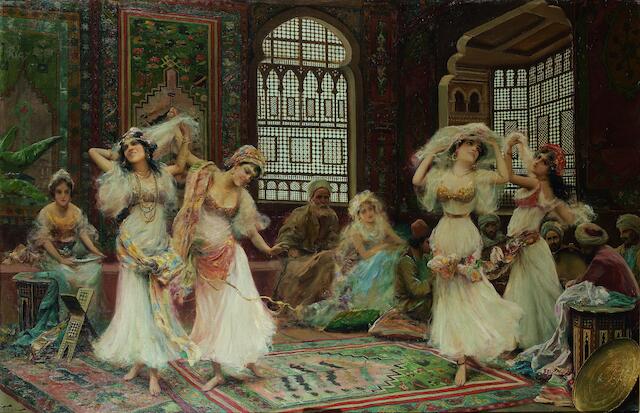
Fabio Fabbi (Italian, 1861-1946) Dancing girls in the harem
Fabio Fabbi (Italian, 1861-1946)
Dancers in the harem 
signed 'F. Fabbi' (lower left)
oil on canvas
90 x 140cm (35 7/16 x 55 1/8in)

Dancers in the Harem, a work most likely inspired by a visit to Cairo, shows the Fabbi's versatility and skill. The backdrop of the room, the carpets and windows are clearly painted with clean lines, articulated and realistic. The dancers, however, are painted with visible brushstrokes, giving the impression that they are moving and dancing to the music. Fabbi's unique ability to mix the two techniques makes the work both interesting and believable. 

The present scene depicts one of Fabbi's favourite themes: Raks Baladi, the popular folk dance of Egypt which is believed to have mothered all Oriental dance. During his trip to Egypt in 1886, Fabbi would have witnessed the skilful women performing Raks Baladi as it was enjoyed at festivals, in the home, and in the living quarters for casual entertainment. The depiction of the dancers is true to what Fabbi would have seen in Cairo. The women don long, simple robes indigenous to Egypt with some ornamentation around the bust and scarves accentuating the hips. This costume differed greatly from region to region in the Middle East, verifying Fabbi's interaction with the Egyptians. 

Fabbio Fabbi
Fabbio Fabbi (1861-1946)
Slave Auction
Oil On Canvas
40.6 x 70.5 cm, (15.98" x 27.76")

Adolf Schreyer 1828-1899 GERMAN THE ADVANCE signed AD Schreyer oil on canvas 41 1/2 by 68 in. 105.4 by 173 cm:
Adolf Schreyer, 1828-1899
GERMAN
THE ADVANCE
signed AD Schreyer
oil on canvas
41 1/2 by 68 in.
105.4 by 173 cm

Adolf Schreyer (July 9, 1828 Frankfurt-am-Main – July 29, 1899 Kronberg im Taunus) was a German painter, associated with the Düsseldorf school of painting. He studied art first at the Städel Institute in his native town, and then at Stuttgart and Munich. He painted many of his favourite subjects in his travels in the East. He first accompanied Maximilian Karl, 6th Prince of Thurn and Taxis through Hungary, Wallachia, Russia and Turkey; then, in 1854, he followed the Austrian army across the Wallachian frontier. In 1856 he went to Egypt and Syria, and in 1861 to Algiers. In 1862 he settled in Paris, but returned to Germany in 1870; and settled at Cronberg near Frankfurt, where he died.

Schreyer was, and is still, especially esteemed as a painter of horses, of peasant life in Wallachia and Moldavia, and of battle incidents. His work is remarkable for its excellent equine draughtsmanship, and for the artist's power of observation and forceful statement; and has found particular favour among French and American collectors. Of his battle-pictures there are two at the Schwerin Gallery, and others in the collection of Count Mensdorff-Pouilly and in the Raven Gallery, Berlin. His painting of a Charge of Artillery of Imperial Guard was formerly at the Luxembourg Museum. The Metropolitan Museum, New York owns three of Schreyer's oriental paintings: Abandoned, Arabs on the March and Arabs making a detour; and many of his best pictures are in the Rockefeller family, Vanderbilt family, John Jacob Astor, William Backhouse Astor, Sr., August Belmont, and William Walters collections. At the Kunsthalle in Hamburg is his Wallachian Transport Train, and at the Staedel Institute, Frankfort, are two of his Wallachian scenes. More

Edwin Lord Weeks 1849 - 1903 AMERICAN FIGURES IN AN INTERIOR WITH GARDEN OF PALMS BEYOND signed E.L. Weeks (lower right) oil on canvas 32 by 39 1/2 in. 81.3 by 100.3 cm:
Edwin Lord Weeks, 1849 - 1903
AMERICAN
FIGURES IN AN INTERIOR WITH GARDEN OF PALMS BEYOND
signed E.L. Weeks (lower right)
oil on canvas
32 by 39 1/2 in.
81.3 by 100.3 cm

After years of travel through Europe, North Africa, the Middle East and India, the American artist Edwin Lord Weeks remained captivated by the sights he encountered abroad and towards the end of his career he began an ambitious series of paintings based on A Thousand and One Nights. From this series, he exhibited Man Waking from Sleep in 1898 and L’histoire de Noureddin et la belle Persane a year later at the Paris Salon of 1899. A series of four paintings of The Porter of Baghdad were sold in the artist’s estate sale of 1905 (one of which was shown at the Paris Salon of 1901). Given the scale and subject, the present painting is almost certainly one from this series, although, like lot xx, it has remained undocumented until now.

In Figures in an Interior with Garden of Palms Beyond, Weeks presents an interesting combination of imagery. Weeks documented his travels through sketches, paintings and photographs, which provided source material for the present scene. Additionally, architectural elements reminiscent of Weeks’ Indian paintings of the 1880s and 1890s now reappear as the background and decorative elements. 

Two figures sit in a sheltered, sun-dappled courtyard overlooking a lush forest of swaying palms, Weeks is careful to render the architecture of the scene, complete with its delicately carved stone latticework, as well as the costumes of the two figures. The lounging girl is swathed in elaborately embroidered sheer red silks, reminiscent of the Nautch dancing girls which Weeks had painted in India  More

Edwin Lord Weeks
The Doctor's Visit (from A Thousand and One Night series) (1903) 

Edwin Lord Weeks exhibited Man Waking from Sleep in 1898, at the Paris Exposition of that year, and L'histoire de Noureddin et la belle Persane, a year later at the Paris Salon of 1899. A series of four paintings of The Porter of Bagdad were sold in the artist's estate sale of 1905; Number 3 of that series was shown at the Paris Salon of 1901. The present painting, The Doctor's Visit, bears a label in Weeks' own hand, sending it to the Universal Exposition in St. Louis in 1904. Weeks, like most artists, sent only recent paintings to major exhibitions, thus enabling us to date The Doctor's Visit to circa 1903, the year of his untimely death.

The Doctor's Visit achieved the highest price among the "1001 Nights" paintings at the artist's estate sale of 1905. Curiously, The Doctor's Visit exploits an interesting combination of imagery, visually rooted in India and Persia to recount a story rooted in Arabic literature. In this work, Weeks has extracted architectural elements from his Indian paintings of the 1880s and 1890s and recombined them into a fantasy of form and pattern as a setting for the Doctor to visit his patient lying upon a marble plinth in the shadow of early morning sunshine. The setting overlooks the azure Lake of Udaipur, India; in the distance are the semi-arid purple hills surrounding the Lake and Palace of Udaipur. Weeks has fashioned an imagined portion of this famed island palace as the open-air lounging spot of bright white marble for his Princess, who lies upon the cushions for her back and the stone for her outstretched legs.

She rests, seductively, in airy white silk halter and gown, accented in gold, falling around her thighs and lower legs to form a mound of ripples in front of her. Her gold tiara and multi-stranded necklace frame her youthful face with wide, dark eyes, slight smile and long, raven hair: her features all tell of Persian ancestry, as do those of the Doctor. Yet the Doctor's costume of embroidered peach-colored silk, tight about the torso and flaring wide–almost to the floor–is purely Indian in style. The gorgeous shimmer of the material has a coarse, dark seam starting at the waist and ending just above the curious upturned toe of his shoes. In its backlit beauty, this fabulously-rendered robe appears royal in nature. The entire costume, from head to foot, begins a dialogue with the form and pattern of the slim, marble column to the left. Weeks has used both elements, figure and column lit in sunshine, to frame the space occupied by the lounging princess. The narrative of The Doctor's Visit is contained within these two beautifully-designed elements by this extremely skillful painter at the end of his career. More

Moorish Girl Lying On A Couch Rabat, Morocco - Edwin Lord Weeks
Edwin Lord Weeks
Moorish Girl Lying On A Couch, Rabat, Morocco
Oil on Board
Material: board
48.2 x 72.4 cm
Private Collection

Edwin Lord Weeks (1849-1903) - Nautch Girl Resting
Edwin Lord Weeks (American, 1849–1903)
Nautch girl resting , ca. 1895–1900
Oil on canvas
91.4 x 154 cm. (36 x 60.6 in.)

In North India, Nautch is one of several styles of popular dance, performed by girls known as Nautch girls. 


Acknowledgement: Bonhams, Sothebys,