Showing posts with label Alberto Pasini. Show all posts

Saturday, July 15, 2023

01 Orientalist Painting, Alberto Pasini's Watering the Horses, with footnotes #112

Alberto Pasini, Italian, 1826 - 1899
Watering the Horses, c. 1874
Oil on canvas
32.5 by 25cm., 12¾ by 9¾in.
Private collection

Sold for 47,880 GBP in October 2022

Alberto Pasini (Busseto, 3 September 1826 – Cavoretto, 15 December 1899) was an Italian painter. He was enrolled at the age of 17 years, in the Academy of Fine Art of Parma, studying landscape painting and drawing. In Parma, he was helped early on by Antonio Pasini, who painted for the local nobility and collaborated with the publishing house established by Giovanni Battista Bodoni. By 1852, he exhibited a series of thirty designs, made into lithographs, depicting various castles around Piacenza, Lunigiana and Parma. He was noticed by the artist Paolo Toschi, who encouraged Pasini to travel to Paris, where Pasini first joined the workshop of Charles and Eugène Ciceri, of the so-called School of Barbizon.

In 1853 his lithograph of The Evening gained him admittance to the Paris Salon, and to the workshop of the famous Théodore Chassériau. The eruption of the Crimean War offered a new opportunity, when in February 1855, this latter painter recommended Pasini to replace him on the entourage of the French plenipotentiary minister Nicolas Prosper Bourée to Persia. Pasini accompanied him, returning through the north of Persia and Armenia before reaching the port of Trebizond. In subsequent trips, he visited Egypt, the Red Sea, Arabia, Istanbul, and Persia. Pasini parlayed his exposures during this trip into numerous highly detailed paintings of orientalist subjects. He left again for Istanbul in October 1867, summoned by the French Ambassador Bourée. He returned to Turkey in 1876 to execute the four paintings commissioned by Sultan Abdul Aziz. He was about to return to Istanbul the next year, when his patron, the Sultan, died.

In 1865, he spent some time in Cannes, painted landscapes of the Riviera. During the Franco-Prussian War of 1870, he returned to Italy, settling in Cavoretto, on the hills around Turin. He continued to travel, closer to his home, with trips to Venice and two sojourns in Spain in 1879 and 1883. More Alberto Pasini


Please visit my other blogs: Art CollectorMythologyMarine ArtPortrait of a Lady, The OrientalistArt of the Nude and The Canals of VeniceMiddle East Artists365 Saints365 Days, and Biblical Icons, also visit my Boards on Pinterest

Images are copyright of their respective owners, assignees or others. Some Images may be subject to copyright

I don't own any of these images - credit is always given when due unless it is unknown to me. if I post your images without your permission, please tell me.

I do not sell art, art prints, framed posters or reproductions. Ads are shown only to compensate the hosting expenses.

If you enjoyed this post, please share with friends and family.

Thank you for visiting my blog and also for liking its posts and pages.

Please note that the content of this post primarily consists of articles available from Wikipedia or other free sources online.


Sunday, October 16, 2022

01 Orientalist Painting, Alberto Pasini's Mosque, with footnotes, #105

Alberto Pasini, Italian, 1826 - 1899
A Mosque, c. 1886
Oil on panel 
 14 5/8 x 21 3/4 in. (37.1 x 55.2 cm)
The Metropolitan Museum of Art

Alberto Pasini (Busseto, 3 September 1826 – Cavoretto, 15 December 1899) was an Italian painter. He was enrolled at the age of 17 years, in the Academy of Fine Art of Parma, studying landscape painting and drawing. In Parma, he was helped early on by Antonio Pasini, who painted for the local nobility and collaborated with the publishing house established by Giovanni Battista Bodoni. By 1852, he exhibited a series of thirty designs, made into lithographs, depicting various castles around Piacenza, Lunigiana and Parma. He was noticed by the artist Paolo Toschi, who encouraged Pasini to travel to Paris, where Pasini first joined the workshop of Charles and Eugène Ciceri, of the so-called School of Barbizon.

In 1853 his lithograph of The Evening gained him admittance to the Paris Salon, and to the workshop of the famous Théodore Chassériau. The eruption of the Crimean War offered a new opportunity, when in February 1855, this latter painter recommended Pasini to replace him on the entourage of the French plenipotentiary minister Nicolas Prosper Bourée to Persia. Pasini accompanied him, returning through the north of Persia and Armenia before reaching the port of Trebizond. In subsequent trips, he visited Egypt, the Red Sea, Arabia, Istanbul, and Persia. Pasini parlayed his exposures during this trip into numerous highly detailed paintings of orientalist subjects. He left again for Istanbul in October 1867, summoned by the French Ambassador Bourée. He returned to Turkey in 1876 to execute the four paintings commissioned by Sultan Abdul Aziz. He was about to return to Istanbul the next year, when his patron, the Sultan, died.

In 1865, he spent some time in Cannes, painted landscapes of the Riviera. During the Franco-Prussian War of 1870, he returned to Italy, settling in Cavoretto, on the hills around Turin. He continued to travel, closer to his home, with trips to Venice and two sojourns in Spain in 1879 and 1883. More Alberto Pasini


Please visit my other blogs: Art CollectorMythologyMarine ArtPortrait of a Lady, The OrientalistArt of the Nude and The Canals of VeniceMiddle East Artists365 Saints and 365 Days, also visit my Boards on Pinterest

Images are copyright of their respective owners, assignees or others. Some Images may be subject to copyright

I don't own any of these images - credit is always given when due unless it is unknown to me. if I post your images without your permission, please tell me.

I do not sell art, art prints, framed posters or reproductions. Ads are shown only to compensate the hosting expenses.

If you enjoyed this post, please share with friends and family.

Thank you for visiting my blog and also for liking its posts and pages.

Please note that the content of this post primarily consists of articles available from Wikipedia or other free sources online.

Tuesday, September 11, 2018

01 Paintings by the Orientalist Artists in the Nineteenth-Century, with footnotes, 33

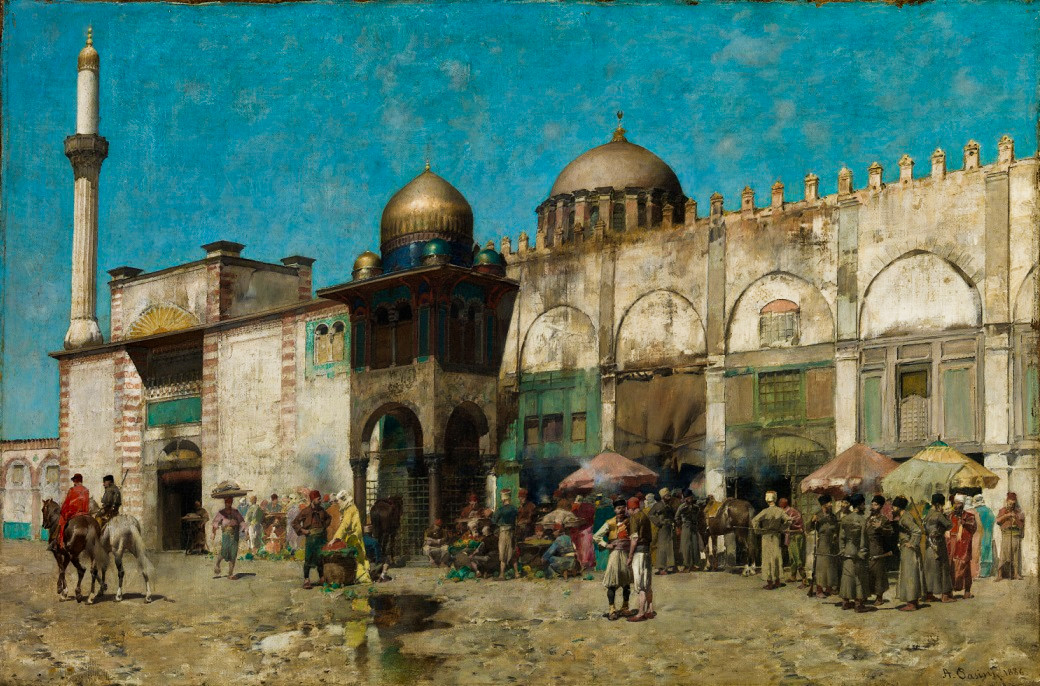
Alberto Pasini, 1826 - 1899, ITALIAN
MARKET IN CONSTANTINOPLE
Oil on canvas
38.5 by 46cm., 15¼ by 18¼in.
Private collection


It is common to think that the western terminus of the Silk Road was Rome in Italy. However, whilst Rome was indeed an important destination for Chinese silk during the first two or three centuries of the Silk Road (perhaps until 200 AD), from the 4th century onwards, the “Rome” to which all roads led in the Mediterranean world was “Eastern Rome” or Constantinople. Even in its long centuries of decline down to its conquest by the Ottoman Turks in 1453, the wealth of Constantinople was legendary, and its location ensured it a very important role in the trade with the East. Renamed Istanbul under the Turks, the city again became the capital of a great empire and played a central role in east-west cultural and economic exchange. More on the MARKET IN CONSTANTINOPLE

Alberto Pasini (Busseto, 3 September 1826 – Cavoretto, 15 December 1899) was an Italian painter. He was enrolled at the age of 17 years, in the Academy of Fine Art of Parma, studying landscape painting and drawing. In Parma, he was helped early on by Antonio Pasini, who painted for the local nobility and collaborated with the publishing house established by Giovanni Battista Bodoni. By 1852, he exhibited a series of thirty designs, made into lithographs, depicting various castles around Piacenza, Lunigiana and Parma. He was noticed by the artist Paolo Toschi, who encouraged Pasini to travel to Paris, where Pasini first joined the workshop of Charles and Eugène Ciceri, of the so-called School of Barbizon.

In 1853 his lithograph of The Evening gained him admittance to the Paris Salon, and to the workshop of the famous Théodore Chassériau. The eruption of the Crimean War offered a new opportunity, when in February 1855, this latter painter recommended Pasini to replace him on the entourage of the French plenipotentiary minister Nicolas Prosper Bourée to Persia. Pasini accompanied him, returning through the north of Persia and Armenia before reaching the port of Trebizond. In subsequent trips, he visited Egypt, the Red Sea, Arabia, Istanbul, and Persia. Pasini parlayed his exposures during this trip into numerous highly detailed paintings of orientalist subjects. He left again for Istanbul in October 1867, summoned by the French Ambassador Bourée. He returned to Turkey in 1876 to execute the four paintings commissioned by Sultan Abdul Aziz. He was about to return to Istanbul the next year, when his patron, the Sultan, died.


In 1865, he spent some time in Cannes, painted landscapes of the Riviera. During the Franco-Prussian War of 1870, he returned to Italy, settling in Cavoretto, on the hills around Turin. He continued to travel, closer to his home, with trips to Venice and two sojourns in Spain in 1879 and 1883. More Alberto Pasini 


Please visit my other blogs: Art CollectorMythologyMarine Art, and The Canals of Venice

Images are copyright of their respective owners, assignees or others. Some Images may be subject to copyright

I don't own any of these images - credit is always given when due unless it is unknown to me. if I post your images without your permission, please tell me.

I do not sell art, art prints, framed posters or reproductions. Ads are shown only to compensate the hosting expenses.

If you enjoyed this post, please share with friends and family.

Thank you for visiting my blog and also for liking its posts and pages.

Friday, November 24, 2017

07 Paintings by the Orientalist Artists of the Nineteenth-Century, with footnotes, #11

Orientalism is a term that is used for the depiction of aspects in Middle Eastern cultures. It refers to the works of the Western artists on Oriental subjects, produced from their travels in Western Asia, during the 19th century. Depictions of Islamic "Moors" and "Turks" can be found in Medieval, Renaissance, and Baroque art. A creative apprehension of a completely different world with its own laws, customs, special attitude towards life and death, love, feelings, and beauty. Wikipedia/Yana Naumovna Lukashevskaya

Henri Emilien Rousseau, French, 1875-1933 
Cavalier des Ouled Sidi-Cheikh 
Oil on board 
6 3/8 x 4 3/4 inches
Private collection

Sidi Sheikh Ben Abu Bekr was a holy marabout, descending in direct line from Abu Bakr , the companion of the Prophet Muhammad, the first caliph of Islam, and his descendants in their genealogy, uninterrupted, go up to Adam . It would be seen very badly, in the Algerian Sahara, if this ancient and venerable nobility were disputed.

Sidi Sheikh according to legend, was a person of exemplary piety and holiness, with the gift of performing miracles, which he passed on to his posterity and especially to the eldest of his descendants. He had an immense influence over all the populations between the border of Morocco and Jebel Amour. More on Sidi Sheikh Ben Abu Bekr

Henri Rousseau Henry, Emilien Rousseau (Cairo 1875 - Aix-en-Provence in 1933) is an Orientalist painter. A pupil of Jean-Léon Gérôme at the Beaux Arts in Paris, he won the second Grand Prix de Rome in 1900 and a travel grant at the Salon of French Artists. He traveled to Belgium, the Netherlands, North Africa, Spain and Italy where he admired the great masters (Rubens, Rembrandt, Velasquez, Murillo, the Titian, Raphael etc ...)

After this initiatory journey, he settled in Versailles and set up his studio at the Villa des Arts in Paris. In 1919 he moved to Aix in Provence with his large family (seven children). Knight of the Legion of Honour in arts. His work  is dedicated to Tunisia, Algeria and especially Morocco, Provence and the Camargue remained its anchor points. His success was with a bourgeois and wealthy clientele, where he sold his work at numerous exhibitions in Paris, Brussels, Stockholm, Marseilles. More Henri Rousseau

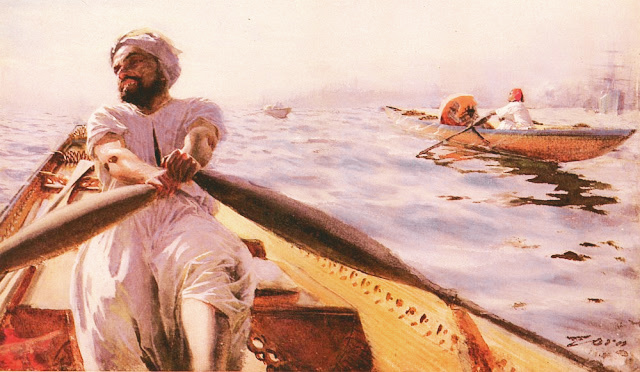
Anders Zorn, (1860–1920)
Kaikroddare
Oil on canvas
Private collection

Anders Leonard Zorn (18 February 1860 – 22 August 1920) was one of Sweden's foremost artists. He obtained international success as a painter, sculptor and etcher. From 1875 to 1880 Zorn studied at the Royal Swedish Academy of Arts in Stockholm. Members of Stockholm society approached him with commissions. Zorn traveled extensively to London, Paris, the Balkans, Spain, Italy and the United States, becoming an international success as one of the most acclaimed painters of his era. It was primarily his skill as a portrait painter that gained Zorn international acclaim based principally upon his incisive ability to depict the individual character of his model. At 29, he was made a Chevalier de la Légion d'honneur at the Exposition Universelle 1889 Paris World Fair. More Anders Leonard Zorn

Georges Washington, (French, 1827-1910)
The hunt 
Oil on panel
22 x 41cm (8 11/16 x 16 1/8in)
Private collection

George Washington, born 15 September 1827 in Marseille and died November 19, 1901 in Douarnenez, was a French Orientalist painter. The young Georges Washington moved to Paris, where he trained at the Ecole des Beaux Arts. The artist’s exotic style was  indebted to Eugène Delacroix. Washington’s love of the Middle East and its customs was further enhanced and encouraged by his father-in-law, the military and Orientalist painter Henri-Félix-Emmanuel Philippoteaux (1815-1884), whose daughter Anne-Léonie Philippoteaux married Washington in Paris on 6th August 1859.

Not long after finishing his training at the Ecole des Beaux Arts, Washington embarked on the first of a number of trips to Algeria and based on close observation of its inhabitants, their dress and customs in 1857 he made his Paris debut at the Salon des Artistes Français with a view of nomads titled Plaine du Hoiina (Sahara Algérien). From then up until 1901 Washington continued to be a popular exhibitor at the Salon; one of his first works shown there to gain critical acclaim was Nomades dans le Sahara en Hiver. In addition to Paris, Washington also showed his work in Moscow in 1881 and was later posthumously honoured when four of his paintings were included in the Exposition Coloniale de Marseille in 1906.

Following two commissions from a Belgian company, he travelled to Morocco and then subsequently visited Hungary, Bulgaria and Turkey, which were to inspire his varied subjects including battle scenes and cavalry skirmishes. His travels also took him to America for the unveiling in Philadelphia of a cyclorama  of the Battle of Gettysburg by his brother-in-law Paul-Dominique Philippoteaux (1846-1923).

Following the death of his wife he retired to live with his daughter and son-in-law at Douarnenez on the Brittany coast, where he died shortly after on 19th November 1901. More George Washington

Alexander M. Rossi, (British, 1840-1916)
Reflection, c. 1896
Oil on canvas
77.5 x 55.5cm (30 1/2 x 21 7/8in)
Private collection

Alexander Mark Rossi (1840 – 9 January 1916) was a successful British artist specializing in genre works who flourished in the late 19th century. He was born on the Greek Island of Corfu, the son of Dr Mark Rossi, an Italian who was one of the three judges presiding over the Ionian Islands during the time of British rule. On a visit to Preston, England in 1866, Rossi met and later married Jane Gillow. He remained in the United Kingdom thereafter. In the 1870s he moved to London.

Between 1871 and 1903, Rossi exhibited 66 works at the Royal Academy and was also a member of the Hogarth Club. Many of his paintings were of children and young adults, the models often being members of his own family. He died in Golders Green, London on 9 January 1916. More on Alexander Mark Rossi 

HOVSEP PUSHMAN, 1877 - 1966
Guardian of the Seraglio (the women's apartments (harem))
Oil on canvas
43 1/4 by 25 1/4 inches (109.8 by 64.1 cm)
Private collection

Hovsep Pushman, 1877 - 1966, a naturalized American citizen, was born in Armenia in 1877. At age 11, he held a scholarship at the Constantinople Academy of Art. By 17, he had gone to the United States and started teaching art in Chicago. He studied the culture of China, immersing himself in oriental art and perhaps philosophy. He then studied in Paris. He exhibited his work at the Salon des Artistes Francais in Paris, winning a bronze medal in 1914 and a silver medal in 1921. He also was awarded the California Art Club’s Ackerman Prize in 1918.

Pushman’s artistic identity began to take shape after he opened his own studio in 1921. Thereafter, Pushman’s career was devoted to one subject, oriental mysticism, and one form, the still life. His paintings typically featured oriental idols, pottery and glassware, all glowing duskily as if illuminated by candlelight. They were symbolic, spiritual paintings, and were sometimes accompanied by readings, which help explain their allegorical significance. 

Pushman died in 1966 in New York City. More on Hovsep Pushman

Jose Cruz Herrera, LA LINEA DE LA CONCEPTION 1890 - 1972 CASABLANCA, ÉCOLE ESPAGNOLE
YOUNG ORIENTAL LADY WITH A NECKLACE
Oil on cardboard
35 x 24,1 cm ; 13 3/4 by 9 3/8 in.
Private collection

José Cruz Herrera (1 October 1890 – 11 August 1972) was a Spanish painter who concentrated principally on genre works and landscape art. He worked in Spain, Uruguay, Argentina, France and especially Morocco, where he lived for much of his life in Casablanca.

His talent was soon apparent and he began formal training in Cádiz. He continued his studies at the School of Fine Arts in Madrid before being awarded a grant to study in Paris and Rome in 1915. He subsequently received several more awards. He concentrated on genre works and landscapes, but he is best known as an orientalist painter, with a particular faculty for producing atmospheric depictions of scenes of everyday life in Morocco.

Cruz Herrera travelled to Montevideo in Uruguay and Buenos Aires in Argentina in 1922. He went to Morocco in 1929. He subsequently established a studio at Neuilly-sur-Seine, just outside Paris, and contributed to collective exhibitions in 1934, 1935 and 1936 at the Salon de la Société Nationale des Beaux-Arts. He also exhibited solo at various times in Madrid, Barcelona and London in 1912, Antwerp in 1931, Casablanca in 1933, and Paris in 1934.

 After the end of the Spanish Civil War in 1939, he returned to Morocco. The following year Spain awarded Cruz Herrera a Knight's Cross in the Order of Isabella the Catholic, followed by a knighthood in the Civil Order of Alfonso X, the Wise in 1958. He died on 11 August 1972 in Casablanca but his remains were transferred back to La Línea to be buried there. More on José Cruz Herrera 

Alberto Pasini, (Italian, 1826-1899)
Landscape with Arab horsemen , c. 1857
Oil on canvas
66 x 41cm (26 x 16 1/8in)
Private collection

Alberto Pasini (Busseto, 3 September 1826 – Cavoretto, 15 December 1899) was an Italian painter. He was enrolled at the age of 17 years, in the Academy of Fine Art of Parma, studying landscape painting and drawing. In Parma, he was helped early on by Antonio Pasini, who painted for the local nobility and collaborated with the publishing house established by Giovanni Battista Bodoni. By 1852, he exhibited a series of thirty designs, made into lithographs, depicting various castles around Piacenza, Lunigiana and Parma. He was noticed by the artist Paolo Toschi, who encouraged Pasini to travel to Paris, where Pasini first joined the workshop of Charles and Eugène Ciceri, of the so-called School of Barbizon.

In 1853 his lithograph of The Evening gained him admittance to the Paris Salon, and to the workshop of the famous Théodore Chassériau. The eruption of the Crimean War offered a new opportunity, when in February 1855, this latter painter recommended Pasini to replace him on the entourage of the French plenipotentiary minister Nicolas Prosper Bourée to Persia. Pasini accompanied him, returning through the north of Persia and Armenia before reaching the port of Trebizond. In subsequent trips, he visited Egypt, the Red Sea, Arabia, Istanbul, and Persia. Pasini parlayed his exposures during this trip into numerous highly detailed paintings of orientalist subjects. He left again for Istanbul in October 1867, summoned by the French Ambassador Bourée. He returned to Turkey in 1876 to execute the four paintings commissioned by Sultan Abdul Aziz. He was about to return to Istanbul the next year, when his patron, the Sultan, died.

In 1865, he spent some time in Cannes, painted landscapes of the Riviera. During the Franco-Prussian War of 1870, he returned to Italy, settling in Cavoretto, on the hills around Turin. He continued to travel, closer to his home, with trips to Venice and two sojourns in Spain in 1879 and 1883. More Alberto Pasini 


Acknowledgement: Bonhamsand others


Please visit my other blogs: Art CollectorMythologyMarine ArtPortrait of a Lady, The OrientalistArt of the Nude and The Canals of VeniceMiddle East Artists365 Saints and 365 Days, also visit my Boards on Pinterest

Images are copyright of their respective owners, assignees or others. Some Images may be subject to copyright

I don't own any of these images - credit is always given when due unless it is unknown to me. if I post your images without your permission, please tell me.

I do not sell art, art prints, framed posters or reproductions. Ads are shown only to compensate the hosting expenses.

If you enjoyed this post, please share with friends and family.

Thank you for visiting my blog and also for liking its posts and pages.

Please note that the content of this post primarily consists of articles available from Wikipedia or other free sources online.


Thursday, March 23, 2017

10 Orientalist Paintings by Artists from the 19th Century, with footnotes, 12

Victor Huguet, 1835 - 1902
MARKET IN THE DESERT
Oil on canvas
66 by 86.5cm., 26 by 34in.
Private Collection

While Huguet’s desert scenes typically depict riders advancing through the landscape, or pausing briefly for a drink at a wadi, this particularly atmospheric, impressionistic example evokes the bustle of a gathered crowd. Clothed in burnous of varying designs and colours for protection from the harsh environment, in the foreground the figures are surrounded by a range of wares, from horse saddles, rugs and ceramics to livestock such as the trio of goats to the left. 

Victor Pierre Huguet , born Lude the 1 st May 1835 and died in Paris August 16, 1902, was a French, landscape and genre painter.. He was a pupil of Emile Loubon in Marseille and received advice from Fromentin in Paris.

In 1852, aged 17, he traveled to Egypt, then to Crimea where he accompanied Durand-Brager before the siege of Sebastopol. He was profoundly influenced by the landscapes he passes through and that will influence his inspiration to Orientalism, where he soon made a name. Discovering Algeria a few years later, he drew from many sources of inspiration.
He exhibited at the Salons de Marseille and Paris in 1859 and the Salon of French Orientalist Painters at its inception in 1893. He was the leading Orientalist artists of Provence. More Victor Pierre Huguet

Alberto Pasini, 1826 - 1899, ITALIAN
THE ROUT, c. 1884 lower right
Oil on canvas
82 by 121cm., 32¼ by 47¾in
Private Collection

Alberto Pasini (Busseto, 3 September 1826 – Cavoretto, 15 December 1899) was an Italian painter. He was enrolled at the age of 17 years, in the Academy of Fine Art of Parma, studying landscape painting and drawing. In Parma, he was helped early on by Antonio Pasini, who painted for the local nobility and collaborated with the publishing house established by Giovanni Battista Bodoni. By 1852, he exhibited a series of thirty designs, made into lithographs, depicting various castles around Piacenza, Lunigiana and Parma. He was noticed by the artist Paolo Toschi, who encouraged Pasini to travel to Paris, where Pasini first joined the workshop of Charles and Eugène Ciceri, of the so-called School of Barbizon.

Alberto Pasini, 1826 - 1899, ITALIAN
THE ROUT, c. 1884 lower right
Detail

In 1853 his lithograph of The Evening gained him admittance to the Paris Salon, and to the workshop of the famous Théodore Chassériau. The eruption of the Crimean War offered a new opportunity, when in February 1855, this latter painter recommended Pasini to replace him on the entourage of the French plenipotentiary minister Nicolas Prosper Bourée to Persia. Pasini accompanied him, returning through the north of Persia and Armenia before reaching the port of Trebizond. In subsequent trips, he visited Egypt, the Red Sea, Arabia, Istanbul, and Persia. Pasini parlayed his exposures during this trip into numerous highly detailed paintings of orientalist subjects. He left again for Istanbul in October 1867, summoned by the French Ambassador Bourée. He returned to Turkey in 1876 to execute the four paintings commissioned by Sultan Abdul Aziz. He was about to return to Istanbul the next year, when his patron, the Sultan, died.

In 1865, he spent some time in Cannes, painted landscapes of the Riviera. During the Franco-Prussian War of 1870, he returned to Italy, settling in Cavoretto, on the hills around Turin. He continued to travel, closer to his home, with trips to Venice and two sojourns in Spain in 1879 and 1883. More Alberto Pasini 

Eugen Bracht, 1842-1921, SWISS
REST IN THE SYRIAN DESERT, c. 1883
Oil on canvas
65 by 125cm., 25½ by 49¼in.
Private Collection

In this atmospheric work, a group of journeying men make a halt in the desert against the backdrop of a range of barren hills. The figure standing by his camel holds a spear, while his companions lie or sit in a circle talking. With great mastery, Bracht evokes the utter stillness and loneliness of the desert air. The broad viewpoint and photographic illusionism in the painting no doubt owe something to Bracht's work as a panorama painter in the early 1880s, notably on the landscape sections for the Sedan Panorama, commissioned to commemorate the Prussian victory in the Battle of Sedan in the Franco-Prussian War. More REST IN THE SYRIAN DESERT

Eugen Felix Prosper Bracht, (1842–1921)
"Memory of Gizeh", c. 1883 
Oil on wood
15.5 x 21.5 cm 
Private Collection

Eugen Felix Prosper Bracht (3 June 1842 – 5 November 1921) was a German landscape painter. Bracht was born in Morges, Waadt (near Lake Geneva in Switzerland) of German parents. They then moved to Darmstadt, Germany where he was a pupil of Karl Ludwig Seeger at the Academy of Fine Arts, Karlsruhe. Later he studied under Hans Gude in Düsseldorf. Dissatisfied with his work, in 1864 he moved to Berlin and became a merchant. In 1876 he decided to become a painter after all and he joined his former teacher in Karlsruhe. He mostly painted landscapes and was one of the famous painters of the late Romanticism in Germany.

He was known for landscapes and coastal scenes in North Germany, and in 1880 and 1881, he made a sketching trip through Syria, Palestine and Egypt. In 1882 he became a Professor of Landscape Painting at the Prussian Academy of Arts. In 1885 he painted the Battle of Chattanooga for the "Philadelphia Panorama Company", a cyclorama which was installed in Philadelphia and Kansas City.

Bracht was supported by Anton von Werner, the conservative director of the Berlin Academy, but broke off with him during the affair of the closure of Edvard Munch's Berlin exhibition in 1892.

When von Werner died, Bracht finished a panorama of the Battle of Sedan which Werner had begun. Later he became a representative of German Impressionism.

In 1901 he obtained a teaching position at the Dresden Academy of Fine Arts that he held until 1919. After his retirement he lived in Darmstadt, where he died in 1921. More Eugen Felix Prosper Bracht 


Giulio Rosati, 1858 - 1917, ITALIAN
THE DANCE
Oil on canvas
52.5 by 82cm., 20¾ by 32¼in.
Private Collection

The wealth of intricate details, luxurious fabrics and the lyrical composition of The Dance showcase Rosati's exceptional skill at combining ethnographic accuracy with spontaneous brushstrokes. The artist's profound passion for the Orient is evident as much through the fascinating array of objects, materials and architecture as the varied characters and personalities he has chosen as his cast. Despite the conviction with which Rosati rendered his scene, the artist's journeys to the Middle East were purely metaphorical - he never visited the region instead relying on photographic evidence and souvenirs for his inspiration.

Giulio Rosati, 1858 - Rome - 1917,  specialised in eighteenth century costume pieces, comical scenes of from the life of the clergy and Orientalist subjects. His preferred medium was watercolour, though he also worked in oils.

Rosati studied at the Academy of Rome. He was the pupil of several eminent artists, in particular the poet and architect Francesco Podesti (1800-1895) and Dario Querci (born 1831), a portrait and history painter from Messina. He also studied with Luis Alvarez y Catala (1836-1901), director of the Prado Museum, Madrid.


Giulio Rosati, (Italian, 1858-1917) 
Bedouins preparing a raiding party, c. 1895
Watercolour on paper 
29¾ x 21 in. (75.5 x 54 cm.) 
Private Collection

Rosati was one of a large group of Italian Orientalist painters working in Rome at the end of the nineteenth century. These artists emulated Mariano Fortuny y Marsal in his skilful rendering of detail and bright colouring. This manner was particularly popular with American and British collectors, many of whom purchased these images as a memento of their travels in the Near East, a voyage very much in vogue at the end of the last century.

Guilio Rosati had a son Alberto who also became an artist. His manner is very much indebted to his father, but he was not so prolific. More Giulio Rosati

Adolf Schreyer, 1828 - 1899, GERMAN
HORSEMEN AT A WATERING HOLE
Oil on canvas
67 by 87.5cm., 26¼ by 34½in.
Private Collection

Adolf Schreyer (July 9, 1828 Frankfurt-am-Main – July 29, 1899 Kronberg im Taunus) was a German painter, associated with the Düsseldorf school of painting. He studied art, first at the Städel Institute in his native town, and then at Stuttgart and Munich. He painted many of his favourite subjects in his travels in the East. He first accompanied Maximilian Karl, 6th Prince of Thurn and Taxis through Hungary, Wallachia, Russia and Turkey; then, in 1854, he followed the Austrian army across the Wallachian frontier. In 1856 he went to Egypt and Syria, and in 1861 to Algiers. In 1862 he settled in Paris, but returned to Germany in 1870; and settled at Cronberg near Frankfurt, where he died.


Schreyer was, and is still, especially esteemed as a painter of horses, of peasant life in Wallachia and Moldavia, and of battle incidents. His work is remarkable for its excellent equine draughtsmanship, and for the artist's power of observation and forceful statement; and has found particular favour among French and American collectors. Of his battle-pictures there are two at the Schwerin Gallery, and others in the collection of Count Mensdorff-Pouilly and in the Raven Gallery, Berlin.  More

Rudolf Ernst, 1854-1932, AUSTRIAN
THE PERFUME MAKERS
Oil on panel
55.5 by 45cm., 22 by 17¾in
Private Collection

The Perfume Makers is an evocation of perfect feminine conviviality and complicity. Two young women are seen working in harmony together; as one girl enters the room carrying a basket of roses, her companion plucks the petals and places them in the urn by her side, ready for crushing to extract their aromatic essence. While the scene is one of tranquility and modesty, the luxuriant and plentiful petals whose scent is almost palpable, the azur blue sky and distant sun-drenched seashore glimpsed through the doorway, the colourful tiles, and the eastern copper and earthenware lend the painting an unspoken sensuality and exotic atmosphere.

Despite their ethnographic detail, depictions of middle-eastern women like this are ultimately constructs of the artist's imagination, since Westerners would have been prohibited by local custom from observing many of the places and customs they painted. More The Perfume Makers

Rudolf Ernst (14 February 1854, Vienna - 1932, Fontenay-aux-Roses) was an Austro-French painter, printmaker and ceramics painter who is best known for his orientalist motifs. He exhibited in Paris under the name "Rodolphe Ernst".

He was the son of an architect and, encouraged by his father, began studies at the Academy of Fine Arts Vienna at the age of fifteen. He spent some time in Rome, copying the old masters, and continued his lessons in Vienna with August Eisenmenger and Anselm Feuerbach.

In 1876, he settled in Paris. The following year, he participated in his first artists' salon. He later made trips to Spain, Morocco, Egypt and Constantinople to study and document what he saw there.

In 1905, he moved to Fontenay-aux-Roses where he set up a shop to produce faience tiles with orientalist themes. He decorated his home in Ottoman style and lived a reclusive life. His exact date of death was apparently not recorded. More Rudolf Ernst 

Alphonse Etienne Dinet (français, 1861 - 1929)
(UNKNOWN) THE PERFUME MAKER
Oil on canvas
65 x 81 cm. (25.6 x 31.9 in.)
Private Collection

Nasreddine Dinet (born as Alphonse-Étienne Dinet on 28 March 1861 – 24 December 1929, Paris) was a French orientalist painter. From 1871, he studied at the Lycée Henry IV, where the future president Alexandre Millerand was also among the students. Upon graduation in 1881 he enrolled in the École nationale supérieure des Beaux-Arts and entered the studio of Victor Galland. The following year he studied under William Bouguereau and Tony Robert-Fleury at the Académie Julian. He also exhibited for the first time at the Salon des artistes français.
Dinet made his first trip to Bou Saâda by the Ouled Naïl Range in southern Algeria in 1884, with a team of entomologists. The following year he made a second trip on a government scholarship, this time to Laghouat.[1] At that time he painted his first two Algerian pictures: les Terrasses de Laghouat and l’Oued M’Sila après l’orage.
He won the silver medal for painting at the Exposition Universelle in 1889, and in the same year founded the Société Nationale des Beaux-Arts along with Meissonier, Puvis de Chavannes, Rodin, Carolus-Duran and Charles Cottet. In 1887 he further founded with Léonce Bénédite, director of the Musée du Luxembourg, the Société des Peintres Orientalistes Français.
In 1903 he bought a house in Bou Saâda and spent three quarters of each year there. He announced his conversion to Islam in a private letter of 1908, and completed his formal conversion in 1913, upon which he changed his name to Nasr’Eddine Dinet. In 1929 he and his wife undertook the Hajj to Mecca. The respect he earned from the natives of Algeria was reflected by the 5,000 who attended his funeral on 12 January 1930 in Bou Saâda. There he was eulogized by the former Governor General of Algeria Maurice Viollette. More Nasreddine Dinet 

Georges Washington, 1827 - 1910, FRENCH
CAVALIERS ARABES
oil on canvas
66 by 92.5cm., 26 by 36½in
Private Collection
George Washington, born 15 September 1827 in Marseille and died November 19, 1901 in Douarnenez, was a French Orientalist painter. Like most aspiring artists, the young Georges Washington moved to Paris, where he trained at the Ecole des Beaux Arts under François-Edouard Picot (1786-1868). The artist’s exotic style was also indebted to Eugène Delacroix (1798-1863). Washington’s art conveys a similar feeling to the work of Eugène Fromentin (1820-76) who often painted naturalistic Middle Eastern scenes of rural and nomadic life. Washington’s love of the Middle East and its customs was further enhanced and encouraged by his father-in-law, the military and Orientalist painter Henri-Félix-Emmanuel Philippoteaux (1815-1884), whose daughter Anne-Léonie Philippoteaux married Washington in Paris on 6th August 1859.

Georges Washington, 1827 - 1910, FRENCH
CAVALIERS ARABES
dETAIL

Not long after finishing his training at the Ecole des Beaux Arts, Washington embarked on the first of a number of trips to Algeria and based on close observation of its inhabitants, their dress and customs in 1857 he made his Paris debut at the Salon des Artistes Français with a view of nomads titled Plaine du Hoiina (Sahara Algérien). From then up until 1901 Washington continued to be a popular exhibitor at the Salon; one of his first works shown there to gain critical acclaim was Nomades dans le Sahara en Hiver. In addition to Paris, Washington also showed his work in Moscow in 1881 and was later posthumously honoured when four of his paintings were included in the Exposition Coloniale de Marseille in 1906.

Following two commissions from a Belgian company, he travelled to Morocco and then subsequently visited Hungary, Bulgaria and Turkey, which were to inspire his varied subjects including battle scenes and cavalry skirmishes. His travels also took him to America for the unveiling in Philadelphia of a cyclorama (a monumental 360° panoramic view) of the Battle of Gettysburg by his brother-in-law Paul-Dominique Philippoteaux (1846-1923).

Following the death of his wife he retired to live with his daughter and son-in-law at Douarnenez on the Brittany coast, where he died shortly after on 19th November 1901. More George Washington


Acknowledgement: Sotheby's

Images are copyright of their respective owners, assignees or others

We do not sell art prints, framed posters or reproductions. Ads are shown only to compensate the hosting expenses.

If you enjoyed this post, please share with friends and family.