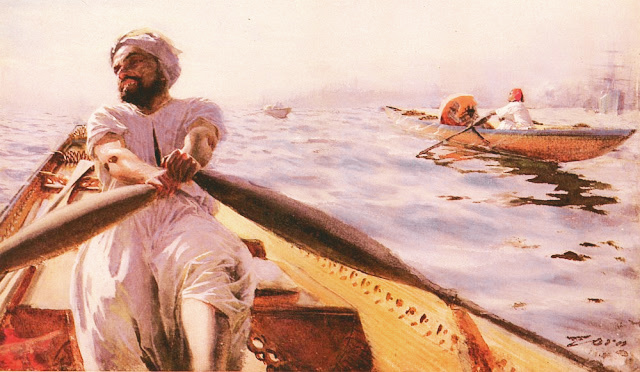
Orientalism is a term that is used for the depiction of aspects in Middle Eastern cultures. It refers to the works of the Western artists on Oriental subjects, produced from their travels in Western Asia, during the 19th century. Depictions of Islamic "Moors" and "Turks" can be found in Medieval, Renaissance, and Baroque art. A creative apprehension of a completely different world with its own laws, customs, special attitude towards life and death, love, feelings, and beauty. Wikipedia/Yana Naumovna Lukashevskaya
Etienne Dinet, 1861 - 1929, FRENCH
LE CAIRE, BRUME, POUSSIERE ET FUMEES DU SOIR
CAIRO, MIST, DUST AND EVENING FUMES
signed E DINET lower left
oil on board
37 by 75cm., 14½ by 29½in
Private Collection
Nasreddine Dinet (born as Alphonse-Étienne Dinet on 28 March 1861 – 24 December 1929, Paris) was a French orientalist painter. Dinet was born the son of a prominent French judge. From 1871, he studied at the Lycée Henry IV, where the future president Alexandre Millerand was also among the students. Upon graduation in 1881 he enrolled in the École nationale supérieure des Beaux-Arts and entered the studio of Victor Galland. The following year he studied under William Bouguereau and Tony Robert-Fleury at the Académie Julian. He also exhibited for the first time at the Salon des artistes français.
Nasreddine Dinet (1861–1929)
Raoucha, c. 1901
Oil on canvas
46 × 45 cm (18.1 × 17.7 in)
Private collection
Dinet made his first trip to Bou Saâda by the Ouled Naïl Range in southern Algeria in 1884, with a team of entomologists. The following year he made a second trip on a government scholarship, this time to Laghouat. At that time he painted his first two Algerian pictures: les Terrasses de Laghouat and l’Oued M’Sila après l’orage.
Alphonse Etienne Dinet (French, 1861-1929)
L'Arabe et son cheval , c. 1903
Oil on canvas
50.8 x 40.64cm (20 x 16in).
Private Collection
With his painting, L'Arabe et son cheval, Dinet's talent for capturing psychology and detail is evident, from the prayer beads around the neck of the rider swathed in white cloth, to the horse's colorful bridle, and background of soft desert mountains. It is one of the only paintings by the artist where the individual appears to be posing, with the rider's steely, direct stare towards the viewer, as Dinet's preferred work state was somewhat spontaneous with the reliance on his camera to capture more permanent scenes. L'Arabe also represents a distinct departure from Dinet's usual cast of playful Berber adolescents and groups of women, illustrating instead a common trio found in Orientalist works of art: a man, his horse and the desert they travel together. The unique curved shape of the top of the canvas is reminiscent of the arched dome commonly found in Middle Eastern architecture, especially the circular construction of mosques. With the maturation of his talent, Dinet became an arch-realist and an authority on Algerian life rather than an exotic maker of myth. More L'Arabe et son cheva
He won the silver medal for painting at the Exposition Universelle in 1889, and in the same year founded the Société Nationale des Beaux-Arts. In 1887 he further founded with Léonce Bénédite, director of the Musée du Luxembourg, the Société des Peintres Orientalistes Français.
Nasreddine Dinet (1861–1929)
On the Terrace in the Moonlight, c. 1908
(Sur les Terrasses, Clair de Lune)
Oil on canvas
51x61cm, 20x24"
Private Collection
In 1903 he bought a house in Bou Saâda and spent three quarters of each year there. He announced his conversion to Islam in a private letter of 1908, and completed his formal conversion in 1913, upon which he changed his name to Nasr’Eddine Dinet. In 1929 he and his wife undertook the Hajj to Mecca. The respect he earned from the natives of Algeria was reflected by the 5,000 who attended his funeral on 12 January 1930 in Bou Saâda. There he was eulogized by the former Governor General of Algeria Maurice Viollette. More Alphonse-Étienne Dinet
Etienne Dinet, 1861 - 1929, FRENCH
SPECTATEURS ADMIRANT UNE DANSEUSE, c. 1905
SPECTATORS ADMIRING A DANCER
Oil on canvas
84 by 102.5cm., 33 by 40¼in.
Private Collection
Spectateurs admirant une danseuse is a superb example of Dinet's mature oeuvre, testament to his intimate knowledge of, and respect for, the people of Algeria. Fluid, almost Impressionistic brushstrokes, and beautifully confident handling of light as it filters through from behind the figures, are coupled with a sympathetic, careful observation of the men’s various expressions as they react to the dance unfolding before them. More Spectateurs admirant une danseuse
Eugène Fromentin, 1820 - 1876, FRENCH
LE SIMOUN
Oil on canvas
55 by 65.5cm., 21¾ by 25¾in.
Private Collection
The simoun is a warm, dry and violent wind that blows on the eastern shores of the Mediterranean Sea: the Sahara , in Palestine , in Syria and in the desert of Arabia.
Le Simoun is among the most iconic images in nineteenth-century Orientalist art, one of a handful of smaller versions of Fromentin's extraordinary painting of 1864, the Coup de vent dans les plaines d'alfa Below
Eugène Fromentin, 1820 - 1876, FRENCH
Coup de vent dans les plaines d'alfa, c. 1864
Gale in the Alfa Plains
Oil on canvas
117 by 163cm
Najd Collection of orientalist paintings
Eugène Fromentin (October 24, 1820 – August 27, 1876) was a French painter and writer, now better remembered for his writings. He was born in La Rochelle. After leaving school he studied for some years under Louis Cabat, the landscape painter. Fromentin was one of the earliest pictorial interpreters of Algeria, having been able, while quite young, to visit the land and people that suggested the subjects of most of his works, and to store his memory as well as his portfolio with the picturesque and characteristic details of North African life. In 1849, he was awarded a medal of the second class.
In 1852, he paid a second visit to Algeria, accompanying an archaeological mission, and then completed that minute study of the scenery of the country and of the habits of its people which enabled him to give to his after-work the realistic accuracy that comes from intimate knowledge. More
Alfred Dehodencq, 1822 - 1882, FRENCH
LE HAJJ
Oil on canvas
85.5 by 120cm., 33¾ by 47¼in.
Private Collection
Dehodencq's large and lavish rendition of the annual Hajj (pilgrimage) en route to Mecca is an especially magnificent and wonderfully detailed painting of the subject by a Western artist. The landscape is not specific, but the shoreline might suggest a location on the Red Sea, south of Aqaba. At the centre of the enfilade of dignitaries, janissaries, soldiers, and musicians and mounted on the leading camel is the holy mahmal, the elaborate coffer containing the Koran that accompanies the pilgrims to Mecca.
Ottoman control of the Hajj developed with the rise of the Ottoman Empire. The sacking of Constantinople in 1453 established the Ottomans as the principle Muslim power worldwide and their later conquest of Egypt and Syria in 1515 and 1517 gave them control of the eastern border of the Red Sea including Mecca and Medina. With the Sultan's adoption of the role of protector of the two shrines at Mecca and Medina the pre-eminent status of the Ottoman Sultan among Muslim rulers was confirmed. In the ensuing years the Ottomans did their utmost to be seen as leaders of the Muslim world and defenders of Islam's holiest cities, a role that included building forts and defences to upgrade the Hajj routes, the three most important of which led from Cairo, Damascus and Baghdad. More
Edmé-Alexis-Alfred Dehodencq, PARIS 1822-1882, OUTPUT PACHA
LA SORTIE DU PACHA
THE PACHA GOING OUT; SIGNED LOWER RIGHT; OIL ON CANVAS
Oil on canvas
118 x 89 cm; 46 1/2 by 35 in
Alfred Dehodencq (23 April 1822 – 2 January 1882) was a mid-19th-century French Orientalist painter born in Paris. He was known for his vivid oil paintings, especially of Andalusian and North African scenes. Dehodencq was born in Paris. During his early years, he studied at the Ecole des Beaux Arts. During the French Revolution of 1848 he was wounded in the arm and was sent to convalesce in the Pyrenees before moving to Madrid. He spent five years in Spain where he became acquainted with the works of Spanish painters Diego Velázquez and Francisco Goya which had a strong influence on his approach to painting.
In 1853 he travelled to Morocco, where for the following ten years he produced many of his most famous paintings depicting scenes of the world he encountered. Dehodencq was the first foreign artist known to have lived in Morocco for an extended number of years.
Dehodencq married Maria Amelia Calderon in 1857 in Cadiz, Spain, and they had three children. Dehodencq returned to Paris in 1863 with his wife, and was decorated with the Legion of Honour in 1870. He committed suicide on 2 January 1882 having been sick for a long time and is buried in the Montmartre Cemetery. More Alfred Dehodencq
Henry James Soulen, (American, 1888-1965)
Hajj camp, en route to the Masjid al-Haram
Oil on canvas
76.2 x 91.4 cm (30 x 36 in)
Private Collection
HENRY JAMES SOULEN (1888 - 1965), was born in Milwaukee, Henry James Soulen was a noted illustrator. He attended the Art Students League in Milwaukee, the Art Institute of Chicago, and later studied under the celebrated teacher, Howard Pyle, the founder of the Brandywine School. He also studied with N.C. Wyeth, Frank Schoonover, and Jessie Wilcox Smith.
An illustrator for the "Saturday Evening Post," Henry Soulen began his career in May, 1912. He also worked for other publications including "Country Gentleman" and "Ladies Home Journal" and earned a Peabody Award for his magazine cover designs. He was known for his use of intense, brilliant color at a time when many illustrations were in black and white.
He was a thorough researcher and eventually collected a large and varied collection of costumes, weapons, and other objects that he used in his drawings. At age 62, he became a college professor at the University of Maryland and taught the first illustration that art department offered. During World War II, he gave free art lessons at the Valley Forge Military Hospital, a rehabilitation center for veterans. More Henry James Soulen
Henry James Soulen (American, 1888-1965)
A pilgrimage to Palestine, Sinai
Oil on canvas
86.4 x 76.2cm (34 x 30in)
Private Collection
Soulen spent several months traveling through the Middle East as the accompanying artist to Dr. Harry Emerson Frosdick who wrote A Pilgrimage to Palestine for the Christmas issue of The Ladies Home Journal. It was during that trip that Soulen painted the present work, A pilgrimage to Palestine, Sinai and fragments of his letter that accompanied sketches sent while overseas were quoted in Frosdick's article:
"A number of persons told me, before I left America, that I would be disappointed by the artistic possibilities of Palestine. They agreed that it was burned up and uninteresting. I am quite sure now they hadn't seen much of the real country. In the cities, including Jerusalem, familiarity with tourists has made the natives more or less uninteresting. But, in the villages and in the wilderness, conditions are as they were thousands of years ago. You will see acres of wheat in the fertile valleys to be reaped with a sickle. The costumes are the same...It is only because we judge Bible stories by our own standards that any of them sound improbable. After my experience of living in the desert, I have begun to understand these stories." More A pilgrimage to Palestine
Henri Emilien Rousseau, (French, 1875-1933)
Return of the falconer
Oil on canvas
50.8 x 43.18cm (20 x 17in).
Private Collection
Return of the falconer. Passionate about portraying the reality rather than the romance of Bedouin life, Rousseau spent the years between 1920 and 1932 in intense study of nomadic culture and visiting the Rif and Atlas mountains of Morocco. By befriending Caïds, or tribal chiefs, Rousseau was granted access to various regions which were otherwise off limits to outsiders, and gained a unique perspective to his work distinct from that of his more imaginative peers. Perhaps it was here where he fell under the spell of the Bedouin horsemen, a subject Rousseau was already familiar with, and would come to characterize his Orientalist compositions. In 1927, the Galerie Georges Petit in Paris saw the exhibition of more than eighty Moroccan works by Rousseau which was met with enormous success. This was followed by an exhibition at the Exposition Universelle, held in 1931.
In this present work, The return of the falconer, Rousseau illustrates a favorite subject of his, the horseman and his hunting bird, which he returned to again and again. More noble than fanciful, the villagers become figures of truth set against the indigenous desert landscape Rousseau was unwilling to romanticize, whether his subjects were quietly reflective, as in this work, or bearing a standard. Yet try as he might to subdue the exotic, there is no escaping the majesty and appeal of falconry in Rousseau's art. More Return of the falconer
Henri Rousseau Henry, Emilien Rousseau (Cairo 1875 - Aix-en-Provence in 1933) is an Orientalist painter. A pupil of Jean-Léon Gérôme at the Beaux Arts in Paris, he won the second Grand Prix de Rome in 1900 and a travel grant at the Salon of French Artists. He traveled to Belgium, the Netherlands, North Africa, Spain and Italy where he admired the great masters (Rubens, Rembrandt, Velasquez, Murillo, the Titian, Raphael etc ...)
After this initiatory journey, he settled in Versailles and set up his studio at the Villa des Arts in Paris. In 1919 he moved to Aix in Provence with his large family (seven children). Knight of the Legion of Honour in arts. His work is dedicated to Tunisia, Algeria and especially Morocco, Provence and the Camargue remained its anchor points. His success was with a bourgeois and wealthy clientele, where he sold his work at numerous exhibitions in Paris, Brussels, Stockholm, Marseilles. More
Leopold Alphons Mielich, (Austrian, 1863-1929)
The house of Cairo
oil on canvas
76.45 x 51.56cm (30 1/8 x 20 5/16in).
Private Collection
Alphons Leopold Mielich (Klosterneuburg, 27 January 1863 - Salzburg, 25 January 1929) was an Austrian orientalist painter. In 1902, he traveled with the Czech scholar Alois Musil to the Umayyad desert castle Qasr Amra, then in the Ottoman Empire (modern-day Jordan), where he copied some of the paintings discovered there. More Alphons Leopold Mielich
Alphons Leopold Mielich, 1863-1929, AUSTRIAN
THE POTTERY SELLER
Oil on canvas
145.5 by 195.5 cm
Private Collection
The Pottery Seller by Alphons Mielich is a masterful evocation of everyday Egyptian life. As startling as the all the bustling activity of market day is the bright desert light, which so fascinated Western painters on their visits to the region, and which lent their palettes a whole new chromatic dimension. The heat of the midday sun is almost palpable, as one trader, engaged in conversation with another, shields his face using the basket containing his wares. Austrian-born Mielich first travelled to Egypt in 1889, and returned on several occasions up until the outbreak of the First World War, and the 'snapshot' verisimilitude of the scene in the present work is testimony to his sensitive understanding of the culture he depicts. More The Pottery Seller
Alberto Pasini, 1826 - 1899, ITALIAN
A FERRY ON THE NILE, c. 1861
Oil on canvas
39 by 65cm., 15½ by 25½in.
Private Collection
Alberto Pasini (Busseto, 3 September 1826 – Cavoretto, 15 December 1899) was an Italian painter. He was enrolled at the age of 17 years, in the Academy of Fine Art of Parma, studying landscape painting and drawing. In Parma, he was helped early on by Antonio Pasini, who painted for the local nobility and collaborated with the publishing house established by Giovanni Battista Bodoni. By 1852, he exhibited a series of thirty designs, made into lithographs, depicting various castles around Piacenza, Lunigiana and Parma. He was noticed by the artist Paolo Toschi, who encouraged Pasini to travel to Paris, where Pasini first joined the workshop of Charles and Eugène Ciceri, of the so-called School of Barbizon.
Alberto Pasini, 1826 - 1899, ITALIAN
Damascus, c. 1880
Oil on fabric
Height: 42.6 cm (16.8 in). Width: 32.6 cm (12.8 in). ;
Walters Art Museum, Mount Vernon-Belvedere, Baltimore, Maryland
In 1853 his lithograph of The Evening gained him admittance to the Paris Salon, and to the workshop of the famous Théodore Chassériau. The eruption of the Crimean War offered a new opportunity, when in February 1855, this latter painter recommended Pasini to replace him on the entourage of the French plenipotentiary minister Nicolas Prosper Bourée to Persia. Pasini accompanied him, returning through the north of Persia and Armenia before reaching the port of Trebizond. In subsequent trips, he visited Egypt, the Red Sea, Arabia, Istanbul, and Persia. Pasini parlayed his exposures during this trip into numerous highly detailed paintings of orientalist subjects. He left again for Istanbul in October 1867, summoned by the French Ambassador Bourée. He returned to Turkey in 1876 to execute the four paintings commissioned by Sultan Abdul Aziz. He was about to return to Istanbul the next year, when his patron, the Sultan, died.
In 1865, he spent some time in Cannes, painted landscapes of the Riviera. During the Franco-Prussian War of 1870, he returned to Italy, settling in Cavoretto, on the hills around Turin. He continued to travel, closer to his home, with trips to Venice and two sojourns in Spain in 1879 and 1883.
More Alberto Pasini
Alberto Pasini, 1826 - 1899, ITALIAN
Arab Caravan, before 1899
Oil on Canvas
Images are copyright of their respective owners, assignees or others