Showing posts with label Eugène Delacroix. Show all posts

Friday, April 26, 2024

01 Painting by Orientalist Artists, The Art of War, Eugène Delacroix's Collision of the Moorish Horsemen, with footnotes #98

Eugène Delacroix (French, 1798-1863)
Collision of the Moorish Horsemen, c. 1843-1844
Oil on canvas
H: 32 x W: 39 in. (81.3 x 99.1 cm)
The Walters Art Museum

"During their military exercises, which consist of riding their horses at full-speed and stopping them suddenly after firing a shot, it often happens that the horses carry away their riders and fight each other when they collide." 

Delacroix uses fluid brush work to capture the color and movement of an Arab Fantasia, or ceremonial cavalry charge, mimicking battle, which he witnessed at the court of Sultan Abd-er-Rahmen of Morocco (1778-1859). More on this painting


Ferdinand Victor Eugène Delacroix (26 April 1798 – 13 August 1863) was a French Romantic artist regarded from the outset of his career as the leader of the French Romantic school.

As a painter and muralist, Delacroix's use of expressive brushstrokes and his study of the optical effects of colour profoundly shaped the work of the Impressionists, while his passion for the exotic inspired the artists of the Symbolist movement. A fine lithographer, Delacroix illustrated various works of William Shakespeare, the Scottish author Walter Scott and the German author Johann Wolfgang von Goethe.

Delacroix took for his inspiration the art of Rubens and painters of the Venetian Renaissance, with an attendant emphasis on colour and movement rather than clarity of outline and carefully modelled form. Dramatic and romantic content characterized the central themes of his maturity, and led him not to the classical models of Greek and Roman art, but to travel in North Africa, in search of the exotic. Friend and spiritual heir to Théodore Géricault, Delacroix was also inspired by Lord Byron, with whom he shared a strong identification with the "forces of the sublime", of nature in often violent action.

However, Delacroix was given to neither sentimentality nor bombast, and his Romanticism was that of an individualist. In the words of Baudelaire, "Delacroix was passionately in love with passion, but coldly determined to express passion as clearly as possible." More on Ferdinand Victor Eugène Delacroix


Please visit my other blogs: Art CollectorMythologyMarine ArtPortrait of a Lady, The OrientalistArt of the Nude and The Canals of VeniceMiddle East Artists365 Saints365 Days, and Biblical Icons, also visit my Boards on Pinterest

Images are copyright of their respective owners, assignees or others. Some Images may be subject to copyright

I don't own any of these images - credit is always given when due unless it is unknown to me. if I post your images without your permission, please tell me.

I do not sell art, art prints, framed posters or reproductions. Ads are shown only to compensate the hosting expenses.

If you enjoyed this post, please share with friends and family.

Thank you for visiting my blog and also for liking its posts and pages.

Please note that the content of this post primarily consists of articles available from Wikipedia or other free sources online.


Saturday, April 20, 2024

03 Paintings by Orientalist Artists, The Art of War, Eugène Delacroix's Combat du Giaour et Hassan/ The Combat of the Giaour and Hassan, with footnotes #97

Eugène Delacroix  (1798–1863)
Combat du Giaour et Hassan/ The Combat of the Giaour and Hassan, c. 1826
Oil on canvas
height: 59.6 cm (23.4 in); width: 73.4 cm (28.8 in)
Art Institute of Chicago

Europeans’ interest in fantastical and often violent depictions of Middle Eastern, North African, and Asian cultures, which reinforced colonialist aims. Although Eugène Delacroix did not visit North Africa until 1832, he began painting Orientalist subjects early on in his career. More on this painting

The Combat of the Giaour and Hassan is the title of three works by Eugène Delacroix, produced in 1826, 1835 and 1856. They all show a scene from Lord Byron's 1813 poem The Giaour, with the Giaour ambushing and killing Hassan, the Pasha, before retiring to a monastery. Giaour had fallen in love with Leila, a slave in Hassan's harem, but Hassan had discovered this and had her killed. More on The Combat of the Giaour and Hassan

Eugène Delacroix  (1798–1863)
Combat du Giaour et du Pacha/ Combat of the Giaour and the Pasha, c. 1835
Oil on canvas
height: 73 cm (28.7 in); width: 61 cm (24 in)
Petit Palais

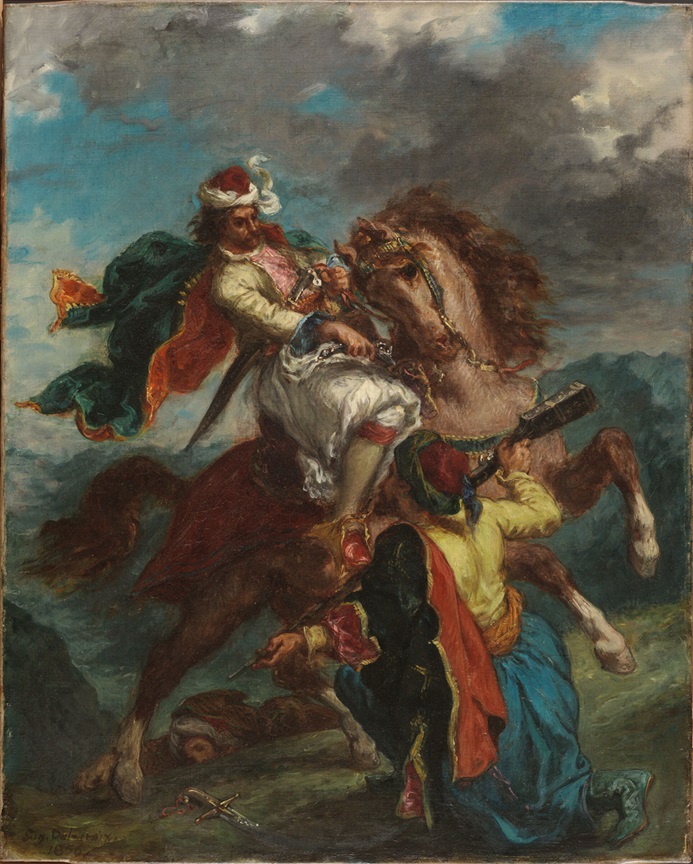
The Giaour, erect above his saddle, tears with a wild smile the fabric covering the pasha's chest to reach the heart with the sharp blade of his sword. The pasha, in unstable balance on his horse, clutching his dagger in his right hand, tries to repel his assailant with the other hand. The ferocity of the fight is also expressed in the attitude of the horses, the black horse biting the white horse on the chest, already wounded in the thigh. The latter seems reluctant to step on the corpse of a Muslim lying on the ground. For Delacroix, the subject is above all a pretext to depict a close combat of great intensity. More on this painting

I only found two of the three mentioned painting!

Eugène Delacroix (French, 1798-1863)
A Turk Surrenders to a Greek Horseman, c. 1856
Oil on paper laid down on canvas
80 x 64.1 cm (31 1/2 x 25 1/4 in.)
Private collection

In the mid-1850s, Delacroix returned to themes he had treated thirty years earlier, though with an important difference. Rather than carefully distinguish literary from historical and topical subjects, he conflated them, as in this instance. Here, he draws on Byron’s description of the giaour (a Turkish slur for non-Muslims) overcoming the Turkish pasha in his poem “The Giaour, a Fragment of a Turkish Tale” (1813). To a contemporary audience, the composition could have appeared to be an episode from the Greek War of Independence (1821–32), a romantic cause célèbre that had inspired two of Delacroix’s large canvases of the 1820s. The result is a nostalgic invention that appealed to mid-century French orientalist fantasies. More on this painting

Ferdinand Victor Eugène Delacroix (26 April 1798 – 13 August 1863) was a French Romantic artist regarded from the outset of his career as the leader of the French Romantic school.
As a painter and muralist, Delacroix's use of expressive brushstrokes and his study of the optical effects of colour profoundly shaped the work of the Impressionists, while his passion for the exotic inspired the artists of the Symbolist movement. A fine lithographer, Delacroix illustrated various works of William Shakespeare, the Scottish author Walter Scott and the German author Johann Wolfgang von Goethe.
Delacroix took for his inspiration the art of Rubens and painters of the Venetian Renaissance, with an attendant emphasis on colour and movement rather than clarity of outline and carefully modelled form. Dramatic and romantic content characterized the central themes of his maturity, and led him not to the classical models of Greek and Roman art, but to travel in North Africa, in search of the exotic. Friend and spiritual heir to Théodore Géricault, Delacroix was also inspired by Lord Byron, with whom he shared a strong identification with the "forces of the sublime", of nature in often violent action.
However, Delacroix was given to neither sentimentality nor bombast, and his Romanticism was that of an individualist. In the words of Baudelaire, "Delacroix was passionately in love with passion, but coldly determined to express passion as clearly as possible." More on Ferdinand Victor Eugène Delacroix


Please visit my other blogs: Art CollectorMythologyMarine ArtPortrait of a Lady, The OrientalistArt of the Nude and The Canals of VeniceMiddle East Artists365 Saints365 Days, and Biblical Icons, also visit my Boards on Pinterest

Images are copyright of their respective owners, assignees or others. Some Images may be subject to copyright

I don't own any of these images - credit is always given when due unless it is unknown to me. if I post your images without your permission, please tell me.

I do not sell art, art prints, framed posters or reproductions. Ads are shown only to compensate the hosting expenses.

If you enjoyed this post, please share with friends and family.

Thank you for visiting my blog and also for liking its posts and pages.

Please note that the content of this post primarily consists of articles available from Wikipedia or other free sources online.


Saturday, February 23, 2019

01 Paintings by the Orientalist Artists in the Nineteenth-Century, with footnotes, 37

Eugène Delacroix
Collision of Arab Horsemen, c. 1833/34
Oil on canvas
31 11/16 × 39 9/16 inches
Private collection

Ferdinand Victor Eugène Delacroix (26 April 1798 – 13 August 1863) was a French Romantic artist regarded from the outset of his career as the leader of the French Romantic school.

As a painter and muralist, Delacroix's use of expressive brushstrokes and his study of the optical effects of colour profoundly shaped the work of the Impressionists, while his passion for the exotic inspired the artists of the Symbolist movement. A fine lithographer, Delacroix illustrated various works of William Shakespeare, the Scottish author Walter Scott and the German author Johann Wolfgang von Goethe.

Delacroix took for his inspiration the art of Rubens and painters of the Venetian Renaissance, with an attendant emphasis on colour and movement rather than clarity of outline and carefully modelled form. Dramatic and romantic content characterized the central themes of his maturity, and led him not to the classical models of Greek and Roman art, but to travel in North Africa, in search of the exotic. Friend and spiritual heir to Théodore Géricault, Delacroix was also inspired by Lord Byron, with whom he shared a strong identification with the "forces of the sublime", of nature in often violent action.

However, Delacroix was given to neither sentimentality nor bombast, and his Romanticism was that of an individualist. In the words of Baudelaire, "Delacroix was passionately in love with passion, but coldly determined to express passion as clearly as possible." MoreFerdinand Victor Eugène Delacroix


Please visit my other blogs: Art CollectorMythologyMarine ArtPortrait of a Lady, The OrientalistArt of the Nude and The Canals of VeniceAnd visit my Boards on Pinterest

Images are copyright of their respective owners, assignees or others. Some Images may be subject to copyright

I don't own any of these images - credit is always given when due unless it is unknown to me. if I post your images without your permission, please tell me.

I do not sell art, art prints, framed posters or reproductions. Ads are shown only to compensate the hosting expenses.

If you enjoyed this post, please share with friends and family.


Thank you for visiting my blog and also for liking its posts and pages.

Wednesday, April 8, 2015

20 Art Works Showing Picasso's Development of his Women of Algiers in their Apartment (Les femmes d'Alger) Series


Women of Algiers in their Apartment (French: Femmes d'Alger dans leur appartement) is an 1834 oil on canvas painting by Eugène Delacroix (Four years after the French conquest of Algeria). It is located in the Louvre, Paris, France. The painting was first displayed at the Salon, where it was universally admired. King Louis Philippe bought it and presented it to the Musée du Luxembourg, which at that time was a museum for contemporary art. After the death of the artist in 1874 the painting was moved to the Louvre, where it is held today.

Picasso fascinated by Delacroix's "Les femmes d’Alger", painted a series of fifteen variations on Delacroix's work. The individual canvases are designated as versions A through O. This was the first extended series that Picasso created after a renowned painting by a past master. 

Odalisque with Raised Arms – Henri Matisse

Picasso conceived the series as an elegy to his friend and great artistic rival, Henri Matisse. Matisse had died in November 1954, five weeks before Picasso began the series. Matisse viewed Delacroix as his immediate forebear in terms of colour and Orientalist subject matter.  Picasso stated, “When Matisse died, he left his odalisques to me as a legacy.”


Matisse, Seated Odalisque

Odalisque in Red Culottes - Henri Matisse

Odalisques Henri Matisse

Les femmes d'Alger are Picasso's greatest achievement in the decades following the end of the Second World War. They represent his perception of an historical genre, for which his treatment is both respectful and playful. 


The impact of the entire group is greater than the sum of its parts, while each of the individual canvases is varied and uniquely characterful. Some are as fine as Picasso ever painted. Picasso altered his approach between paintings steeped in color, and those rendered en grisaille. 

Picasso, Women of Algiers, (Version A)


Pablo Picasso, Les femmes d'Alger "B"

Pablo Picasso, Les femmes d'Alger "C"


Pablo Picasso, Les femmes d'Alger "D"


Pablo Picasso, Les femmes d'Alger (E) (Women of Algiers), 1955; oil on canvas, 18 1/8 in. x 21 5/8 in. (46.04 cm x 54.93 cm)

Picasso, “Les Femmes d'Alger”, (Version F)

Pablo Picasso, Les femmes d'Alger "G" 1955


Pablo Picasso Les femmes d'Alger (Version "H") 1955 oil on canvas 51.3 x 63.9 in.


Pablo Picasso, Les femmes dAlger, version I

Oil on canvas
38-1/8 x 51-1/8 in. (96.8 x 129.9 cm)

"Les Femmes d'Alger (J)," by Pablo Picasso, oil on canvas, 45 by 57 1/2 inches, 1955

Pablo Picasso, Les femmes d'Alger "K"

Pablo Picasso (1881-1973) 
Les femmes d'Alger, version L 

Pablo Picasso (1881-1973) 
Les femmes d'Alger, version L 
signed 'Picasso' (lower right); dated '9.2.55.' (on the reverse) 
oil on canvas 
51 x 38¼ in. (130 x 97 cm.) 
Painted in Paris, 9 February 1955

Among the monochrome variations, the Version "L" is truly magisterial. She is not simply an odalisque enjoying her narghile (water-pipe), she is the goddess Astarte enthroned in her temple, but also sphinx-like, inscrutable, a mythic image of sexually powerful and fertile womanhood brought forward from the distant past. 


Pablo Picasso, Les femmes d'Alger M

Pablo Picasso, Les femmes d'Alger (Women of Algiers), Variation "N" 1955
Oil on canvas
45 x 57 5/8 

Pablo Picasso, Les femmes d’Alger (Version "O"), 1955. Oil on canvas.

“Les femmes d’Alger, (Version “O”) is the culmination of Picasso's project. With its packed composition, play on cubism and perspective, its violent colors, and its brilliant synthesis of Picasso’s lifelong obsessions, it is a milestone in Picasso’s oeuvre and one of his most famous masterpieces.


“To me there is no past or future in my art. If a work of art cannot live always in the present it must not be considered at all. The art of the Greeks, of the Egyptians, of the great painters who lived in other times, is not an art of the past; perhaps it is more alive today than it ever was...”                                                                                       — Pablo Picasso, 1923