Thursday, September 26, 2024

01 Painting by Orientalist Artists. Julio Romero de Torres' Personaje marroquí, with footnotes, #90

Julio Romero de Torres, (Spanish, 1880–1930)
Personaje marroquí/ Moroccan character, c. 1903
Oil on canvas
43.5 x 27 cm. (17.1 x 10.6 in.)
Private collection

Julio Romero de Torres (9 November 1874 – 10 May 1930) began to paint under the instruction of his father, the well-known Andalucian artist and teacher, Rafael Romero Barros. Whilst growing up and studying art, he was exposed to the exciting emergence of Realism, Impressionism and Symbolism, giving rise to a unique style in which he combined the Realist traditions of Gustave Courbet and Mariano Fortuny, the photographic portraiture of Federico de Madrazo and the Impressionism of Aureliano de Beruete, Dario de Regoyos and Joaquín Sorolla y Bastida. His early career developed well and he was rewarded with a mention of honour at the 1895 National Exhibition went on to win third class medals in 1899 and 1904.

Romero de Torres once described himself as a 'painter from the soul of Andalucia’. In the present work we see how he focused upon subjects based on folklore, in particular 'la mujer morena’ or brown skinned beauty. The strongly drawn sitter leans elegantly on a glazed ceramic amphora. She gazes directly at the viewer in a calm and cool manner inviting admiration and interest. Her elegant draped clothing and jewellery contrast with the mundane task of gathering water, but the work is pervaded by a sense of nobility and timelessness.. More on Julio Romero de Torres


Please visit my other blogs: Art CollectorMythologyMarine ArtPortrait of a Lady, The OrientalistArt of the Nude and The Canals of VeniceMiddle East Artists365 Saints365 Days, and Biblical Icons, also visit my Boards on Pinterest and my art stores at  deviantart and Aaroko

Images are copyright of their respective owners, assignees or others. Some Images may be subject to copyright

I don't own any of these images - credit is always given when due unless it is unknown to me. if I post your images without your permission, please tell me.

Ads are shown only to compensate the hosting expenses.

If you enjoyed this post, please share with friends and family.

Thank you for visiting my blog and also for liking its posts and pages.

Please note that the content of this post primarily consists of articles available from Wikipedia or other free sources online.


Tuesday, September 24, 2024

03 Works , Orientalist Artist, Unknown artist, Reclining Arab warrior woman odalisque with fruit, with footnotes #133

Unknown artist
Reclining Arab warrior woman odalisque with fruit
AI Generated
1024 x 1024

The image of a reclining Arab warrior woman as an odalisque, surrounded by fruit, is a captivating blend of strength, beauty, and sensuality. 

Picture a beautifully adorned warrior, draped in intricate fabrics that blend traditional and modern elements. Her armor is ornate yet practical, signifying her prowess in battle, while her poise and expression reflect confidence and contemplation.

Unknown artist
Reclining Arab warrior woman odalisque with fruit
AI Generated
1024 x 1024

She reclines gracefully, perhaps against a backdrop of an array of fruits—pomegranates, figs, and dates—scatter around her, symbolizing fertility, prosperity, and the sweetness of life. The contrast between her warrior spirit and the gentle abundance of nature paints a powerful narrative of balance between strength and nurturing.

Unknown artist
Reclining Arab warrior woman odalisque with fruit
AI Generated
1024 x 1024

The scene captures the essence of a multifaceted identity, merging the roles of warrior, protector, and bearer of life’s bounty. 


Please visit my other blogs: Art CollectorMythologyMarine ArtPortrait of a Lady, The OrientalistArt of the Nude and The Canals of VeniceMiddle East Artists365 Saints365 Days, and Biblical Icons, also visit my Boards on Pinterest and my art stores at  deviantart and Aaroko

Images are copyright of their respective owners, assignees or others. Some Images may be subject to copyright

I don't own any of these images - credit is always given when due unless it is unknown to me. if I post your images without your permission, please tell me.

Ads are shown only to compensate the hosting expenses.

If you enjoyed this post, please share with friends and family.

Thank you for visiting my blog and also for liking its posts and pages.

Please note that the content of this post primarily consists of articles available from Wikipedia or other free sources online.

Friday, September 20, 2024

01 Work, Orientalist Art, Francesco Hayez's The Desert Patrol, with footnotes #131

After Francesco Hayez
The Desert Patrol
AI Generated
832 x 1216 px
freepik

Desert Patrol, was a paramilitary force. Its main task was to guard tribe's  borders with its neighbors, as well as to provide protection.

As the sun dips below the horizon, the sky transforms into a canvas of deep oranges and purples, casting a warm glow over the rugged desert landscape. Alma, with her keen eyes scanning the terrain, takes steady strides ahead of the patrol. The soft crunch of sand beneath their boots accompanies the low murmur of conversations among the team.

Each member carries the weight of the day’s encounters, the silence punctuated by the occasional call of a distant bird. The air, once scorched by the sun, now cools, bringing with it the scent of sage and earth. Stars begin to twinkle overhead, a tapestry emerging as night approaches.

With a final look around, she turns back towards the path, her heart steady with purpose. The campfire awaits, promising warmth and stories, a refuge in the vastness of the desert. As they trek onward, the shadows lengthen, and the night envelops them in its quiet embrace. Each step brings them closer to the comfort of home, where tales of adventure and survival will illuminate the dark.


Alma was by far the most distinguished of women because of her many superior qualities, especially because of the bravery she demonstrated in defense of her people.

Islam elevated the status of women, treating them on an equal footing with a man. Women had a newfound independent identity, in the physical and spiritual spheres.

Islamic history is full of warrior women who fiercely fought for what they believed in, defended what they cherished, and defied all expectations and became legends.

The Warrior Woman is an ancient archetype that is not well known because the stories have been both forgotten and suppressed. Mythology is full of warrior goddesses.

Traditionally, the Bedouin were among the most dangerous of desert tribes, fighting among themselves when outsiders weren’t available. Constantly on the move to find new pastures for their livestock, they learned to live with the minimum of possessions and little external support in the harshest of lands. Loyalty to tribe and family was all that helped a warrior survive. More on Desert Warriors

Francesco Hayez (10 February 1791 – 21 December 1882) was an Italian painter, the leading artist of Romanticism in mid-19th-century Milan, renowned for his grand historical paintings, political allegories and exceptionally fine portraits.

Hayez came from a relatively poor family from Venice. He was brought up by his mother's sister, who had married a well-off shipowner and collector of art. From childhood he showed a predisposition for drawing, so his uncle apprenticed him to an art restorer. Later he became a student of the painter Francesco Maggiotto with whom he continued his studies for three years. He was admitted to the painting course of the New Academy of Fine Arts in 1806. In 1809 he won a competition from the Academy of Venice for one year of study at the Accademia di San Luca in Rome. He remained in Rome until 1814, then moved to Naples where he was commissioned by Joachim Murat to paint a major work depicting Ulysses at the court of Alcinous. In the mid-1830s he attended the "Salotto Maffei" salon in Milan.
Francesco Hayez lived long and was prolific. His output spanned both historic paintings, and Neoclassic style grand themes, either from biblical or classical literature. He also painted scenes from theatrical presentations of his day.  More Francesco Hayez


Please visit my other blogs: Art CollectorMythologyMarine ArtPortrait of a Lady, The OrientalistArt of the Nude and The Canals of VeniceMiddle East Artists365 Saints365 Days, and Biblical Icons, also visit my Boards on Pinterest and deviantart

Images are copyright of their respective owners, assignees or others. Some Images may be subject to copyright

I don't own any of these images - credit is always given when due unless it is unknown to me. if I post your images without your permission, please tell me.

Ads are shown only to compensate the hosting expenses.

If you enjoyed this post, please share with friends and family.

Thank you for visiting my blog and also for liking its posts and pages.

Please note that the content of this post primarily consists of articles available from Wikipedia or other free sources online.


Wednesday, September 18, 2024

05 Works, Orientalist Art, Francesco Hayez's The Caravan guard, with footnotes #130

After Francesco Hayez
The Desert caravan 1
AI Generated
832 x 1216
freepik

Imagine a canvas alive with the rich, warm tones that Francesco Hayez masterfully employed. The scene unfolds under a vivid azure sky, where billowing clouds reflect shades of gold and crimson, giving an impression of time stretching at dusk. 

After Francesco Hayez
The Caravan guards 1
AI Generated
832 x 1216
freepik

At the forefront, Alma, a striking Bedouin warrior woman, commands attention. Her piercing eyes, filled with determination and an enigmatic allure, seem to draw you into her world. Clad in garments that ripple like the sands around her, she sits gracefully atop a powerful steed. The horse's mane, tousled by the wind, mirrors the wild and untamed nature of the desert.

After Francesco Hayez
The Caravan guards 2
AI Generated
832 x 1216
freepik

Alma leads a diverse group of riders that convey movement and urgency. Her companions, variously adorned in traditional attire, exude a sense of purpose as they navigate the undulating dunes. The play of light and shadow creates an atmospheric depth, emphasizing the sweat on their brows and the grit of the journey.

After Francesco Hayez
The Desert caravan 2
AI Generated
832 x 1216
nightcaf

The background features the sweeping vastness of the desert, with distant dunes casting long shadows. A lone oasis peeks through the haze, hinting at both danger and refuge. The air is thick with tension, as if the group is on the brink of an adventure where destiny awaits.

After Francesco Hayez
The Caravan guards 3
AI Generated
832 x 1216
freepik

Every detail, from the intricate embroidery of Alma's garments to the tension in the horses' muscles, captures the essence of Hayez's romantic style—imbued with emotion, a sense of drama, and the beauty of the human experience in the face of nature's awe.

Alma was by far the most distinguished of women because of her many superior qualities, especially because of the bravery she demonstrated in defense of her people.

Islam elevated the status of women, treating them on an equal footing with a man. Women had a newfound independent identity, in the physical and spiritual spheres.

Islamic history is full of warrior women who fiercely fought for what they believed in, defended what they cherished, and defied all expectations and became legends.

The Warrior Woman is an ancient archetype that is not well known because the stories have been both forgotten and suppressed. Mythology is full of warrior goddesses.

Traditionally, the Bedouin were among the most dangerous of desert tribes, fighting among themselves when outsiders weren’t available. Constantly on the move to find new pastures for their livestock, they learned to live with the minimum of possessions and little external support in the harshest of lands. Loyalty to tribe and family was all that helped a warrior survive. More on Desert Warriors

Francesco Hayez (10 February 1791 – 21 December 1882) was an Italian painter, the leading artist of Romanticism in mid-19th-century Milan, renowned for his grand historical paintings, political allegories and exceptionally fine portraits.

Hayez came from a relatively poor family from Venice. He was brought up by his mother's sister, who had married a well-off shipowner and collector of art. From childhood he showed a predisposition for drawing, so his uncle apprenticed him to an art restorer. Later he became a student of the painter Francesco Maggiotto with whom he continued his studies for three years. He was admitted to the painting course of the New Academy of Fine Arts in 1806. In 1809 he won a competition from the Academy of Venice for one year of study at the Accademia di San Luca in Rome. He remained in Rome until 1814, then moved to Naples where he was commissioned by Joachim Murat to paint a major work depicting Ulysses at the court of Alcinous. In the mid-1830s he attended the "Salotto Maffei" salon in Milan.
Francesco Hayez lived long and was prolific. His output spanned both historic paintings, and Neoclassic style grand themes, either from biblical or classical literature. He also painted scenes from theatrical presentations of his day.  More Francesco Hayez


Please visit my other blogs: Art CollectorMythologyMarine ArtPortrait of a Lady, The OrientalistArt of the Nude and The Canals of VeniceMiddle East Artists365 Saints365 Days, and Biblical Icons, also visit my Boards on Pinterest and deviantart

Images are copyright of their respective owners, assignees or others. Some Images may be subject to copyright

I don't own any of these images - credit is always given when due unless it is unknown to me. if I post your images without your permission, please tell me.

Ads are shown only to compensate the hosting expenses.

If you enjoyed this post, please share with friends and family.

Thank you for visiting my blog and also for liking its posts and pages.

Please note that the content of this post primarily consists of articles available from Wikipedia or other free sources online.


Friday, September 6, 2024

09 Works, Orientalist Art, Rembrandt's Warrior By The Sea, with footnotes #129

After Rembrandt
Warrior By The Sea 1
AI Generated
freepik

After months of traversing the harsh desert, battling enemies and protecting her people, Alma,  the Bedouin warrior woman finally decides to take a much-needed break by the sea. She longs for the soothing sound of waves crashing against the shore and the salty breeze that brings a sense of tranquility.

After Rembrandt
Warrior By The Sea 2
AI Generated
deviantart

After Rembrandt
Warrior By The Sea 3
AI Generated
freepik

Leaving behind her armor and weapons, she dons a simple linen dress that billows in the gentle wind. Her long, braided hair is unbound, cascading down her back, freed from the confines of her warrior helmet. With a light pack slung over her shoulder, she sets out towards the shore, determined to find solace in the embrace of the sea.
After Rembrandt
Warrior By The Sea 4
AI Generated
nightcafe

As she arrives at the beach, the warrior woman is enthralled by the beauty before her. The golden sands stretch as far as the eye can see, meeting the sparkling azure waters. The waves crash against the shore, resembling a symphony to her ears, washing away the weight of her battles and leaving her rejuvenated.

After Rembrandt
Warrior By The Sea 5
AI Generated
freepik

After Rembrandt
Warrior By The Sea 6
AI Generated
freepik

Finding a secluded spot, she unpacks a simple blanket and settles herself upon it. Gazing out at the vast expanse of the sea, she lets her thoughts drift away, away from the chaos and into a realm of peace and serenity. The rhythmic movement of the waves lulls her into a state of deep relaxation.

After Rembrandt
Warrior By The Sea 7
AI Generated
freepik

As the sun starts to set, turning the sky into a myriad of vibrant hues, the Bedouin warrior woman's heart is filled with gratitude. She reflects on the strength and courage that has brought her this far, and the moments of peace that make it all worthwhile. The sea, with its eternal and ever-changing presence, becomes a symbol of resilience and endurance.

After Rembrandt
Warrior By The Sea 8
AI Generated
freepik


In this tranquil moment, the warrior woman contemplates the balance between duty and self-care. She realizes that by taking time off for herself, she becomes an even stronger protector and guardian of her people. The sea becomes a source of inspiration, reminding her to find solace amidst the chaos and nourish her soul.

After Rembrandt
Warrior By The Sea 9
AI Generated
freepik

As the night descends, the Bedouin warrior woman packs up her belongings, feeling a newfound sense of calm and purpose. She carries the serenity of the sea within her, ready to face the challenges that lie ahead. And with renewed strength, she continues her journey, knowing that she can always return to the sea whenever she needs to rejuvenate her warrior spirit.


Please visit my other blogs: Art CollectorMythologyMarine ArtPortrait of a Lady, The OrientalistArt of the Nude and The Canals of VeniceMiddle East Artists365 Saints365 Days, and Biblical Icons, also visit my Boards on Pinterest and deviantart

Images are copyright of their respective owners, assignees or others. Some Images may be subject to copyright

I don't own any of these images - credit is always given when due unless it is unknown to me. if I post your images without your permission, please tell me.

Ads are shown only to compensate the hosting expenses.

If you enjoyed this post, please share with friends and family.

Thank you for visiting my blog and also for liking its posts and pages.

Please note that the content of this post primarily consists of articles available from Wikipedia or other free sources online.

Wednesday, September 4, 2024

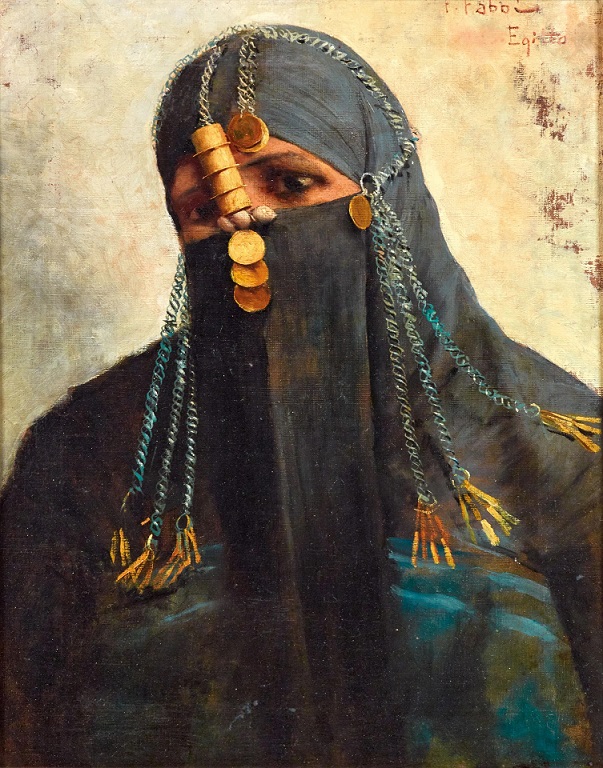
01 Work, Orientalist Artist, Fabio Fabbi's A veiled Egyptian woman with an arousa el burka the traditional face veil, with footnotes #129

Fabio Fabbi (Italian, 1861–1946)
A veiled Egyptian woman with an arousa el burka the traditional face veil
Oil on canvas
46.5 x 37.5 cm. (18.3 x 14.8 in.)
Private collection

Estimated at USD 11,000 .- to USD 16,000 .- in October 2018

The arousa el burqa is the large tubular object, almost out of proportion, resting on the forehead of the woman depicted on the postcard above. These aouras are part of the Egyptian face veil and an amulet holder (or amulet in its own right), worn on a string on the forehead of the wearer. Literally, arousa means the ‘bride (or doll) of the veil’. They are in fact the only decoration on the traditional translucent, black Egyptian veil. These face veils were made of black crinkly silk, lace or crocheted cloth, sometimes produced in Mahalla el Kubra now located within the city of Cairo. More on The arousa el burqa

Fabio Fabbi was an Italian painter working in the Orientalist tradition. Born in Bologna, Italy in 1861, he began his artistic career by studying at the Accademia Di Belle Arti in Florence in the 1880s. He would gain considerable popularity for his exoticized, Neoclassical paintings, usually depicting Middle Eastern and North African street scenes and featuring harem women, dancers, and Muslim warriors. Fabbi's work was considered more commercial than many of his peers, resulting in the artist’s fiscal prosperity and his frequent contributions to exhibitions in Turin, Milan, and Florence. He died in 1946. More on Fabio Fabbi


Please visit my other blogs: Art CollectorMythologyMarine ArtPortrait of a Lady, The OrientalistArt of the Nude and The Canals of VeniceMiddle East Artists365 Saints365 Days, and Biblical Icons, also visit my Boards on Pinterest and deviantart

Images are copyright of their respective owners, assignees or others. Some Images may be subject to copyright

I don't own any of these images - credit is always given when due unless it is unknown to me. if I post your images without your permission, please tell me.

Ads are shown only to compensate the hosting expenses.

If you enjoyed this post, please share with friends and family.

Thank you for visiting my blog and also for liking its posts and pages.

Please note that the content of this post primarily consists of articles available from Wikipedia or other free sources online.


Sunday, September 1, 2024

01 Work, Orientalist Artist, Alexandre Cabanel's Thamar, with footnotes #125

Alexandre Cabanel
Thamar, c. 1875
Huile sur toile/ Oil on canvas
H. 180,0 ; L. 248,0 cm.
Musée d’Orsay

In the Book of Genesis, Tamar was the daughter-in-law of Judah (twice), as well as the mother of two of his children: the twins Perez and Zerah.

Tamar is first described as marrying Judah's eldest son, Er. Because of his wickedness, Er was killed by God. By way of a levirate union, Judah asked his second son, Onan, to provide offspring for Tamar so that the family line might continue. This could have substantial economic repercussions, with any son born deemed the heir of the deceased Er, and able to claim the firstborn's double share of inheritance. However, if Er was childless, Onan would inherit as the oldest surviving son.

Onan performed coitus interruptus. His action displeased God and so, like his older brother, God killed him. At this point, Judah is portrayed as viewing Tamar to be cursed and therefore as being reluctant to give her his remaining and youngest son Shelah. Rather, he tells Tamar to wait for Shelah. However, even after Shelah has grown up, Judah still does not give Tamar to him in marriage.

After Shelah had grown up, Judah became a widower. After Judah mourned the death of his wife, he planned on going to Timnath to shear his sheep. Upon hearing this news, Tamar disguised herself as a prostitute and immediately went to Timnath which was en route to Judah's destination. Upon arriving at a place near Timnath, where two roads met, Judah saw the woman but did not recognize her as Tamar because of the veil she wore over her face. Thinking she was a prostitute, he requested her services. Tamar's plan was to become pregnant by this ruse so that she might bear a child in Judah's line, since Judah had not given her to his son Shelah. So she played the part of a prostitute and struck a bargain with Judah for a goat, secured by his staff, seal, and cord. When Judah was able to have a goat sent to Timnath, in order to collect his staff and seal, the woman was nowhere to be found and no one knew of any prostitute in Timnath.

Three months later, Tamar was accused of prostitution on account of her pregnancy. Upon hearing this news, Judah ordered that she be burned to death. Tamar sent the staff, seal, and cord to Judah with a message declaring that the owner of these items was the man who had made her pregnant. Upon recognizing these items as his security, Judah released Tamar from her sentence. Tamar, having thus secured her place in the family as well as Judah's posterity, gave birth to twins, Perez and Zerah. Their birth is reminiscent of the birth of Rebekah's twin sons. The midwife marks Zerah's hand with a scarlet cord when he emerges first from the womb, though Perez is born first. Perez is identified in the Book of Ruth as the ancestor of King David. The Genesis narrative also makes a note that Judah did not have further sexual relations with Tamar. 

According to Ethiopic tradition, Perez became the king of Persia. More on Thamar

Alexandre Cabanel (28 September 1823 – 23 January 1889) was a French painter born in Montpellier, Hérault. He painted historical, classical and religious subjects in the academic style. He was also well known as a portrait painter. According to Diccionario Enciclopedico Salvat, Cabanel is the best representative of the L'art pompier and Napoleon III's preferred painter.

Cabanel entered the École des Beaux-Arts in Paris at the age of seventeen, and studied with François-Édouard Picot. He exhibited at the Paris Salon for the first time in 1844, and won the Prix de Rome scholarship in 1845 at the age of 22. Cabanel was elected a member of the Institute in 1863. He was appointed professor at the École des Beaux-Arts in 1864 and taught there until his death.

He was closely connected to the Paris Salon: "He was elected regularly to the Salon jury and his pupils could be counted by the hundred. Through them, Cabanel did more than any other artist of his generation to form the character of belle époque French painting". His refusal together with William-Adolphe Bouguereau to allow the impressionist painter Édouard Manet and many other painters to exhibit their work in the Salon of 1863 led to the establishment of the Salon des Refusés by the French government. Cabanel won the Grande Médaille d'Honneur at the Salons of 1865, 1867, and 1878. More on Alexandre Cabanel


Please visit my other blogs: Art CollectorMythologyMarine ArtPortrait of a Lady, The OrientalistArt of the Nude and The Canals of VeniceMiddle East Artists365 Saints365 Days, and Biblical Icons, also visit my Boards on Pinterest and deviantart

Images are copyright of their respective owners, assignees or others. Some Images may be subject to copyright

I don't own any of these images - credit is always given when due unless it is unknown to me. if I post your images without your permission, please tell me.

Ads are shown only to compensate the hosting expenses.

If you enjoyed this post, please share with friends and family.

Thank you for visiting my blog and also for liking its posts and pages.

Please note that the content of this post primarily consists of articles available from Wikipedia or other free sources online.