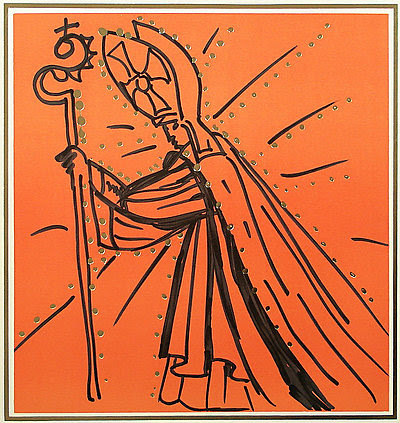
Salvador Dalí
The Twelve Apostles (as Knights of the Round Table) (F. 180-81; M. & L. 1504-1515), c, 1977
lithograph in colors with embossing and foil on Arches paper
Private collection
Though there is some discussion surrounding the identification of the figures, they are accepted to be: Christ, James the Lesser, James the Greater, "The Watcher" and Saints Andrew, Mark, John, Peter, Thomas, Jude, Matthew, and Phillip
Identification has been made by examination of the images for symbols associated with each of them. More weight has been given to tradition than to theological scholarships because Dali would not have been aware of the latter.
Salvador Dalí
Lancelot of the Lake/ James the Greater
From The Twelve Apostles (as Knights of the Round Table) (F. 180-81; M. & L. 1504-1515), c, 1977
lithograph in colors with embossing and foil on Arches paper
H: 19 3/8", : 18 1/8"
Private collection
Lancelot, also spelled Launcelot, also called Lancelot of the Lake, French Lancelot du Lac, one of the greatest knights in Arthurian romance; he was the lover of Arthur’s queen, Guinevere, and was the father of the pure knight Sir Galahad. More on Lancelot
James the Great, also known as James, son of Zebedee, Saint James the Great, Saint James the Greater, Saint James the Elder, or Saint Jacob (died AD 44), was one of the Twelve Apostles of Jesus. According to the New Testament, he was the second of the apostles to die (after Judas Iscariot), and the first to be martyred. Saint James is the patron saint of Spain and, according to tradition, his remains are held in Santiago de Compostela in Galicia. More on James the Greater
Salvador Dalí
Patricius/ Christ
From The Twelve Apostles (as Knights of the Round Table) (F. 180-81; M. & L. 1504-1515), c, 1977
lithograph in colors with embossing and foil on Arches paper
H: 19 3/8", : 18 1/8"
Private collection
Patricius (459–471) was an Eastern Roman Caesar, the son of the powerful general Aspar, who for almost two decades was the effective power behind the throne of the Eastern Roman Empire. Of mixed Roman and barbarian origin, Patricius was destined for the imperial throne by his father. He rose to the rank of caesar under Emperor Leo I, before his father's murder in 471 led to his own downfall and possibly death.
More on Patricius
The word Christ appears in English and in most European languages. English-speakers now often use "Christ" as if it were a name, one part of the name "Jesus Christ", though it was originally a title ("the Messiah"). Its usage in "Christ Jesus" emphasizes its nature as a title. Compare the usage "the Christ".
The most common, and easily recognisable, Christian symbol is the cross. This refers to the Christian belief that Jesus Christ was crucified on a cross to save mankind.
More on Christ

Salvador Dalí
The Knighting of Sir Galahad/ Phillip
From The Twelve Apostles (as Knights of the Round Table) (F. 180-81; M. & L. 1504-1515), c, 1977
lithograph in colors with embossing and foil on Arches paper
H: 19 3/8", : 18 1/8"
Private collection
Galahad, sometimes referred to as Galeas or Galath, among other versions of his name, is a knight of King Arthur's Round Table and one of the three achievers of the Holy Grail in Arthurian legend. He is the illegitimate son of Sir Lancelot du Lac and Lady Elaine of Corbenic and is renowned for his gallantry and purity as the most perfect of all knights. More on Galahad
The Synoptic Gospels list Philip as one of the apostles. The Gospel of John recounts Philip's calling as a disciple of Jesus. Philip is described as a disciple from the city of Bethsaida, and the evangelist connects him with Andrew and Peter, who were from the same town. He also was among those surrounding John the Baptist when the latter first pointed out Jesus as the Lamb of God. More on Philip
Salvador Dalí
Lancelot Healing Sir Urre/ Doubting Thomas
From The Twelve Apostles (as Knights of the Round Table) (F. 180-81; M. & L. 1504-1515), c, 1977
lithograph in colors with embossing and foil on Arches paper
H: 19 3/8", : 18 1/8"
Private collection
Sir Urry, grieved by seven wounds that will never heal until the wounds have been treated by the best knight in the world, comes to Arthur's court at Pentecost. Arthur and all his court try to help him, but only Launcelot is effective, not through his own virtue but through his humble appeal to the Trinity. Urry follows Launcelot from that day forward, along with Sir Lavine. More on Sir Urry
Doubting Thomas was a skeptic who refused to believe without direct personal experience , the resurrected Jesus had appeared to the ten other apostles until he could see and feel Jesus' crucifixion wounds.
In art this subject, formally termed The Incredulity of Saint Thomas, has been common since at least the early 6th century, when it appears in the mosaics at Basilica of Sant'Apollinare Nuovo in Ravenna, and on the Monza ampullae. In those depictions, as later in the Baroque, the subject, normally depicted at the moment Thomas puts his fingers into Jesus' side. More on Doubting Thomas
Knight of the Sparrow-Hawk/ John
From The Twelve Apostles (as Knights of the Round Table) (F. 180-81; M. & L. 1504-1515), c, 1977
lithograph in colors with embossing and foil on Arches paper
H: 19 3/8", : 18 1/8"
Private collection
Sir Geraint, who was the eldest son of King Erbin of Dumnonia was a Knight of Devonshire. After the death of his his wife, Prince Geraint spent much of his time at King Arthur’s Court looking for action and adventure. It was during this period that he encountered the Sparrow Hawk Knight.
Sparrow Hawk Knight was the nephew of Earl Yniol, and that he had had robbed him of his earldom and all his wealth.
Geraint borrowed Yniol's rusty old armor and entered a tournament against the Sparrow Hawk Night and was victorious, and Enid, Yniol daughter, was awarded the prize for beauty. The "sparrow-hawk" agreed to return the earldom to Yniol.
More on Knight of the Sparrow-Hawk
John the Apostle (6 AD – c. 100 AD) or Saint John the Beloved was one of the Twelve Apostles of Jesus according to the New Testament.,G generally listed as the youngest apostle. The Church Fathers identify him as John the Evangelist, John of Patmos, John the Elder, and the Beloved Disciple, and testify that he outlived the remaining apostles and was the only one to die of natural causes.
More on John the Apostle
Merlin the Magician/ Mark
From The Twelve Apostles (as Knights of the Round Table) (F. 180-81; M. & L. 1504-1515), c, 1977
lithograph in colors with embossing and foil on Arches paper
H: 19 3/8", : 18 1/8"
Private collection
Merlin is a mythical figure prominently featured in the legend of King Arthur and best known as a mage, with several other main roles. More on Merlin
Mark the Evangelist, also known as John Mark or Saint Mark, is the person who is traditionally ascribed to be the author of the Gospel of Mark. According to Church tradition, Mark founded the episcopal see of Alexandria, which was one of the five most important sees of early Christianity. More on Mark the Evangelist
Knights of the Realm/ The Watcher
From The Twelve Apostles (as Knights of the Round Table) (F. 180-81; M. & L. 1504-1515), c, 1977
lithograph in colors with embossing and foil on Arches paper
Private collection
The image of a woman’s face with 12 tiny figures in her hair cannot be that of an apostle. It has been called “The Watcher” and may represent what Dali Called “the piercing gaze a Gala.” In the Knights of the Round Table the piece has been given the name “Knights of the Realm”.
A Watcher is a type of biblical angel.
Keeper of the Keys/ Peter
From The Twelve Apostles (as Knights of the Round Table) (F. 180-81; M. & L. 1504-1515), c, 1977
lithograph in colors with embossing and foil on Arches paper
H: 19 3/8", : 18 1/8"
Private collection
In Arthurian legend, Sir Kay is King Arthur's foster brother and later seneschal, keeper of the keys or sergeant at arms, as well as one of the first Knights of the Round Table. In later literature he is known for his acid tongue and bullying, boorish behaviour, but in earlier accounts he was one of Arthur's premier warriors. More on Sir Kay
Jesus declares: "Blessed are you, Simon son of Jonah, for this was not revealed to you by flesh and blood, but by my Father in heaven. And I tell you that you are Cephas (Peter) (Petros), and on this rock (petra) I will build my church, and the gates of Hades will not overcome it. I will give you the keys of the kingdom of heaven; whatever you bind on earth will be bound in heaven, and whatever you loose on earth will be loosed in heaven."
More on Peter
Visions of Camelot/ Andrew
From The Twelve Apostles (as Knights of the Round Table) (F. 180-81; M. & L. 1504-1515), c, 1977
lithograph in colors with embossing and foil on Arches paper
H: 19 3/8", : 18 1/8"
Private collection
According to some accounts, seven decades after Jesus was crucified, his apostle Andrew underwent the same punishment. To disparage and mock his Christianity, the Romans tilted the cross on which he was crucified so that it appeared as an "X" rather than in the shape held in reverence by the Christian faithful. Andrew had converted multitudes to Christianity throughout the Mediterranean, including the wife of a Roman provincial governor in southern Greece; the governor, in turn, immediately ordered Andrew to be scourged and then crucified. More on Andrew
Vicar of Britain/ James the Lesser
From The Twelve Apostles (as Knights of the Round Table) (F. 180-81; M. & L. 1504-1515), c, 1977
lithograph in colors with embossing and foil on Arches paper
H: 19 3/8", : 18 1/8"
Private collection
James the Lessor was Bishop of Jerusalem. In the Knights of the Round Table the piece has been given the name “Vicar of Britain”.
Excaliber/ Jude
From The Twelve Apostles (as Knights of the Round Table) (F. 180-81; M. & L. 1504-1515), c, 1977
lithograph in colors with embossing and foil on Arches paper
H: 19 3/8", : 18 1/8"
Private collection
The image of Jude has no special symbol. This could be Bartholomew, who was flayed alive, or it could be Thaddeus (Simon).’ In the Knights of the Round Table the piece has been given the name “Excalibur”.
Geoffrey of Monmouth/ Matthew
From The Twelve Apostles (as Knights of the Round Table) (F. 180-81; M. & L. 1504-1515), c, 1977
lithograph in colors with embossing and foil on Arches paper
H: 19 3/8", : 18 1/8"
Private collection
Geoffrey of Monmouth (c. 1095 – c. 1155) was a cleric from Monmouth, Wales, and one of the major figures in the development of British historiography and the popularity of tales of King Arthur. He is best known for his chronicle The History of the Kings of Britain which was widely popular in its day, being translated into other languages from its original Latin. More on Geoffrey of Monmouth
The Gospel of Matthew is the first book of the New Testament of the Bible and one of the three synoptic Gospels. It tells how Jesus comes to his people (the Jews) but is rejected by them. More on The Gospel of Matthew
Salvador Dali was born in 1904 in Figueres, Spain. Dali was encouraged to explore his artistic talents from an early age. He received formal training at the Academia de San Fernando in Madrid where he quickly gained attention from his classmates for his Cubist work. Dali was expelled from the Academia for behavioral issues and moved to Paris, where he quickly befriended Picasso, Magritte, and Miro. His new acquaintances led Dali to his Surrealist phase.
Though inspired by classic artists like Raphael, Bronzino, Vermeer, and Velazquez (Dali’s trademark mustache was influenced by Velazquez), Dali is best known for his surrealist work. In 1931, Dali painted “The Persistence of Memory,” his most famous piece, which featured the motif of the melting clock, which can be found in many of his works.
More on Salvador Dali
Please visit my other blogs: Art Collector, Mythology, Marine Art, Portrait of a Lady, The Orientalist, Art of the Nude and The Canals of Venice, Middle East Artists, 365 Saints and 365 Days, also visit my Boards on Pinterest
Images are copyright of their respective owners, assignees or others.
Some Images may be subject to copyright
I don't own any of these images - credit is always given when due unless
it is unknown to me. if I post your images without your permission, please tell
me.
I do not sell art, art prints, framed posters or reproductions. Ads are
shown only to compensate the hosting expenses.
If you enjoyed this post, please share with friends and family.
Thank you for visiting my blog and also for liking its posts and pages.
Please note that the content of this post primarily consists of articles
available from Wikipedia or other free sources online.


.webp)