Monday, December 5, 2022

01 Orientalist Painting, Narcisse Berchère's Horseman at the camp, with footnotes, #110

Narcisse Berchère, (Etampes 1819- Asnières 1891)
Horseman at the camp
Oil on panel a non-parquet board
14 x 10 cm
Private collection

Narcisse Berchère (11 September 1819, Étampes - 20 September 1891, Asnières-sur-Seine was a French painter and engraver; best known for his Orientalist works.

His initial studies were at the École des Beaux-Arts de Paris, with Charles-Caïus Renoux [fr]. Later, he worked in the studios of Jean-Charles-Joseph Rémond.

He spent much of his working life in Paris; making extended trips to Provence and Spain, and specializing in landscapes. He visited Egypt, Asia Minor and the Greek archipelago from 1849 to 1850 and sent his first paintings to the Salon from Greece.

In 1856, he returned to Egypt and crossed the Sinai desert with his friend, the painter Léon Belly. They were then joined by Jean-Léon Gérôme and Auguste Bartholdi; setting out on an expedition up the Nile Valley that October.

Four years later, Ferdinand de Lesseps entrusted him to create a series of paintings, tracing the different stages in the excavation of the Suez Canal. During this project he maintined a detailed correspondence with Eugène Fromentin. Their letters were published in 1863. He was invited to attend the inaugural ceremonies at the Canal in 1869.

After many years of travelling throughout North Africa and the Middle East, he settled in Asnières-sur-Seine. Many of his sketches and paintings are preserved at the Musée municipal d'Étampes [fr], in Essonne. More on Narcisse Berchère


Please visit my other blogs: Art CollectorMythologyMarine ArtPortrait of a Lady, The OrientalistArt of the Nude and The Canals of VeniceMiddle East Artists365 Saints and 365 Days, also visit my Boards on Pinterest

Images are copyright of their respective owners, assignees or others. Some Images may be subject to copyright

I don't own any of these images - credit is always given when due unless it is unknown to me. if I post your images without your permission, please tell me.

I do not sell art, art prints, framed posters or reproductions. Ads are shown only to compensate the hosting expenses.

If you enjoyed this post, please share with friends and family.

Thank you for visiting my blog and also for liking its posts and pages.

Please note that the content of this post primarily consists of articles available from Wikipedia or other free sources online.


Saturday, December 3, 2022

01 Orientalist Painting, Henri Adrien Tanoux's Tambourine odalisque, with footnotes, #109

Henri Adrien Tanoux, (Marseille 1865 - Paris 1923)
Tambourine odalisque, c. 1914
Oil on original canvas
46 x 55.5 cm
Private collection

An odalisque was a chambermaid or a female attendant in a Turkish seraglio, particularly the court ladies in the household of the Ottoman sultan. In western usage, the term came to mean the harem concubine, and refers to the eroticized artistic genre in which a woman is represented mostly or completely nude in a reclining position, often in the setting of a harem. More on An odalisque

Henri Adrien Tanoux ( Marseille , 18 October as as 1865 - Paris , 1923 ) was a French painter. He dedicated himself to landscapes , nudes and oriental scenes .

He studied at the Academy of Fine Arts in Paris where he was a pupil of Léon Bonnat . He exhibited his works regularly at the Paris Salon and received an honorable mention at the Universal Exhibition in Paris in 1889. More on Henri Adrien Tanoux 


Please visit my other blogs: Art CollectorMythologyMarine ArtPortrait of a Lady, The OrientalistArt of the Nude and The Canals of VeniceMiddle East Artists365 Saints and 365 Days, also visit my Boards on Pinterest

Images are copyright of their respective owners, assignees or others. Some Images may be subject to copyright

I don't own any of these images - credit is always given when due unless it is unknown to me. if I post your images without your permission, please tell me.

I do not sell art, art prints, framed posters or reproductions. Ads are shown only to compensate the hosting expenses.

If you enjoyed this post, please share with friends and family.

Thank you for visiting my blog and also for liking its posts and pages.

Please note that the content of this post primarily consists of articles available from Wikipedia or other free sources online.

Thursday, November 24, 2022

01 Orientalist Painting, Henri-Léopold Lévy's Phoenix, with footnotes, #108

Henri-Léopold Lévy, French, 1840-1904
Le phoenix
Oil on canvas 
28 ⅞ by 17 ½ in.; 73.3 by 44.5 cm
Private collection

In Ancient Greek folklore, a phoenix is a long-lived bird that cyclically regenerates or is otherwise born again. Associated with the sun, a phoenix obtains new life by arising from the ashes of its predecessor. Some legends say it dies in a show of flames and combustion, others that it simply dies and decomposes before being born again. Most accounts say that it lived for 500 years before rebirth. More on the Phoenix

Henri-Léopold Lévy (23 September 1840, Nancy - 29 December 1904, Paris) was a French painter of Jewish ancestry, known primarily for mythological and Biblical subjects.

His artistic education began at the École des beaux-arts de Paris. His first exhibit at the Salon came in 1865, where he displayed his portrayal of Hecuba. It brought him a first-class medal. Two years later, he received an award for his version of Jehoash of Judah. In 1869 he was given a prize for his "Hebrew Captive Weeping at the Ruins of Jerusalem". In 1872, after showing his portrait of Herodias, he was named a Chevalier in the Legion of Honor.

Despite being a Chevalier, his career suffered from the anti-Semitism that swept France after the Dreyfus Affair. He was, however, able to continue participating in the Salon until 1903. During this time, he took an extended trip to the Middle East with his friend, Fromentin, and produced several Orientalist works. He also served as a teacher. More on Henri-Léopold Lévy


Please visit my other blogs: Art CollectorMythologyMarine ArtPortrait of a Lady, The OrientalistArt of the Nude and The Canals of VeniceMiddle East Artists365 Saints and 365 Days, also visit my Boards on Pinterest

Images are copyright of their respective owners, assignees or others. Some Images may be subject to copyright

I don't own any of these images - credit is always given when due unless it is unknown to me. if I post your images without your permission, please tell me.

I do not sell art, art prints, framed posters or reproductions. Ads are shown only to compensate the hosting expenses.

If you enjoyed this post, please share with friends and family.

Thank you for visiting my blog and also for liking its posts and pages.

Please note that the content of this post primarily consists of articles available from Wikipedia or other free sources online.

Saturday, November 5, 2022

01 Orientalist Painting, Edwin Longsden Long's THE IONIAN POTTERY SELLER, with footnotes, #107

Edwin Longsden Long, British, 1829 - 1891
THE IONIAN POTTERY SELLER, c.1881
Oil on canvas
46 by 35⅛ in.; 116.8 by 89.4 cm
Private collection

 Ionia is the name given during ancient times to the central region of Anatolia ’s Aegean shore in Asia Minor, present-day Turkey, one of the most important centres of the Greek world. On the islands and cities of Ionia the style of pottery was not as rigorously geometric as it was in the Dorian ceramic from the continent.  Some Ionian schools of archaic pottery such as Corinth and Rhodes were highly influence by Eastern styles, the so called Orientalizing style. More on Ionian Pottery

Edwin Longsden Long RA (12 July 1829 – 15 May 1891) was an English genre, history, biblical and portrait painter. Long was born in Bath, and was educated at Dr. Viner's School in Bath. Adopting the profession of a painter, Long came to London and studied in the British Museum. He was subsequently a pupil in the school of James Mathews Leigh in Newman Street London, and practiced first as a portrait artist painting Charles Greville, Lord Ebury and others.

Long made the acquaintance of John Phillip RA, and accompanied him to Spain, where they spent much time. Long was greatly influenced by the paintings of Velasquez and other Spanish masters, and his earlier pictures, such as 'La Posada' (1864) and 'Lazarilla and the blind beggar' (1870), were painted under Spanish influence. His first important pictures were 'The Suppliants' (1872) and 'The Babylonian marriage market' (both subsequently purchased by Thomas Holloway). In 1874, he visited Egypt and Syria, and subsequently his work took a new direction. He became thoroughly imbued with middle-eastern archaeology and painted oriental scenes like 'The Egyptian Feast' (1877), 'The Gods and their makers' (1878) etc.

Long was elected an associate of the Royal Academy in 1870 and an academician (RA) in 1881. His pictures suited the taste and appealed to the religious sentiment of a large portion of the public, and their popularity was increased by a wide circulation of engravings. He consequently determined to exhibit his next pictures in a separate gallery of his own in Bond Street, London and there in 1883, and the following years, his 'Anno Domini' and 'Zeuxis at Crotona' met with great commercial success.

Long died from pneumonia resulting from influenza, at his home, "Kelston" in Netherhall Gardens, Hampstead, on 15 May 1891, in his sixty-second year. He was buried in West Hampstead Cemetery. More on Edwin Longsden Long


Please visit my other blogs: Art CollectorMythologyMarine ArtPortrait of a Lady, The OrientalistArt of the Nude and The Canals of VeniceMiddle East Artists365 Saints and 365 Days, also visit my Boards on Pinterest

Images are copyright of their respective owners, assignees or others. Some Images may be subject to copyright

I don't own any of these images - credit is always given when due unless it is unknown to me. if I post your images without your permission, please tell me.

I do not sell art, art prints, framed posters or reproductions. Ads are shown only to compensate the hosting expenses.

If you enjoyed this post, please share with friends and family.

Thank you for visiting my blog and also for liking its posts and pages.

Please note that the content of this post primarily consists of articles available from Wikipedia or other free sources online.

Saturday, October 22, 2022

01 Orientalist Painting, Eduardo Leon Garrido's NUDE IN A LIGHT-FILLED BOUDOIR , with footnotes, #106

Eduardo Leon Garrido, Spanish, 1856 - 1949
Detail; NUDE IN A LIGHT-FILLED BOUDOIR 
Oil on panel 
15 by 18⅛ in.; 38.1 by 46 cm
Private collection

Eduardo Leon Garrido, Spanish, 1856 - 1949
NUDE IN A LIGHT-FILLED BOUDOIR 
Oil on panel 
15 by 18⅛ in.; 38.1 by 46 cm
Private collection

Eduardo Leon Garrido ( Madrid , 1856 - Caen , 1949) was a Spanish painter. He began his training at the School of Painting in Madrid and as a disciple in the workshop of Vicente Palmaroli . Thanks to a grant from the Provincial de Madrid, traveled to Paris where he attended the workshop of Raimundo Madrazo . Later he traveled to Italy , connecting in Venice with Spanish painters of the likes of Mariano Fortuny and Martín Rico . In 1905 he was appointed professor of the School of Arts and Crafts in Varennes , staying in France the rest of his life. 

His style is influenced by impressionism and for some critics is reminiscent of that of Manet . His work is dedicated to traditional themes, portraits of women wearing elegant clothes of the Belle Époque and reproduction of gallant scenes. He achieved great success in his time and exhibited in Paris, London and Munich .

Some of his paintings can be seen in the Museo del Prado (Madrid), Museo Nacional de Bellas Artes (Argentina) , Bilbao Fine Arts Museum and private collections such as the Bellver Collection of Seville. More Eduardo Leon Garrido


Please visit my other blogs: Art CollectorMythologyMarine ArtPortrait of a Lady, The OrientalistArt of the Nude and The Canals of VeniceMiddle East Artists365 Saints and 365 Days, also visit my Boards on Pinterest

Images are copyright of their respective owners, assignees or others. Some Images may be subject to copyright

I don't own any of these images - credit is always given when due unless it is unknown to me. if I post your images without your permission, please tell me.

I do not sell art, art prints, framed posters or reproductions. Ads are shown only to compensate the hosting expenses.

If you enjoyed this post, please share with friends and family.

Thank you for visiting my blog and also for liking its posts and pages.

Please note that the content of this post primarily consists of articles available from Wikipedia or other free sources online.

Tuesday, October 18, 2022

01 Orientalist Painting, Vasilios Chatzis' Byzantine naval battle, with footnotes, #111

Vasilios Chatzis, (Greek, 1870-1915)
Byzantine naval battle
Oil on card
25 x 22.5 cm
Private collection

The Byzantine navy was the naval force of the East Roman or Byzantine Empire. Like the empire it served, it was a direct continuation from its Imperial Roman predecessor, but played a far greater role in the defence and survival of the state than its earlier iteration. While the fleets of the unified Roman Empire faced few great naval threats, operating as a policing force vastly inferior in power and prestige to the legions, the sea became vital to the very existence of the Byzantine state, which several historians have called a "maritime empire" More on the The Byzantine navy

Vasileios Hatzis or Vassileios Chatzis (Greek, 1870 – 1915) was a Greek painter who was best known for his seascapes.

Vasileios Hatzis was born in 1870 in Kastoria. His family was involved in shipping, and he spent his childhood in Patras. From 1886 to 1893 he studied at the Athens School of Fine Arts. During the Balkan Wars of 1912–13 the government assigned him to the navy, where he portrayed action scenes of the Greek fleet. He died in Athens in 1915.

Hatzis is primarily known for his seascapes, but also painted landscapes and genre scenes from the life of farmers and fishermen. His work includes both academic and en plein air styles. The influence of impressionism may be detected in his work. He first exhibited in Athens in 1899, and his works were shown in group exhibitions in Athens (1902, 1907, 1909, 1910) and Alexandria (1903, 1906). A solo exhibition was held soon after his death at the Zappeion hall in Athens that showed more than 260 works. More on Vasilios Chatzis


Please visit my other blogs: Art CollectorMythologyMarine ArtPortrait of a Lady, The OrientalistArt of the Nude and The Canals of VeniceMiddle East Artists365 Saints and 365 Days, also visit my Boards on Pinterest

Images are copyright of their respective owners, assignees or others. Some Images may be subject to copyright

I don't own any of these images - credit is always given when due unless it is unknown to me. if I post your images without your permission, please tell me.

I do not sell art, art prints, framed posters or reproductions. Ads are shown only to compensate the hosting expenses.

If you enjoyed this post, please share with friends and family.

Thank you for visiting my blog and also for liking its posts and pages.

Please note that the content of this post primarily consists of articles available from Wikipedia or other free sources online.


Sunday, October 16, 2022

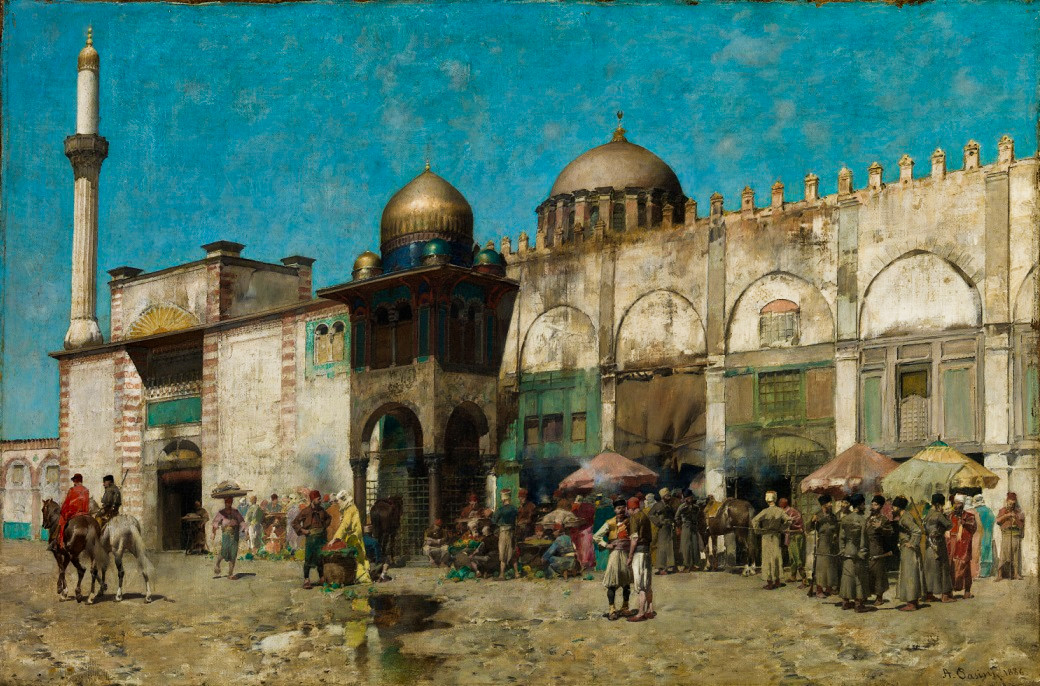
01 Orientalist Painting, Alberto Pasini's Mosque, with footnotes, #105

Alberto Pasini, Italian, 1826 - 1899
A Mosque, c. 1886
Oil on panel 
 14 5/8 x 21 3/4 in. (37.1 x 55.2 cm)
The Metropolitan Museum of Art

Alberto Pasini (Busseto, 3 September 1826 – Cavoretto, 15 December 1899) was an Italian painter. He was enrolled at the age of 17 years, in the Academy of Fine Art of Parma, studying landscape painting and drawing. In Parma, he was helped early on by Antonio Pasini, who painted for the local nobility and collaborated with the publishing house established by Giovanni Battista Bodoni. By 1852, he exhibited a series of thirty designs, made into lithographs, depicting various castles around Piacenza, Lunigiana and Parma. He was noticed by the artist Paolo Toschi, who encouraged Pasini to travel to Paris, where Pasini first joined the workshop of Charles and Eugène Ciceri, of the so-called School of Barbizon.

In 1853 his lithograph of The Evening gained him admittance to the Paris Salon, and to the workshop of the famous Théodore Chassériau. The eruption of the Crimean War offered a new opportunity, when in February 1855, this latter painter recommended Pasini to replace him on the entourage of the French plenipotentiary minister Nicolas Prosper Bourée to Persia. Pasini accompanied him, returning through the north of Persia and Armenia before reaching the port of Trebizond. In subsequent trips, he visited Egypt, the Red Sea, Arabia, Istanbul, and Persia. Pasini parlayed his exposures during this trip into numerous highly detailed paintings of orientalist subjects. He left again for Istanbul in October 1867, summoned by the French Ambassador Bourée. He returned to Turkey in 1876 to execute the four paintings commissioned by Sultan Abdul Aziz. He was about to return to Istanbul the next year, when his patron, the Sultan, died.

In 1865, he spent some time in Cannes, painted landscapes of the Riviera. During the Franco-Prussian War of 1870, he returned to Italy, settling in Cavoretto, on the hills around Turin. He continued to travel, closer to his home, with trips to Venice and two sojourns in Spain in 1879 and 1883. More Alberto Pasini


Please visit my other blogs: Art CollectorMythologyMarine ArtPortrait of a Lady, The OrientalistArt of the Nude and The Canals of VeniceMiddle East Artists365 Saints and 365 Days, also visit my Boards on Pinterest

Images are copyright of their respective owners, assignees or others. Some Images may be subject to copyright

I don't own any of these images - credit is always given when due unless it is unknown to me. if I post your images without your permission, please tell me.

I do not sell art, art prints, framed posters or reproductions. Ads are shown only to compensate the hosting expenses.

If you enjoyed this post, please share with friends and family.

Thank you for visiting my blog and also for liking its posts and pages.

Please note that the content of this post primarily consists of articles available from Wikipedia or other free sources online.