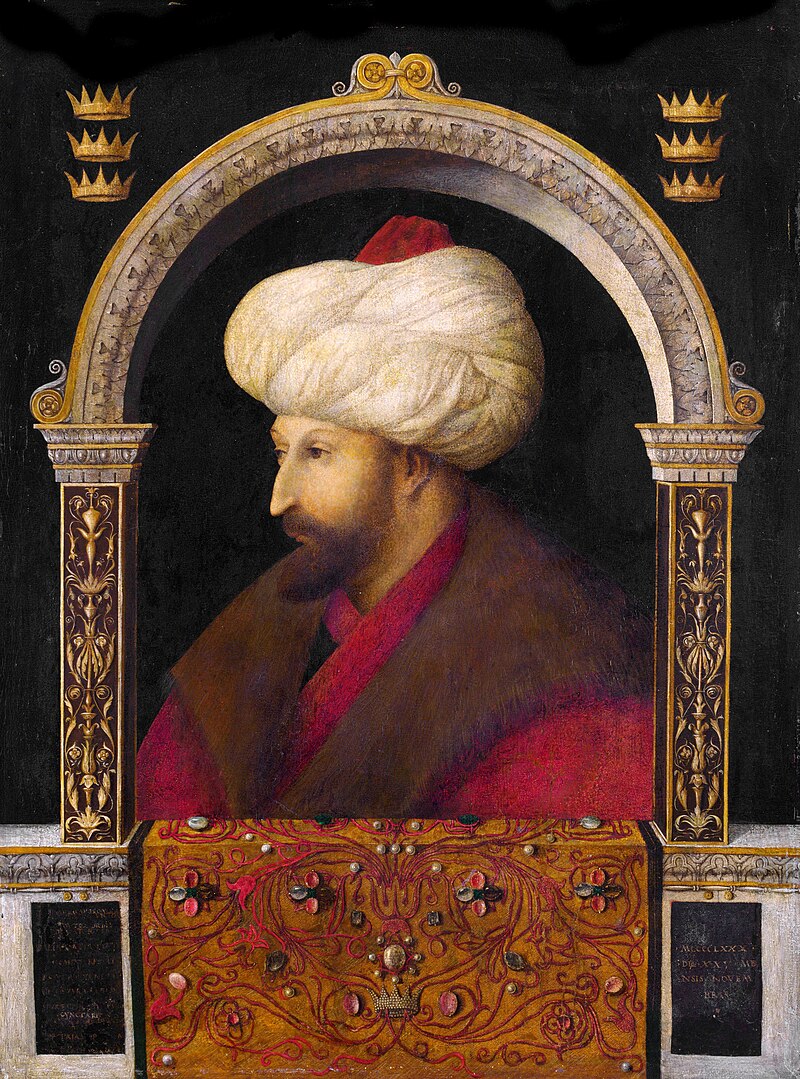
Orientalism is a term used by scholars in art history, literary, geography, and cultural studies for an approach to the depiction of "Oriental" cultures (including those of the Middle East, North Africa, South Asia, and Southeast Asia) taken by writers, designers, and artists from the West, particularly in the nineteenth century. Orientalist painting depicting "the Middle East" was a genre of 19th-century Academic art. The literature of Western countries took a similar interest in Oriental themes. It is also used for the use of Asian styles in Western art, especially in architecture and the decorative arts. More

Frederick Goodall, RA (British, 1822-1904)
The way from the village - Time of inundation, Egypt
Oil on canvas
35 1/4 x 57in (89.8 x 145cm)
Private collection
Frederick Goodall RA (London 17 September 1822 – 29 July 1904) was an English artist, born in 1822, the second son of steel line engraver Edward Goodall (1795–1870). He received his education at the Wellington Road Academy.
Frederick's first commission, for Isambard Brunel, was six watercolour paintings of the Rotherhithe Tunnel. Four of these were exhibited at the Royal Academy when Frederick was 16. His first oil won a Society of Arts silver medal. He exhibited work at the Royal Academy 27 times between 1838 and 1859. He was elected Associate of the Royal Academy in 1852.
Goodall visited Egypt in 1858 and again in 1870, both times travelling and camping with Bedouin tribesmen. In order to provide authentic detail to his paintings, Goodall brought back sheep and goats from Egypt. The Egyptian theme was prominent in his work, with 170 paintings being exhibited at the Royal Academy over 46 years.
Goodall's work received high praise and acclaim from critics and artists alike and he earned a fortune from his paintings. He had a home built at Grim's Dyke, Harrow Weald, where he would entertain guests such as the Prince of Wales (later Edward VII). More

Frederick Goodall, RA (British, 1822-1904)
Leaving The Village
Oil on canvas
35 1/4 x 57in (89.8 x 145cm)
Private property

Frederick Goodall (1822–1904)
The Song of the Nubian Slave, c. 1863
Oil on canvas
68.6 × 91 cm (27 × 35.8 in)
Private property

Rudolf Swoboda (1859-1914)
The carpet menders
Oil on canvas
79 x 107 cm
Private property
Rudolf Swoboda the younger (1859–1914) was a 19th-century Austrian painter, born in Vienna. He studied under Leopold Carl Müller, and voyaged with him to Egypt in 1880. He was a well-known Orientalist.
In 1886, Queen Victoria commissioned Swoboda to paint several of a group of Indian artisans who had been brought to Windsor as part of the Golden Jubilee preparations. Victoria liked the resulting paintings so much that she paid Swoboda's way to India to paint more of her Indian subjects.
Swoboda painted many of the ordinary people of India in a grouping of small (no more than eight inches high) paintings which resulted.
While in India, he stayed, part of the time, with John Lockwood Kipling, and met his son Rudyard Kipling. The younger Kipling was unimpressed with Swoboda, writing to a friend about two "Austrian maniacs" who thought they were "almighty" artists aiming to "embrace the whole blazing East" More

Eugène Fromentin (October 24, 1820 – August 27, 1876)
Le Simoon
Oil on canvas
55.2 x 65.4 cm, (21.73" x 25¾")
Private collection
Eugène Fromentin (October 24, 1820 – August 27, 1876) was a French painter and writer, now better remembered for his writings. He was born in La Rochelle. After leaving school he studied for some years under Louis Cabat, the landscape painter. Fromentin was one of the earliest pictorial interpreters of Algeria, having been able, while quite young, to visit the land and people that suggested the subjects of most of his works, and to store his memory as well as his portfolio with the picturesque and characteristic details of North African life. In 1849, he was awarded a medal of the second class.
In 1852, he paid a second visit to Algeria, accompanying an archaeological mission, and then completed that minute study of the scenery of the country and of the habits of its people which enabled him to give to his after-work the realistic accuracy that comes from intimate knowledge. More

Charles Robertson RWS, (British, 1844-1891)
Carpet Bazaar, Cairo, 1887
مصر زمان شارع الغورية بالقاهرة
Private collection

Charles Robertson RWS, (British, 1844-1891)
Alnashar's dream (The barber's fifth brother, Arabian nights)
watercolour and bodycolour
105 x 74cm (41 5/16 x 29 1/8in).
Private property

Arthur Trevor Haddon (British, 1864-1941)
Arabs in a busy street
Oil on canvas
87 x 119.5cm (34 1/4 x 47 1/16in).
Private property
Arthur Trevor Haddon (1864-1941), also known as Trevor Haddon, was a British painter and illustrator. He was born in London. He entered the Slade School of Fine Art in 1883, where he studied under Alphonse Legros. He also studied with Hubert von Herkomer from 1888 to 1890. More
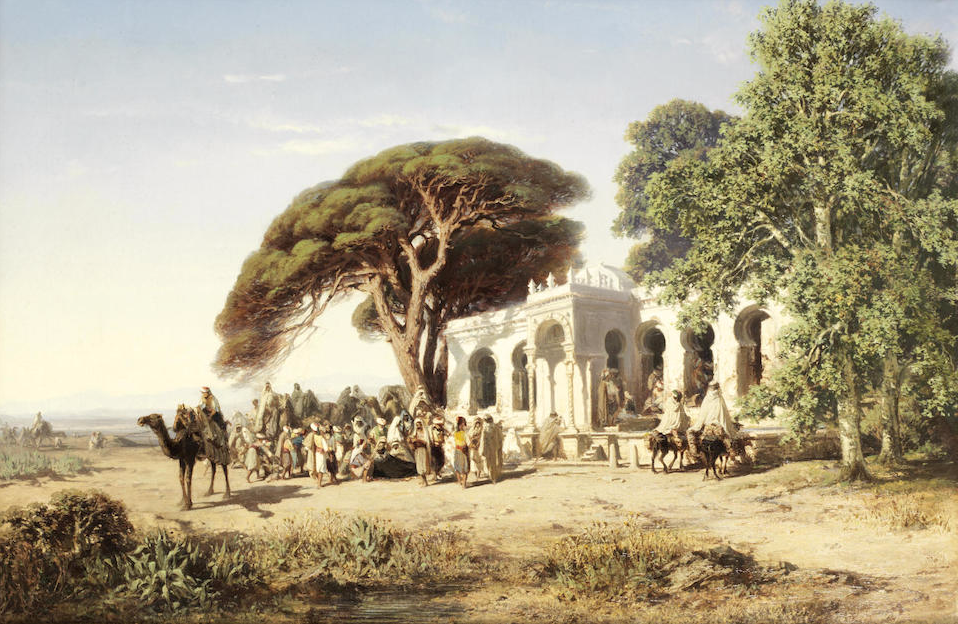
Vincent Joseph François Courdouan (French, 1810-1893)
A rest in the desert, Algeria
Oil on canvas
53 x 78.5cm (20 7/8 x 30 7/8in)
Private property
Joseph Vincent François Courdouan (7 March 1810, Toulon - 8 December 1893, Toulon) was a French painter who specialized in maritime scenes. He began his artistic studies at the age of twelve with the local artist Pierre Letuaire. Later, he spent some time at the "École des Beaux-Arts de la Marine", a small school under the direction of the naval sculptor Félix Brun (1763-1831). In 1829, he went to Paris where he studied engraving and worked in the studios of the painter Paulin Guérin, who was also originally from Toulon.
After completing his studies, he returned home and, in 1833, became a member of the Académie du Var, a group that promotes the arts and sciences in that region and can boast of many prominent members. Three years later, he was back in Paris with his first exhibition at the Salon, where he continued to exhibit, winning a Third Class Medal in 1838 for his watercolors and pastels.
In 1840, he began accepting students. He travelled to Naples in 1844. The following year, he turned more to oil painting and exhibited widely throughout France, notably in Lyon. In 1847, he visited Algeria and achieved a Gold Medal at the Salon in 1848 for his painting "Battle of the Romulus". This recognition was a major factor in his receiving a Professorship at the "École de la Marine de Toulon" in 1849. Three years later, he was awarded the Légion d’Honneur.
He was named Honorary Director of the Musée d'Art de Toulon in 1857 and, five years later, was admitted into the Félibrige (an Occitan cultural association) by its founder, Frédéric Mistral. The following year, at the age of 53, he married one of his students.
He continued to exhibit and travel widely for many years (including a trip to Egypt in 1866). He had his last showing at the Salon in 1883 and his last major exhibitions at Hyères and Aix-en-Provence in 1886. He died in the same house where he had been born. More

Hugo Ungewitter (1869 - c. 1944)
Abyssinians Crossing the River, c. 1936
Oil on canvas
Germany, 1936
Dimensions: 100 x 150 cm
Private property
Hugo Ungewitter (1869-c. 1944). From 1887, Hugo Ungewitter visited the Royal Prussian Academy of Arts in Düsseldorf. He received commissions from the afore-mentioned Academy and the Court of Berlin. From 1906, he lived in Berlin and painted mainly battle scenes. In 1913, he was appointed professor at the Court of Berlin. His favorite subjects were nature and animal depictions, as well as military and hunting scenes, mostly in South America and Russia. More

Roy Allison (20th Century), in the manner of Adolf Schreyer (German, 1828-1899)
Arab tribesman on horseback halting at a river
Oil on canvas
47.5 x 102cm (18 11/16 x 40 3/16in).
Private property

Enrico Maltese (1862–1920)
Woman in long black dress with cape at a well
Oil on canvas, relined
93.5 x 67 cm
Private property
Enrico Maltese (1862–1920). The Italian painter Enrico Maltese, born in the South of Sicily, went to Naples to study as a young man. After that he returned to his hometown Modica. The artist painted portraits, landscapes, townscapes and genre paintings. More

Samuel Colman (March 4, 1832 – March 26, 1920)
AN ARAB ENCAMPMENT
Oil on canvas
9 1/2 x 16 in
Private property
Samuel Colman (March 4, 1832 – March 26, 1920) was an American painter, interior designer, and writer, probably best remembered for his paintings of the Hudson River. Born in Portland, Maine, Colman moved to New York City with his family as a child. His father opened a bookstore, attracting a literate clientele that may have influenced Colman's artistic development. He is believed to have studied briefly under the Hudson River school painter Asher Durand, and he exhibited his first work at the National Academy of Design in 1850. By 1854 he had opened his own New York City studio. The following year he was elected an associate member of the National Academy, with full membership bestowed in 1862. More

C. Alberti (German 19th Century)
Arab street scenes
Oil on canvas
55.5 x 46cm (21 7/8 x 18 1/8in)
Private property

Paul Cirou (French, 1869-1951)
Arab market scenes
Oil on panel
35 x 60cm (13 3/4 x 23 5/8in)
Private property
Paul Cirou , born in Sainte-Mère-Église in 1869 , died in the same city in 1951 , was a French orientalist painter. He was a student at the School of Fine Arts in Dijon and then the Académie Julian in Paris .
He started at the Salon of French artists in 1898, with landscapes and portraits, including that of his father. He left to Algeria in 1907 for health reasons and moved there in 1912. He lived and worked there until 1936. Returning to Paris, he taught, with his wife, at his studio in the rue de la Tombe-Issoire . He exhibited his Algerian works successfully. He designed cartoons for large tapestries commissioned by the Manufacture des Gobelins, and the state.
After the death of his wife in 1950, he returned to his family to Sainte-Mère-Église. He died in 1951 before he could complete his project to execute frescoes of the theme of the Second World War. More

Paul Cirou (French, 1869-1951)
Arab market scenes
Oil on panel
35 x 60cm (13 3/4 x 23 5/8in)
Private property

Paul Cirou (French, 1869-1951)
Arab market scenes
Oil on panel
35 x 60cm (13 3/4 x 23 5/8in)
Private property

C. Alberti (German 19th Century)
Arab street scenes
Oil on canvas
55.5 x 46cm (21 7/8 x 18 1/8in)
Private property

Nicaise de Keyser (26 August 1813, Zandvliet – 17 July 1887, Antwerp)
WEST AND EAST, c. 1854
OIL ON CANVAS
172 x 128 cm ; 67 5/8 by 50 3/8 in
Private collection
Nicaise de Keyser (26 August 1813, Zandvliet – 17 July 1887, Antwerp) was a Belgian painter of mainly historical paintings and portraits. H was one of the key figures in the Belgian Romantic-historical school of painting. He received his painting tuition at the Antwerp Academy of Fine Arts under Jozef Jacobs and Mattheus Ignatius van Bree. After 1835 he made many travels including to England and Scotland, Paris and Italy. He married the genre painter Isabella Telghuys on 6 October 1840. In 1846, he was elected to the National Academy of Design as an Honorary Academician.
When in 1855 the leading Belgian Romantic painter Gustave Wappers resigned as director of the Antwerp Academy, de Keyser succeeded him. As with the work of other Belgian history painters such as Edouard de Bièfve, Ernest Slingeneyer and Louis Gallait, there was particular appreciation for Nicaise de Keyser's history paintings in German-speaking Europe. De Keyser regularly travelled to Germany and in 1873 he was awarded the famous Prussian order "Pour le Mérite".
Despite his great success and fame throughout his lifetime, his work, like that of the other Belgian Romantic painters, was quickly forgotten in the 20th century. More

George-Henry Laporte, HANNOVER 1799 - 1873 LONDON,
CAMP IN THE DESERT
Oil on canvas
76 x 105.5 cm; 29 7/8 by 41 1/2 in
Private collection
George Henry Laporte (1799 - 1873), was an animal painter, exhibited sporting subjects at the Academy, British Institution, and Suffolk Street Gallery from 1818, and was a founding member of the Institute of Painters in Water-colours, where he showed representations of animals, hunting scenes, and military groups. Some of his works were engraved in the New Sporting Magazine. George Henry Laporte held the appointment of animal painter to the King of Hanover. He died suddenly at 13 Norfolk Square, London on 23 October 1873. More

Adrien Dauzats, (BORDEAUX 1804 - PARIS 1868)
MOSQUE OF CAIRO, 1840
OIL ON CANVAS
35 x 27 cm ; 13 3/4 by 10 6/8 in
Private collection
Adrien Dauzats, a French landscape and genre painter, was born at Bordeaux in 1804. He became a pupil of Michel-Julien Gué, and afterwards travelled in France, Spain, Egypt, and Palestine, for the purpose of making illustrations for Baron Taylor's 'Voyages pittoresques et romantiques de l'ancienne Prance,' 1820-63; ' Voyage pittoresque en Espagne, en Portugal, et sur la côte d'Afrique, de Tanger à Tetouan,' 1826-32; 'La Syrie, I'Egypte, la Palestine et la Judée,' 1835-39, and other books. He was a frequent exhibitor at the Salon of genre subjects and interiors of churches, and was also a lithographer. He died in Paris in 1868. More

Ernest Honnorat
CHESS PLAYERS, c. 1895
Oil on panel
32 x 40.5 cm; 12 1/2 by 15 7/8 in
Private collection

Adolf Meckel von Hemsbach, BERLIN 1856 - 1893 BERLIN
BEDOUIN IN THE DESERT, c. 1891
Oil on canvas
181 x 266 cm; 71 104 1/4 by 3/4 in
Private collection
Adolf Meckel of Hemsbach (* 17th February 1856 in Berlin ; † 24. May 1893 ) was a German landscape and genre painter. After the early death of his father, he spent his childhood with the maternal grandparents in Saint Petersburg. He studied painting at the Karlsruhe Academy of Fine Arts in Hans Gude. From 1880 to 1881 he visited the Arab countries of Egypt , Palestine , the coast of the Dead Sea, in Jordan. Further journeys led him to the countries of the North African Maghreb . Among others, he visited St. Catherine's Monastery at the foot of Mount Sinai . Besides the tropical landscapes he created numerous orientale genre scenes. After his final return he was initially based in Karlsruhe, then moved in 1892 back into his own country.

Adolf Meckel von Hemsbach, (1856-1893)
The Sinai Saint Catherine's Monastery, c. 1892
Oil on canvas
Museum voor Schone Kunsten, Ghent, Belgium
Early 1881 he spent a week in the Sinai desert and came back numerous times after this first visit to The Orient. In often large monumental landscapes he combined the rough and inhospitable desert region with daily life elements, in 'The St Catherine Monastery in the Sinai' this is illustrated by the caravan in the foreground. This painting shows an almost awkward sense of realism, supported by the many details, the material effects and the unusual size. Von Meckel sent this ambitious painting to the Salon of Ghent in 1892, where the city bought it for the Museum of Fine Arts. More
Meckel regularly presented his work at the Royal Academy of Arts in Berlin exhibition, the Great Berlin Art Exhibition, as well as in Munich Glass Palace. He also exhibited in Dresden, Stuttgart and Vienna. In 1893, he took his own life. More

Francesco Longo Mancini (1880-1954)
Harem Scene, c. 1910
Mixed media with watercolor and gouache on wove paper
54 x 35.8 cm
Private collection
Francesco Longo Mancini (1880–1954) was an Italian painter of the early 20th century who was known for his paintings of nudes. He was born in Catania where he lived part of his life.
After studying at the Regio Istituto Tecnico in Catania, Mancini moved to Rome and studied at the Scuola Libera del Nudo under the guidance of Francesco Jacovacci and Filippo Prosperi. His painting ‘La Preghiera di Maometto’ was purchased by King Umberto di Savoia. He created his quite coherent artistic work especially in the first decades of the 20th century, in which he ignored mostly the various avant-garde movements. More

Francesco Longo Mancini, (1880-1954)
Harem Scene, c. 1910
Detail

Fabio Fabbi, (Italian, 1861-1946)
In the harem
Oil on canvas
90.5 x 141cm (35 5/8 x 55 1/2in)
Private collection
An excellent example of Fabio Fabbi's painting, combining the rich colour and detail of the interior with the sensuality of the exotic dancers. Harems, terraces and bazaars form the backdrop to many of the artist's most successful works.
Fabio Fabbi was born in Bologna, Italy in 1861. As a young man, he enrolled at the Accademia Di Belle Arti in Florence and studied sculpture and painting in the 1880s, winning prizes in both categories. After his studies, he travelled to Paris, Munich, and Egypt, which was the inspiration for his Orientalist subjects.
Upon his return to Italy, he dedicated himself solely to painting and was honoured with the distinction of professorship at the Accademia.
Fabbi's depictions of odalisques and bazaars which were well-received by the public, and his output was prolific. From 1884 onward, Fabbi regularly contributed to exhibitions in Turin, Milan and Florence. More

Paul Joanovitch, (Austrian, 1859-1957)
The falconer
Watercolour
60 x 40cm (23 5/8 x 15 3/4in)
Private collection
Paul Joanovitch, (Austrian, 1859-1957) was born in Vršac, (then part of the Austrian Empire, now modern day Serbia) in June 1859. Aged 15, he enrolled at the Academy of Fine Arts in Vienna under the tutelage of Christian Griepenkerl (1839-1912). It was there that Joanovitch also studied with Leopold Carl Müller (1834-1892).
Initially Joanovitch concentrated on depicting the life and customs of the indigenous people of the Balkans and in 1882 he was awarded the first prize at the academy and an Imperial scholarship for his series of paintings The Wounded Montenegrin.
In 1893 Joanovitch signed a contract with The French Gallery in London to produce a series of works depicting Balkan life; he was also elected a member of the Serbian Academy in the same year, but continued to travel extensively throughout the Caucasus, Greece, Egypt, Turkey, Italy and Spain.
By the early 1900s he turned almost exclusively to painting portraits enjoying considerable success with wealthy Viennese patrons. He remained in Vienna for the vast majority of the rest of his working life and died in 1957. More

Alexander Mann, (British, 1853-1908)
Desert travellers
Oil on canvas
53.5 x 86.5cm (21 1/16 x 34 1/16in)
Private collection
Alexander Mann (22 January 1853 – 26 January 1908) was a Scottish landscape and genre painter. He was a member of New English Art Club and Royal Institute of Oil Painters. Alexander Mann took drawing lessons from the age of ten with Robert Greenlees (1820–94) and then attended evening classes at the Glasgow School of Art, where Greenlees was headmaster.
In 1877 he went to Paris and enrolled at the Académie Julian, and then studied under Mihály Munkácsy and from 1881 to 1885 under Carolus-Duran. From 1883-93 Mann exhibited in London at the Royal Academy, Royal Institute of Oil Painters, Fine Art Society, New Gallery, Ridley Art Club, New English Art Club and Society of British Artists, a society that appointed James McNeill Whistler its President in 1886. At the same year he was invited to become the first Scottish member of the New English Art Club and was joined by several of his friends, notably John Lavery, Thomas Millie Dow of the Glasgow Boys and Norman Garstin.
Mann settled in England, at West Hagbourne, Berkshire, and later in the neighboring village of Blewbury, where he painted a series of views of the Downs and portraits of country people. Mann traveled extensively in Britain, paying several visits to the coast in Angus and Fife, and to Walberswick, Suffolk.
His travels also covered Europe and the Americas. A visit to Venice in 1884 was Alexander's first artistic venture beyond Britain and the immediate environs of Paris; this was followed by a voyage to the Caribbean and the Southern States of America. From 1890 to 1892 he lived with his family in Tangiers. Later he travelled to Madrid through Southern Spain in 1892 accompanied by John Lavery, another alumnus of the Académie Julian.
He recorded his visits and ideas for studio compositions in sketchbooks, using photography as well to assist his memory of a subject. In 1895 Mann’s work was exhibited in London at the Barbican and in Dublin at the Hugh Lane Municipal Gallery of Modern Art. But he preferred to "live away from the haunts of other artists" because the relative prosperity which he owed to his family made it unnecessary to pay much attention to exhibition institutions, patrons and dealers.
In 1893 he was elected a member of the Royal Institute of Oil Painters. Today he is regarded as one of the Glasgow Boys although he was never an active member. More

Sir William Russell Flint, RA, PRWS, (British, 1880-1969)
The Paid Dancer
Watercolour
35.5 x 51.5cm (14 x 20 1/4in)
Private collection
Sir William Russell Flint (4 April 1880 – 30 December 1969) was a Scottish artist and illustrator who was known especially for his watercolour paintings of women. He also worked in oils, tempera, and printmaking. He was born in Edinburgh then educated at Daniel Stewart's College and Edinburgh Institution. From 1894 to 1900 Flint apprenticed as a lithographic draughtsman while taking classes at the Royal Institute of Art, Edinburgh. From 1900 to 1902 he worked as a medical illustrator in London while studying part-time at Heatherley's Art School. He furthered his art education by studying independently at the British Museum.
Flint was elected president of Britain’s Royal Society of Painters in Watercolours (now the Royal Watercolour Society) in 1936 to 1956, and knighted in 1947. More

Raphael von Ambros, (Austrian, 1855-1895)
A street vendor
Oil on panel
38.5 x 47cm (15 3/16 x 18 1/2in)
Private collection
Born in Prague, Raphael von Ambros was a pupil of Hans Makart (1840-1884) at the famous Vienna Academy, where he would have studied alongside an extraordinary generation of Orientalist painters such as Jean Discart (French, 1856-1944), Ludwig Deutsch (1855-1935) and Rudolf Ernst (1854-1932). Like his contemporaries, Ambros found the perfect audience for his Cairo street scenes at the Paris Salon, where he exhibited from 1887. More

The Handing Over Of The Sacred Carpet In Cairo
Oil on Canvas
214 x 315 cm
Private collection
Every year at the expense of the Sultan a fine carpet or huge fabric for festooning the Kaaba at Mecca is made in this city, and we are now viewing the procession which is bearing it from the citadel to the mosque of the Hasanên, where the pieces will be sewed together and lined, in readiness for the departure of the pilgrims. More
Konstantin Yegorovich Makovsky (June 20 1839 —September 17 1915) was an influential Russian painter, affiliated with the "Peredvizhniki (Wanderers)". Many of his historical paintings, such as The Russian Bride's Attire (1889), showed an idealized view of Russian life of prior centuries. He is often considered a representative of a Salon art.
KKonstantin Makovsky was born in Moscow. His father was the Russian art figure and amateur painter, Yegor Ivanovich Makovsky. His mother was a composer, and she hoped her son would one day follow in her footsteps. His younger brothers Vladimir and Nikolay and his sister Alexandra also went on to become painters.
In 1851 Makovsky entered the Moscow School of Painting, Sculpture and Architecture where he became the top student, easily getting all the available awards. Makovsky's inclinations to Romanticism and decorative effects can be explained by the influence of Bryullov.
Although art was his passion, he also considered what his mother had wanted him to do. He set off to look for composers he could refer to, and first went to France. Before, he had always been a classical music lover, and listened to many pieces. He often wished he could change the tune, or style of some of them to make them more enjoyable.
In 1858 Makovsky entered the Imperial Academy of Arts in Saint Petersburg. From 1860 he participated in the Academy's exhibitions with paintings such as Curing of the Blind (1860) and Agents of the False Dmitry kill the son of Boris Godunov (1862). In 1863 Makovsky and thirteen other students held a protest against the Academy's setting of topics from Scandinavian mythology in the competition for the Large Gold Medal of Academia; all left the academy without a formal diploma.
A significant change in his style occurred after traveling to Egypt and Serbia in the mid-1870s. His interests changed from social and psychological problems to the artistic problems of colors and shape.
In the 1880s he became a fashioned author of portraits and historical paintings. At the World's Fair of 1889 in Paris he received the Large Gold Medal for his paintings Death of Ivan the Terrible, The Judgement of Paris, and Demon and Tamara. He was was killed in 1915 when his horse-drawn carriage was hit by an electric tram in Saint Petersburg. More

Ferencz-Franz Eisenhut, 1857 - 1903
A CARAVAN OUTSIDE OF A MOSQUE
oil on panel
15 1/2 by 23 3/4 in., 39.4 by 60.3 cm
Private collection


 Ferenc Eisenhut (1857–1903)
Gül Baba's Death, c. 1886
[The painting is currently adorns the Hungarian Embassy in Ankara residence
 Ferencz Franz Eisenhut (Hungarian, 1857–1903)
The death of Gül Baba , 1886
Oil on Cardboard
58 x 76 cm. (22.8 x 29.9 in.)
Private collection
 Ferencz-Franz Eisenhut, 1857 - 1903
The Battle of Zenta (1896)
Oil on canvas
7 meters wide and 4 meters high
Sombor City Hall,
 Ferencz-Franz Eisenhut, 1857 - 1903
The Battle of Zenta (1896)
Detail

Climent Pujol Gustavino, 1840 - 1915
VISITING THE SCRIBE
Ooil on panel
36 1/4 by 28 in, 92 by 71.1 cm
Private collection
Private collection
Franz Eisenhut (Hungarian: Eisenhut Ferencz; Serbian: Франц Ајзенхут; 25 January 1857 – 2 June 1903) was a prominent Danube Swabian Realist and Orientalist painter. He is considered one of Austria-Hungary's greatest academic painters in the second half of the 19th century. His most famous and recognizable paintings include Death of Gül Baba, Battle of Zenta, Slave trade and Cock fighting and many other, depicting mostly motifs from the Orient. His works can be found in many European museums across the continent.
Franz Eisenhut was born in Nova Palanka, Voivodeship of Serbia and Banat of Temeschwar, Austrian Empire (today's Serbia) in a German family. His father, Georg Eisenhut was from Palanka, and his mother Theresia Sommer was from Bukin.

Ferencz-Franz Eisenhut, 1857 - 1903
Before the Verdict, c. 1890
Oil on Canvas
160 x 324 cm
Private collection
His father had hoped for Franz to become a merchant, but the Hungarian painter Telepy Károly discovered his talent for painting. Influential citizens of Palanka at the time, led by lawyer Karl Mezey and pharmacist Karlo Harliković, collected money for his studies. He studied at Hungarian Royal Drawing School in Budapest from 1875 until 1877. Afterwards, he became a student of the Royal Academy of Fine Arts in Munich. He studied there until 1883 in class of Gyula Benczúr, the Hungarian painter.

Ferencz Franz Eisenhut (1857-1903).
The Healing through the Qu’ran, c. 1886
Oil on canvas
59,1x43,8 cm
Private collection
After finishing the Academy, he went on a trip to the Orient for the first time, visiting the Caucasus. The next year, he held his first exhibition in Budapest. The Orient became his main source of inspiration and Orientalist paintings will become his most famous works. In 1883 and 1884, he went to the Caucasus once again, visiting Tbilisi and Baku. In 1886 and 1887, he traveled from Naples to Tunisia and Algeria. His first great success was the 1886 painting "Healing through the Koran in Beirut" (above).

Gül Baba's Death, c. 1886
[The painting is currently adorns the Hungarian Embassy in Ankara residence
Gül Baba (* end of the 15th century in Merzifon , Amasya Province ; † 1. September 1541 ) was a Turkish Bektashi - dervish and poet of the 16th century. He is in the Muslim faith as a saint revered and his mausoleum in Budapest is considered the northernmost pilgrimage of Islam. More

The death of Gül Baba , 1886
Oil on Cardboard
58 x 76 cm. (22.8 x 29.9 in.)
Private collection
Many of his paintings were reproduced by woodcutting workshops across Europe, because, as his friend Lyka Karoly claimed, "his paintings showed the authentic Orient". Another famous painting made at the time was Death of Gül Baba (above), for which he won the State Gold Medal in Budapest. Afterwards, he had exhibitions in Munich, Paris and Madrid. In 1894, he painted the interior of New York Palace in Budapest.
Franz Eisenhut's most famous work is the painting "Battle of Zenta" (below), made in 1896 for the Hungarian Millennium Exhibition, celebrating 1000 years since the Hungarian settlement in the Great Hungarian Plain. The painting was ordered by the Bács-Bodrog County and is still exhibited in Sombor City Hall, as Sombor was the county seat at the time. This painting, with dimensions of 7x4 meters, is the largest oil painting in the Balkans today. More

The Battle of Zenta (1896)
Oil on canvas
7 meters wide and 4 meters high
Sombor City Hall,

The Battle of Zenta (1896)
Detail
Climent Pujol Gustavino, 1840 - 1915
VISITING THE SCRIBE
Ooil on panel
36 1/4 by 28 in, 92 by 71.1 cm
Private collection
Climent or Clément Pujol de Guastavino (Olesa de Montserrat, Circa 1850 - Paris, active in 1910) was born in Barcelona Olesa de Montserrat. He traveled to Barcelona to carry out his studies at the School of Fine Arts, where he became disciple of Antonio Caba.
He became known at the Barcelona Fine Arts Exhibition 1871 due to his pen drawing in 1872, in 1873 his work, A winter afternoon on the promenade of San Juan and Cloister of the Cathedral.
In 1876 Climent decides to head to Paris, where he joined the workshop of landscape painter Nicolas Louis Cabat (1812-1893). He later joined with Jean Leon Gerome (1824 -1904) adopting the Orientalist style. In 1876 he presented at the Paris Show, and the Barcelonesa interior Clunny museum.
From Paris continues to send his paintings to the Barcelona exhibition of Sala Parés, 1884, and the Universal Exposicon,1888. In 1887, Josep Rubaudonadeu donated to the Institute of Education a portrait of Juan Matas Hortal painted by Pujol.
He continued exhibiting at the Parisian salons, in 1888 with "Prière au mosquée", and at the Salon of 1889 "Depart pour la chasse". At the Universal Exhibition of that year he was awarded an honorable mention for his Orientalist painting "Moorish Dance".
In 1892 he shared a studio with Antoni Costa i Fabrés in Paris.
He exhibited his works in 1897 at the Exhibition of Tunis, where he obtained a medal of first class. One of his last appearances was in 1908 at the International Exhibition of 1908 in Montecarlo with painting, Cadeaux au Caïd Les. More
Images are copyright of their respective owners, assignees or others
Acknowledgement: Sothebey's, Bonhams,