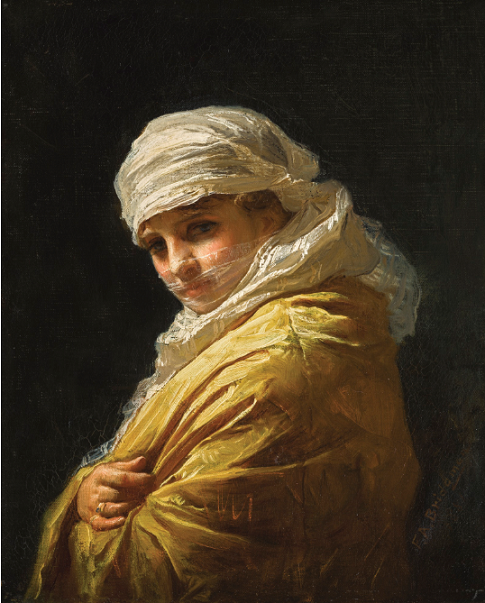
Showing posts with label Frederick Arthur Bridgman. Show all posts

Sunday, February 27, 2022

01 Painting by Orientalist Artists, Frederick Arthur Bridgman's WAITING FOR ORDERS, with footnotes, #85

Frederick Arthur Bridgman, (1847 - 1928)
DAND L'ATTENTES DES INSTRUCTIONS/ WAITING FOR ORDERS, ALGERIA, c. 1881
Oil on canvas
29 X 45 CM (11, 5x 18 IN.)
Private collection

Frederick Arthur Bridgman (November 10, 1847 - 1928) was an American artist, born in Tuskegee, Alabama. The son of a physician, Bridgman would become one of the United States' most well-known and well-regarded painters and become known as one of the world's most talented "Orientalist" painters. He began as a draughtsman in New York City, for the American Bank Note Company in 1864-1865, and studied art in the same years at the Brooklyn Art Association and at the National Academy of Design; but he went to Paris in 1866 and became a pupil of Jean-Leon Gerome. Paris then became his headquarters. A trip to Egypt in 1873-1874 resulted in pictures of the East that attracted immediate attention, and his large and important composition, The Funeral Procession of a Mummy on the Nile, in the Paris Salon (1877), bought by James Gordon Bennett, brought him the Cross of the Legion of Honor. Other paintings by him were An American Circus in Normandy, Procession of the Bull Apis (now in the Corcoran Gallery of Art, Washington, D.C.), and a Rumanian Lady (in the Temple collection, Philadelphia, Pennsylvania). More on Frederick Arthur Bridgman


Please visit my other blogs: Art CollectorMythologyMarine ArtPortrait of a Lady, The OrientalistArt of the Nude and The Canals of VeniceMiddle East Artists365 Saints and 365 Days, also visit my Boards on Pinterest

Images are copyright of their respective owners, assignees or others. Some Images may be subject to copyright

I don't own any of these images - credit is always given when due unless it is unknown to me. if I post your images without your permission, please tell me.

I do not sell art, art prints, framed posters or reproductions. Ads are shown only to compensate the hosting expenses.

If you enjoyed this post, please share with friends and family.

Thank you for visiting my blog and also for liking its posts and pages.

Please note that the content of this post primarily consists of articles available from Wikipedia or other free sources online.

Sunday, September 29, 2019

01 Painting by the Orientalist Artists in the Nineteenth-Century, with footnotes, 66

Frederick Arthur Bridgman, 1847 - 1928, AMERICAN
STREET IN ALGERIA, c. 1882
Oil on canvas
87 by 137cm., 34¼ by 54in
Private collection

Street in Algeria amply demonstrates Frederick Arthur Bridgman’s first-hand knowledge of North African life, and the proto-cinematic, highly finished compositions he painted at the height of his career. The work conveys a mood of quiet contemplation, as a rider takes a refreshing drink while conversing in the street, the woman next to him wearing a colourful gandoura dress. More on this painting

Frederick Arthur Bridgman (November 10, 1847 - 1928) was an American artist, born in Tuskegee, Alabama. The son of a physician, Bridgman would become one of the United States' most well-known and well-regarded painters and become known as one of the world's most talented "Orientalist" painters. He began as a draughtsman in New York City, for the American Bank Note Company in 1864-1865, and studied art in the same years at the Brooklyn Art Association and at the National Academy of Design; but he went to Paris in 1866 and became a pupil of Jean-Leon Gerome. Paris then became his headquarters. A trip to Egypt in 1873-1874 resulted in pictures of the East that attracted immediate attention, and his large and important composition, The Funeral Procession of a Mummy on the Nile, in the Paris Salon (1877), bought by James Gordon Bennett, brought him the Cross of the Legion of Honor. Other paintings by him were An American Circus in Normandy, Procession of the Bull Apis (now in the Corcoran Gallery of Art, Washington, D.C.), and a Rumanian Lady (in the Temple collection, Philadelphia, Pennsylvania). More on Frederick Arthur Bridgman


Please visit my other blogs: Art CollectorMythologyMarine ArtPortrait of a Lady, The OrientalistArt of the Nude and The Canals of VeniceAnd visit my Boards on Pinterest

Images are copyright of their respective owners, assignees or others. Some Images may be subject to copyright

I don't own any of these images - credit is always given when due unless it is unknown to me. if I post your images without your permission, please tell me.

I do not sell art, art prints, framed posters or reproductions. Ads are shown only to compensate the hosting expenses.

If you enjoyed this post, please share with friends and family.


Thank you for visiting my blog and also for liking its posts and pages.

Tuesday, September 17, 2019

01 Painting by the Orientalist Artists, with footnotes, 65

Frederick Arthur Bridgman, 1847 - 1928, AMERICAN
YOUNG WOMAN IN A WHITE TURBAN
Oil on canvas
27 by 23cm., 10½ by 9in.
Private collection

Frederick Arthur Bridgman (November 10, 1847 - 1928) was an American artist, born in Tuskegee, Alabama. The son of a physician, Bridgman would become one of the United States' most well-known and well-regarded painters and become known as one of the world's most talented "Orientalist" painters. He began as a draughtsman in New York City, for the American Bank Note Company in 1864-1865, and studied art in the same years at the Brooklyn Art Association and at the National Academy of Design; but he went to Paris in 1866 and became a pupil of Jean-Leon Gerome. Paris then became his headquarters. A trip to Egypt in 1873-1874 resulted in pictures of the East that attracted immediate attention, and his large and important composition, The Funeral Procession of a Mummy on the Nile, in the Paris Salon (1877), bought by James Gordon Bennett, brought him the Cross of the Legion of Honor. Other paintings by him were An American Circus in Normandy, Procession of the Bull Apis (now in the Corcoran Gallery of Art, Washington, D.C.), and a Rumanian Lady (in the Temple collection, Philadelphia, Pennsylvania). More on Frederick Arthur Bridgman


Please visit my other blogs: Art CollectorMythologyMarine ArtPortrait of a Lady, The OrientalistArt of the Nude and The Canals of VeniceAnd visit my Boards on Pinterest

Images are copyright of their respective owners, assignees or others. Some Images may be subject to copyright

I don't own any of these images - credit is always given when due unless it is unknown to me. if I post your images without your permission, please tell me.

I do not sell art, art prints, framed posters or reproductions. Ads are shown only to compensate the hosting expenses.

If you enjoyed this post, please share with friends and family.


Thank you for visiting my blog and also for liking its posts and pages.

Tuesday, February 19, 2019

01 Paintings by the Orientalist Artists in the Nineteenth-Century, with footnotes, 37

Frederick Arthur Bridgman, (AMERICAN, 1847-1928) 
THE FRUIT SELLER, 1926 
Oil on canvas
18 x 21 3/4 in.
Private collection

Frederick Arthur Bridgman (November 10, 1847 - 1928) was an American artist, born in Tuskegee, Alabama. The son of a physician, Bridgman would become one of the United States' most well-known and well-regarded painters and become known as one of the world's most talented "Orientalist" painters. He began as a draughtsman in New York City, for the American Bank Note Company in 1864-1865, and studied art in the same years at the Brooklyn Art Association and at the National Academy of Design; but he went to Paris in 1866 and became a pupil of Jean-Leon Gerome. Paris then became his headquarters. A trip to Egypt in 1873-1874 resulted in pictures of the East that attracted immediate attention, and his large and important composition, The Funeral Procession of a Mummy on the Nile, in the Paris Salon (1877), bought by James Gordon Bennett, brought him the Cross of the Legion of Honor. Other paintings by him were An American Circus in Normandy, Procession of the Bull Apis (now in the Corcoran Gallery of Art, Washington, D.C.), and a Rumanian Lady (in the Temple collection, Philadelphia, Pennsylvania). More on Frederick Arthur Bridgman


Please visit my other blogs: Art CollectorMythologyMarine ArtPortrait of a Lady, The OrientalistArt of the Nude and The Canals of VeniceAnd visit my Boards on Pinterest

Images are copyright of their respective owners, assignees or others. Some Images may be subject to copyright

I don't own any of these images - credit is always given when due unless it is unknown to me. if I post your images without your permission, please tell me.

I do not sell art, art prints, framed posters or reproductions. Ads are shown only to compensate the hosting expenses.

If you enjoyed this post, please share with friends and family.


Thank you for visiting my blog and also for liking its posts and pages.

Sunday, August 26, 2018

01 Paintings by the Orientalist Artists in the Nineteenth-Century, with footnotes, 25

Frederick Arthur Bridgman, 1847 - 1928, AMERICAN
ALGERIAN SPAHI ON HORSEBACK, c. 1900
Watercolour and pencil on paper
41 by 30cm., 16 by 11¾in.
Private collection

Spahis were light cavalry regiments of the French army recruited primarily from the indigenous populations of Algeria, Tunisia and Morocco. 

Following the French occupation of Algiers in 1830, detachments of locally recruited irregular horsemen were attached to the regiments of light cavalry assigned to North African service. These auxiliaries were designated as chasseurs spahis. In 1834 they were organised into four squadrons of regular spahis. In 1841 the 14 squadrons by then in existence were brought together in a single corps of spahis. Finally, in 1845 three separate Spahi regiments were created: the 1st of Algiers; the 2nd of Oran and the 3rd of Constantine.


The spahi regiments saw extensive service in the French conquest of Algeria, in the Franco-Prussian War, in Tonkin towards the end of the Sino-French War (1885), in the occupation of Morocco and Syria, and in both World Wars. A detachment of Spahis served as the personal escort of Marshal Jacques Leroy de Saint Arnaud in the Crimean War. A contingent of Spahis also participated in the North China campaign of 1860. During the Franco-Prussian War of 1870-71 one detached squadrons of Spahis formed part of the forces defending Paris, while a provisional regiment comprising three squadrons was attached to the Army of the Loire. A serious rising against French rule in Algeria during 1871–72 was sparked off by the mutiny of a squadron of Spahis who had been ordered to France to reinforce those units already there.  More on Spahis


Frederick Arthur Bridgman (November 10, 1847 - 1928) was an American artist, born in Tuskegee, Alabama. The son of a physician, Bridgman would become one of the United States' most well-known and well-regarded painters and become known as one of the world's most talented "Orientalist" painters. He began as a draughtsman in New York City, for the American Bank Note Company in 1864-1865, and studied art in the same years at the Brooklyn Art Association and at the National Academy of Design; but he went to Paris in 1866 and became a pupil of Jean-Leon Gerome. Paris then became his headquarters. A trip to Egypt in 1873-1874 resulted in pictures of the East that attracted immediate attention, and his large and important composition, The Funeral Procession of a Mummy on the Nile, in the Paris Salon (1877), bought by James Gordon Bennett, brought him the Cross of the Legion of Honor. Other paintings by him were An American Circus in Normandy, Procession of the Bull Apis (now in the Corcoran Gallery of Art, Washington, D.C.), and a Rumanian Lady (in the Temple collection, Philadelphia, Pennsylvania). More on Frederick Arthur Bridgman


Please visit my other blogs: Art CollectorMythologyMarine Art, and The Canals of Venice

Images are copyright of their respective owners, assignees or others. Some Images may be subject to copyright

I don't own any of these images - credit is always given when due unless it is unknown to me. if I post your images without your permission, please tell me.

I do not sell art, art prints, framed posters or reproductions. Ads are shown only to compensate the hosting expenses.

If you enjoyed this post, please share with friends and family.


Thank you for visiting my blog and also for liking its posts and pages.

Sunday, August 12, 2018

01 Paintings by the Orientalist Artists in the Nineteenth-Century, with footnotes, 27

Frederick Arthur Bridgman, 1847 - 1928, AMERICAN
WOMEN OF BLIDAH ON THE DAY OF THE PROPHET, c. 1900
Oil on canvas
66 by 54.5cm., 26 by 21½in.
Private collection

The Day of the Prophet, known as Mawlid, is celebrated on either the twelfth or seventeenth day of Rabia al Awal, the third month of the Muslim calendar, roughly coinciding with January. Mawlid also provided a framework for female involvement. Women often participated in the celebrations outside the mosque rituals. The present work shows a congregation of women dressed in their ritual drapery. It was painted a year after Bridgman's larger work of the same subject, depicting Algerian women burning candles in the cemetry of Oued El-Kebir outside Blidah, in Algeria. More on The Day of the Prophet

Blidah , today Blida, is the name of a city in Algeria. It is the capital of the province of the same name and is also called Ville des Roses ("City of Roses").


The city is located about 40 km south of the Algerian capital Algiers in a valley of Tellatlas. The coast of the Mediterranean is about 30 km away. In 1838 , Blidah was captured by French troops who set up a garrison there. In 1825 and 1867 , the city was destroyed by earthquakes. Today there is a university ( Université Saad Dahlab Blida ). More on Blidah


Please visit my other blogs: Art CollectorMythologyMarine Art, and The Canals of Venice

Images are copyright of their respective owners, assignees or others. Some Images may be subject to copyright

I don't own any of these images - credit is always given when due unless it is unknown to me. if I post your images without your permission, please tell me.

I do not sell art, art prints, framed posters or reproductions. Ads are shown only to compensate the hosting expenses.

If you enjoyed this post, please share with friends and family.


Thank you for visiting my blog and also for liking its posts and pages.

Friday, January 19, 2018

05 Paintings by the Orientalist Artists in the Nineteenth-Century, with footnotes, 12

Adolf Schreyer, 1828 - 1899, GERMAN
ARAB HORSEMAN
Oil on canvas
82.5 by 68cm., 32½ by 26¾in.
Private collection

Adolf Schreyer (July 9, 1828 Frankfurt-am-Main – July 29, 1899 Kronberg im Taunus) was a German painter, associated with the Düsseldorf school of painting. He studied art, first at the Städel Institute in his native town, and then at Stuttgart and Munich. He painted many of his favourite subjects in his travels in the East. He first accompanied Maximilian Karl, 6th Prince of Thurn and Taxis through Hungary, Wallachia, Russia and Turkey; then, in 1854, he followed the Austrian army across the Wallachian frontier. In 1856 he went to Egypt and Syria, and in 1861 to Algiers. In 1862 he settled in Paris, but returned to Germany in 1870; and settled at Cronberg near Frankfurt, where he died.

Schreyer was, and is still, especially esteemed as a painter of horses, of peasant life in Wallachia and Moldavia, and of battle incidents. His work is remarkable for its excellent equine draughtsmanship, and for the artist's power of observation and forceful statement; and has found particular favour among French and American collectors. Of his battle-pictures there are two at the Schwerin Gallery, and others in the collection of Count Mensdorff-Pouilly and in the Raven Gallery, Berlin.  More on Adolf Schreyer

Charles Landelle, 1821 - 1908, FRENCH
L'ORIENTALE
Oil on canvas
55.5 by 38.5cm., 22 by 15in.
Private collection


Zacharie Charles Landelle, born on 2 June 1821 In Laval, the October 13 , 1908 In Chennevières-sur-Marne, is a French painter and portraitist. Born to a modest family. In 1857 he married Alice Letronne, daughter of the general of the guard Jean-Antoine Letronne who saved the National Archives in 1848 . Two sons, Georges and Paul, were born of this union, all of whom died during the lifetime of their father.

He followed his father  to Paris 1827. He only return to his hometown only at the end of his life.

He developed a talent and a very solid craft at the Ecole des Beaux Arts in Paris where he was admitted in 1837 as a pupil of Paul Delaroche and Ary Scheffer . At the beginning of his career, he painted several portraits to support himself. Influenced by Italian paintings after traveling in the South of France and Italy, he made copies of some of the paintings by the great masters of the Renaissance at the Louvre.

His portraits and large religious paintings were instantly successful, and allowed him to gain the recognition of the high society of the nineteenth century. Napoleon III admired him very much, bought from him the two canvases of the Beatitudes ( 1852 ) to offer them to the city of Laval. He received numerous state commissions.

From his travels in North Africa and the Middle East in the 1860s , he created works that were often very successful. His first voyage to Morocco dates from 1866. In 1866 he painted Femme Fellah, which earned him the nickname of a painter of the fellahs , a work purchased by the Emperor for his personal collection, but destroyed in the fire at the Château de Saint-Cloud in 1870. A replica, executed By Charles Landelle, is preserved in the museum of the Old Castle of Laval.


In 1875 , he is in Egypt, and travels the Nile with the explorer Mariette . He travelled each year to the East, or Algeria and returned with paintings. At the end of his life, Charles Landelle encouraged the creation in Laval of a museum of painting which he inaugurated in 1895, at the height of his glory, alongside the President of the Republic : it is the current Science Museum. More on Zacharie Charles Landelle


Frederick Arthur Bridgman, 1847 - 1928, AMERICAN
HALT IN THE DESERT
Oil on panel
18.5 by 23.5cm., 7¼ by 9¼in.
Private collection


Frederick Arthur Bridgman (November 10, 1847 - 1928) was an American artist, born in Tuskegee, Alabama. The son of a physician, Bridgman would become one of the United States' most well-known and well-regarded painters and become known as one of the world's most talented "Orientalist" painters. He began as a draughtsman in New York City, for the American Bank Note Company in 1864-1865, and studied art in the same years at the Brooklyn Art Association and at the National Academy of Design; but he went to Paris in 1866 and became a pupil of Jean-Leon Gerome. Paris then became his headquarters. A trip to Egypt in 1873-1874 resulted in pictures of the East that attracted immediate attention, and his large and important composition, The Funeral Procession of a Mummy on the Nile, in the Paris Salon (1877), bought by James Gordon Bennett, brought him the Cross of the Legion of Honor. Other paintings by him were An American Circus in Normandy, Procession of the Bull Apis (now in the Corcoran Gallery of Art, Washington, D.C.), and a Rumanian Lady (in the Temple collection, Philadelphia, Pennsylvania). More on Frederick Arthur Bridgman

Blas Olleros Y Quintana (Spanish, 1851–1919)
THE PERSIAN BATH
Oil on canvas
123.5 by 92cm., 48¾ by 36¼in
Private collection

Blas Olleros y Quintana was a Spanish visual artist who was born in 1852. Many works by the artist have been sold at auction, including 'In a Persian Bath' (above)sold at Sotheby's London 'European Paintings' in 2012. More on Blas Olleros y Quintana

Emile Cambiaggio, 1857 - 1930, ITALIAN
UNE CHARMEUSE, The charmer
Oil on canvas
141 by 204cm., 55½ by 80in.
Private collection

Emile Cambiaggio, 1857 - 1930, ITALIAN was a French visual artist who was born in 1857. Several works by the artist have been sold at auction, including 'Une charmeuse' (above)sold at Christie's London '19th Century European Art' in 2003. More on Emile Cambiaggio


Images are copyright of their respective owners, assignees or others

We do not sell art, art prints, framed posters or reproductions. Ads are shown only to compensate the hosting expenses.

If you enjoyed this post, please share with friends and family.

Sunday, May 31, 2015

38 works by Orientalist Paintings you should know about

Robert Alott, Pierre Auzole, Jean-François ARRIGONI NERI, Etienne TICKET, Alphonse BIRCK, Marcel Blairat, Primitif  BONO, Cécile Augustine BOUGOURD, Jules COIGNET, Maurice Bouviolle, Frederick Arthur BRIDGMAN, Georges CLAIRIN, Louis Aimable Crapelet, Devilly Louis Theodore, Louis Endres, Jean-Charles Langlois, Ernest Louis LESSIEUX, Georges MAURY, Arthur Merice, Henry PONTOY, Joseph Jacques REYMANN, Henri Emilien Rousseau, Agapit STEVENS

Robert Alott (1850-1910) GERMAN SCHOOL 
ACTIVITIES AROUND THE MOSQUES 
LIVELYNESS NEAR THE Mosques 
Oil on canvas, signed lower right "R.Alott" 
In view: 67 x 40 cm 
He studied at the Academy of Fine -Arts Vienna and made ​​several trips to North Africa and Egypt.

Pierre Auzole (XIX - XX CENTURY) 
LANDSCAPE 

VIEW OF SOUTH ALGERIA 
Oil on canvas, signed "Pierre Auzole" lower right 
38 x 61.5 cm.

José ALSINA (XIX - XX CENTURY)
 THE CHESS PLAYERS 
Oil on canvas 
signed "Alsina" in the lower left and dated 1901 lower left corner 
27 x 35.5 cm 

This art work appeared in the Salon des Artistes. French in 1900 and the Colonial Exhibition in Marseilles in 1906.


THE RETURN TO KSAR 
ON THE WAY BACK TO THE KSAR 
Oil on canvas, signed "ARRIGONI NERI" bottom left. Titled and countersigned on the back of the canvas. 
65 x 81 cm

Jean-François Arrigoni Neri , born in Paris on 28 March 1937 is a French painter, illustrator , engraver and lithographer.


LADIES 
THE PLAYERS PLAYERS CHECKERS 
Oil on canvas, signed "ARRIGONI NERI" bottom left. Titled and countersigned on the back of the canvas. 
65 x 81 cm 

He made ​​his graphic arts studies at the Ecole Estienne in Paris where he graduated in 1955. In 1963, the National Directorate of Fine Arts bought one of his paintings. Passionate about Africa, he traveled For many months Algeria, Morocco, Tunisia and Egypt where he made ​​many sketches completed by shots that used to set him on his paintings, the details of a sunny moment..


RIDERS 
RIDERS MOROCCAN MOROCCAN 
Oil on canvas, signed "ARRIGONI NERI" bottom left. Titled and countersigned on the back of the canvas. 
65 x 81 cm

 A MOUSSEM IN ATLAS ATLAS MOUNTAINS
Oil on canvas, signed "ARRIGONI NERI" bottom left. Titled and countersigned on the back of the canvas. 
65 X 81 cm

OF THE SOUQ RISSANI 
MARKET AT RISSANI 
Oil on canvas, signed "ARRIGONI NERI" bottom right. Titled and countersigned on the back of the canvas. 
65 x 81 cm

Jean-François ARRIGONI NERI (1937-2014) 
FANTASIA IN SOUTH MOROCCO 
Oil on canvas, signed "ARRIGONI NERI" bottom right, countersigned on the back of the canvas and titled on the frame 
65 x 50. cm

Jean-François ARRIGONI NERI (1937-2014) 
Camel 
Oil on canvas, signed "ARRIGONI NERI" bottom left. Titled and countersigned on the back of the canvas. 
73 x 92 cm

TEA IN THE SHADOW OF A
PALM TREE
Oil on canvas, signed "ARRIGONI NERI" bottom right. Titled and countersigned on the back of the canvas. 
65 x 54 cm

Etienne TICKET (1821-1888) 
WATER BEARER WITH A RED fez 
Oil on panel signed. "E. Ticket" in the lower right 
41.5 x 29.5 cm

 Alphonse BIRCK (1859-1942) 
RIDERS NEAR A MOSQUE 
Watercolor on paper, signed lower right "A. BIRCK" and included "Bedouins of the desert of Libya. Egypt 
"38 x 27 cm

Marcel Blairat (BORN 1849) 
ANIMATED STREET LEADING TO MOSQUES 
LIVELY STREET LEADING TO THE Mosques 
Oil on canvas, signed "M.Blairat" lower left 
31 x 38 cm

Marcel Blairat (BORN 1849) 
WOMEN IN SNAKE 
WOMAN WITH A SNAKE 
Watercolor on paper, signed "M.Blairat" bottom left. On the back label of Château Borély Exhibition. 
A view Marseille. 24 x 12 cm

Primitif  BONO (1880-1955) 
STROLLERS IN ALGIERS CASBAH 
WALKERS IN THE Algier CASBA 
Oil on panel, signed "P.Bono" lower right 
33 x24 cm.

Cécile Augustine BOUGOURD (1857-1941) 
OF THE SOUQ SELLIERS TUNIS TO 
THE MARKET IN TUNIS Saddlers 
Oil on canvas, signed "Cécile Bougourd" at bottom right 
24 x 32.5 cm 
Pont-Audemer Painter and scenery. Norman Cécile Bougourd went with his father for a long trip to North Africa and seduced by Tunisia, she moved to Tunis from 1900 to 1913, where she painted café scenes, souqs and the scene of daily life.
The Museum Alfred Canel Pont-Audemer keeps many works of Cécile Bougourd and her father Augustus.


Jules COIGNET (1798-1860) 
TURKISH 
TURKISH UNDER ARCHES UNDER THE ARCHES 
Oil on canvas, signed "J. Coignet "bottom left. 
21.5 x 16 cm

Maurice Bouviolle (1893-1971) 
THE SHEEP MARKET  AT GHARDAÏA Sheeps
Oil on canvas, signed "M. Bouviolle" bottom right. Cartel with the name of the painter and the city on the frame 
90 x 110 cm 

ÉCOLE AMÉRICAINE 
LIVELINESS NEAR A MAUSOLEUM 
Huile sur toile, 
signée : « F.A. Brigman » en bas à droite.
 63 x 92 cm

The most sought after painter of the American School, he went to Paris in 1866 and spent four years in Gérôme's studio. He first trip to Algeria, then in 1873, he left Egypt where he stayed a long. In 1890 he exhibited in New York and Chicago. His works are held in all major US museums.


Georges CLAIRIN (1843-1919) 
WOMEN "Ouled Nail" 
Great watercolor on paper, signed "G. Clairin 
"At bottom left view. 72 x 50.5 cm 


ACTIVITIES ALONG THE NILE 
Watercolor on paper, signed: "Am Crapelet 1865." 
At the bottom right view.
 8 x 13 cm

THE SKIRMISH 
Oil on canvas, 
signed and dated "T.Devilly 1879" lower left 
51 x 82 cm 

In Paris, he became a student of Paul Delaroche at the School of Fine Arts. He participated in later Exhibition of Painting and Sculpture in 1840. The Painting shows the famous episodes of the conquest of Algeria and excels in the representation of jumpers.

EA. SCHOOL ORIENTALISTE SCHOOL (Nineteenth Century) 
Backgammon GAME 
Oil on canvas, signed illegible lower left EA. 
25.5 x 32.5 cm

ORIENTALISTE SCHOOL (XIX - XX CENTURY) 
THE RIDE 
THE Cavalcade 
unreadable Oil on board signed lower left 
23 x 28 cm

Jean-Charles Langlois (Colonel) 1789-1870 
STROLLERS AND SMOKING IN STREET 
Oil on canvas, 
signed and dated "C.Langlois" lower left 
49 x 33 cm. 
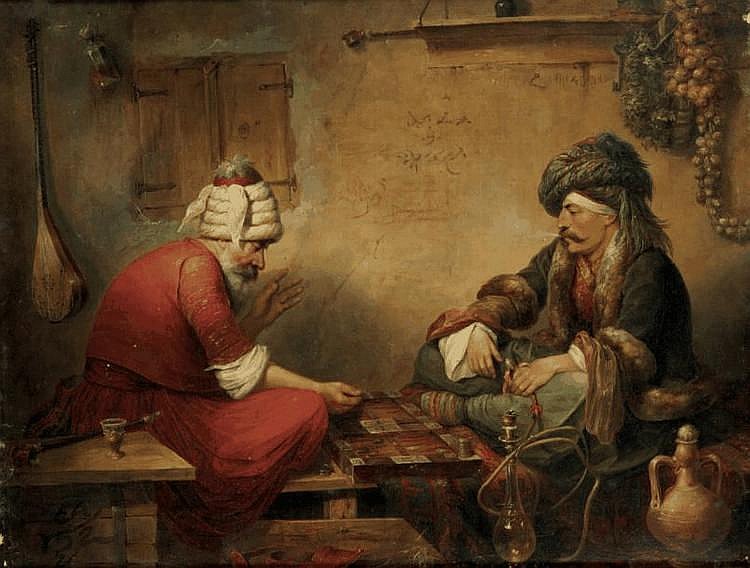
First painter of battles, he asked to go at his own expenseon an expedition to Algiers in 1830. He returned in Algeria in 1832 and painted representative sites of the city and its surroundings.

Ernest Louis LESSIEUX (1848-1925) 
RABAT 
RABAT SEEN THE LIGHT
Watercolor on paper, 
signed and titled lower right "E. Louis Lessieux, Rabat seen from Salér" 
20 x 31.5 cm

 LG (XIX - XX CENTURY) 
PORTRAIT OF A SUBSTANTIAL 
PORTRAIT OF AN ARAB ARAB Nobleman 
Watercolor on paper, signed "LG" in the bottom right 
A view: 36 x 20 cm.


Lieutenant LONG (XIXe SIÈCLE) 
LE PASSAGE DE L’OUED 
CROSSING THE OUED 
Huile sur toile, signée “Lt. Long” en bas à gauche. 
24 x 40 cm

Georges MAURY (BORN 1872) 
FANTASIA MOROCCAN 
Oil on canvas,
 signed "G. Maury "in the lower right 
60 x 120 cm

Arthur Merice (died in 1908) 
THE EGYPTIAN MUSICIAN PLAYINGTHE HARP
Oil on canvas, 
signed "A.MERICE" lower right 
80 x 64 cm.


Henry PONTOY (1888-1968) 
MARKET NEAR THE WALLS 
Gouache on paper, 
signed "Pontoy 1937" lower left 
42 x 57 cm.

Henry PONTOY (1888-1968) 
PORTRAIT OF A WOMAN KABYLE 
Oil on panel, 
signed "Pontoy" lower right 
45 x 35.5 cm.

Joseph Jacques REYMANN (BORN 1848) 
WOMEN 
WOMEN ON SIDI ABDALLAH ALGER STREET SIDI
Oil on panel, signed "Reymann" in the lower right and situated "Rue Sidi Abdallah in Algiers" on the bottom left. Under glass. 
39 x 22.5 cm

Henri Emilien Rousseau (1875-1933) 
HALT 
HALT OF THE RIDERS 
Oil on canvas, signed "Henri Rousseau" bottom right. Dated (19) 21 
55 x 72.5 cm 

Pupil of Jean-Léon Gérôme at the Ecole des Beaux-Arts, he won a 1900 Grand Prix de Rome and a travel scholarship to visit the museums of Europe . In 1901, he traveled to Algeria, Tunisia and Spain and more between 1903 and 1932 period in which he among other big five trips to Morocco.


Agapit STEVENS (1849-1917) 
ORIENTAL 
GIRL IN EAST WITH CORAL NECKLACE
Oil on canvas, 
signed "A.Stevens" bottom left 
75.5 x 56 cm.

BELGIAN SCHOOL 
A FAMILY SCENE IN KABYLIE
Oil on canvas, signed "Verschaffelt" lower left 
54 x 65 cm 


In 1919, he discovered Bou Saada where he resided a time . He returned in 1924 when he married a young woman from the tribe of Ouled Sidi Brahim with whom he has two children and lived a secluded life with his family. The Sahara did not prevent his exhibiying regularly in Algiers 


Philip ZILKHEN (1857-1930) 
KHAMSIN IN CAIRO CAIRO 
Oil on canvas, 
signed "Ph.Zilkhen" at bottom right 
47 x 59 cm.