Monday, May 25, 2020

01 Orientalist Painting, with footnotes, #56

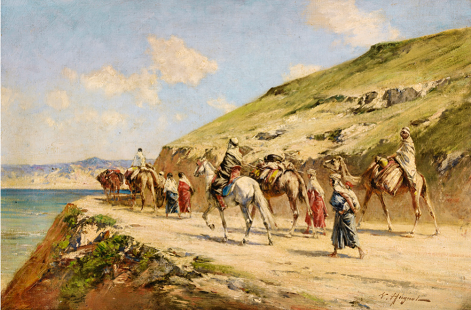
Victor-Pierre Huguet, LUDE 1835 - 1902 PARIS
CAVALIERS ON A PATH
Oil on canvas
40 x 59,8 cm ; 15 3/4 by 23 1/2 in
Peivate properly

Victor Pierre Huguet , born Lude the 1 st May 1835 and died in Paris August 16, 1902, was a French, landscape and genre painter.. He was a pupil of Emile Loubon in Marseille and received advice from Fromentin in Paris.

In 1852, aged 17, he traveled to Egypt, then to Crimea where he accompanied Durand-Brager before the siege of Sebastopol. He was profoundly influenced by the landscapes he passes through and that will influence his inspiration to Orientalism, where he soon made a name. Discovering Algeria a few years later, he drew from many sources of inspiration.
He exhibited at the Salons de Marseille and Paris in 1859 and the Salon of French Orientalist Painters at its inception in 1893. He was the leading Orientalist artists of Provence. More Victor Pierre Huguet


Images are copyright of their respective owners, assignees or others. Some Images may be subject to copyright

I don't own any of these images - credit is always given when due unless it is unknown to me. if I post your images without your permission, please tell me.

I do not sell art, art prints, framed posters or reproductions. Ads are shown only to compensate the hosting expenses.

If you enjoyed this post, please share with friends and family.

Thank you for visiting my blog and also for liking its posts and pages.

Please note that the content of this post primarily consists of articles available from Wikipedia or other free sources online.

Wednesday, May 20, 2020

01 Orientalist Painting, with footnotes, #55

Nathaniel Sichel
Portrait of an Egyptian Woman
Oil on canvas
42 x 28 in
Private collection

Nathaniel Sichel's artistic career began at the Royal Academy of Art in Munich, where he was trained in the academic tradition by Julius Schrader. He continued his studies in Paris at the École des Beaux arts where he won the prestigious Prix de Rome in 1864 with a painting entitled Joseph explains the dreams of the Pharaoh. This work solidified his reputation as a painter of Orientalist and historical subjects. Among these, he is mostly known for his depictions of Oriental beauties, dressed in opulent costumes and adorned with gold coins and jewelry.

The artist composed pictures of female figures in a Moorish setting, dressed in sensuous and dramatic attire. The artist's depiction of the Eastern world is skillfully executed with varied patterns in the architecture, décor, carpets, and textiles, emphasized by his superior draftsmanship and adept brushwork. More on Nathaniel Sichel


Images are copyright of their respective owners, assignees or others. Some Images may be subject to copyright

I don't own any of these images - credit is always given when due unless it is unknown to me. if I post your images without your permission, please tell me.

I do not sell art, art prints, framed posters or reproductions. Ads are shown only to compensate the hosting expenses.

If you enjoyed this post, please share with friends and family.

Thank you for visiting my blog and also for liking its posts and pages.


Please note that the content of this post primarily consists of articles available from Wikipedia or other free sources online.

Thursday, May 7, 2020

01 Orientalist Painting, with footnotes, #55

Ethel Carrick, (1872 - 1952)
A Market in Kairouan, (Circa 1911)
Oil on canvas
38 x 46 cm
Private collection

Kairouan (also spelled Kairwan), is the capital of the Kairouan Governorate in Tunisia. It is a UNESCO World Heritage site. The city was founded by the Umayyads around 670. In the period of Caliph Mu'awiya (reigned 661–680), it became an important centre for Sunni Islamic scholarship and Quranic learning, and thus attracting a large number of Muslims from various parts of the world, next only to Mecca and Medina. The holy Mosque of Uqba is situated in the city. More on Kairouan

Ethel Carrick (February 7, 1872 – June 17, 1952), also known by her married name of Ethel Carrick Fox, was an English-born Impressionist and Post-Impressionist painter. Much of her career was spent in France and in Australia, where she was associated with the movement known as the Heidelberg School.

Mainly a painter, Carrick is known for her flower paintings, landscapes and scenes of outdoor urban life in parks and on beaches. Some of these draw on her international travels, such as her paintings of outdoor markets in the Middle East and elsewhere.

Carrick began as an Impressionist plein air painter but fairly quickly moved to a more Post-Impressionist style featuring blockier compositions and sharper color contrasts. Some of the works produced around 1911-12 are distinctly Fauvist. Her canvases of urban life tend to be dense with human activity and feature patches of vibrant color. More on Ethel Carrick


Images are copyright of their respective owners, assignees or others. Some Images may be subject to copyright

I don't own any of these images - credit is always given when due unless it is unknown to me. if I post your images without your permission, please tell me.

I do not sell art, art prints, framed posters or reproductions. Ads are shown only to compensate the hosting expenses.

If you enjoyed this post, please share with friends and family.

Thank you for visiting my blog and also for liking its posts and pages.


Please note that the content of this post primarily consists of articles available from Wikipedia or other free sources online.


Tuesday, April 21, 2020

01 Painting by Orientalist Artists, with footnotes, 54

Adolf Schreyer, 1828 - 1899, GERMAN
ARAB HORSEMAN
Oil on canvas
82.5 by 68cm., 32½ by 26¾in.
Private collection

Adolf Schreyer (July 9, 1828 Frankfurt-am-Main – July 29, 1899 Kronberg im Taunus) was a German painter, associated with the Düsseldorf school of painting. He studied art, first at the Städel Institute in his native town, and then at Stuttgart and Munich. He painted many of his favourite subjects in his travels in the East. He first accompanied Maximilian Karl, 6th Prince of Thurn and Taxis through Hungary, Wallachia, Russia and Turkey; then, in 1854, he followed the Austrian army across the Wallachian frontier. In 1856 he went to Egypt and Syria, and in 1861 to Algiers. In 1862 he settled in Paris, but returned to Germany in 1870; and settled at Cronberg near Frankfurt, where he died.

Schreyer was, and is still, especially esteemed as a painter of horses, of peasant life in Wallachia and Moldavia, and of battle incidents. His work is remarkable for its excellent equine draughtsmanship, and for the artist's power of observation and forceful statement; and has found particular favour among French and American collectors. Of his battle-pictures there are two at the Schwerin Gallery, and others in the collection of Count Mensdorff-Pouilly and in the Raven Gallery, Berlin.  More on Adolf Schreyer


Images are copyright of their respective owners, assignees or others. Some Images may be subject to copyright

I don't own any of these images - credit is always given when due unless it is unknown to me. if I post your images without your permission, please tell me.

I do not sell art, art prints, framed posters or reproductions. Ads are shown only to compensate the hosting expenses.

If you enjoyed this post, please share with friends and family.

Thank you for visiting my blog and also for liking its posts and pages.


Please note that the content of this post primarily consists of articles available from Wikipedia or other free sources online.

Tuesday, April 14, 2020

01 Painting by Orientalist Artist Lalla Essaydi, with footnotes, #53

Lalla Essaydi
Harem Revisited #48a, c. 2013
Chromogenic print mounted to aluminum
85 7/10 × 71 1/2 in, 217.7 × 181.6 cm

Moroccan born photographer Lalla Essaydi explores Arab female identity by hand-painting Arabic calligraphy in henna on different surfaces such as female bodies, fabric and walls. Through her compositions, Essaydi references nineteenth century Orientalist style and rejects traditional objectified representations of Arab women. The artist critiques French painters such as Jean Auguste Dominique Ingres and Eugène Delacroix who often painted middle-eastern harems filled with eroticized Arab female bodies. Her photographs address and deconstruct the complex power structures imposed on the Arab female body by alluding to historical stereotypes. 


In her series Harem, Essaydi refers to the dangerous nature of the harem, contrasting the idealistic setting that Western artists previously depicted. The artist places her figures within the Moroccan Palace Dar El Basha and dresses them in patterns similar to the palace’s mosaics, wood carvings and stained glass. By camouflaging the women’s bodies into the background, Essaydi illustrates how women seemingly appear as another piece of décor in the room. To counter societal norms, Essaydi utilizes calligraphy and applies henna to adorn the female bodies. The text is not necessarily meant to be read or understood, but rather alludes symbolically to the restrictions faced by women in today’s societies and how they find their voice despite all imposed restrictions. Through the perspective of an Arab woman living in a Western world, Lalla Essaydi redefines Arab female identity. More on Lalla Essaydi


Images are copyright of their respective owners, assignees or others. Some Images may be subject to copyright

I don't own any of these images - credit is always given when due unless it is unknown to me. if I post your images without your permission, please tell me.

I do not sell art, art prints, framed posters or reproductions. Ads are shown only to compensate the hosting expenses.

If you enjoyed this post, please share with friends and family.

Thank you for visiting my blog and also for liking its posts and pages.

Please note that the content of this post primarily consists of articles available from Wikipedia or other free sources online.

Monday, April 6, 2020

01 Painting by the Orientalist Artists, with footnotes, 53

Auguste Pinchart, (1842 - 1920)
MATERNITÉ TUNISIENNE/ TUNISIAN MOTHERHOOD
Oil on canvas
27 X 35 CM (10 5/8 X 13 3/4 IN.)
Private collection

Emile Auguste Pinchart was a French painter of portraits and genre and followed the tradition of an idealised vision of life during La Belle Epoque, in the style of Tissot and his followers. His light and natural palette reflects a sentiment of delightful charm. A pupil of Gerome, he exhibited at the Salon de Paris, obtaining an honourable mention in 1883 and a third-class medal in 1884.  

Pinchart intermittently left his native France for Geneva, where he held workshops there on posters and reproductions, under the name of Atelier-Pinchart. As well as exhibiting at the Salon de Paris, he was elected a member of the Societe des Artistes Francais in 1905. More on Emile Auguste Pinchart


Images are copyright of their respective owners, assignees or others. Some Images may be subject to copyright

I don't own any of these images - credit is always given when due unless it is unknown to me. if I post your images without your permission, please tell me.

I do not sell art, art prints, framed posters or reproductions. Ads are shown only to compensate the hosting expenses.

If you enjoyed this post, please share with friends and family.

Thank you for visiting my blog and also for liking its posts and pages.

Please note that the content of this post primarily consists of articles available from Wikipedia or other free sources online.

Thursday, April 2, 2020

01 Orientalist Painting, with footnotes, #52

Léon Cauvy, (1874 - 1933)
MARCHÉ EN ALGÉRIE/ MARKET IN ALGERIA, c. 1918
Oil on rigid cardboard
28.2 X 39.7 CM (11 1/8 X 15 5/8 IN.)
Private collection

Léon Cauvy (12 January 1874, Montpellier - 3 January 1933, Algiers) was a French Orientalist painter.

He began his studies in 1890 at the local School of Fine Arts; winning several awards for his sketches and ink wash paintings, although his interests soon turned to decorative work. Later, he went to Paris and spent some time studying with Albert Maignan at the École des Beaux-arts.

He participated in the Salon from 1901 to 1903. At the Salon of 1907, he was awarded third place. That same year, he and Paul Jouve became the first winners of the Prix Abd-el-Tif. One of the benefits of the prize was a year's stay at the Villa Abd-el-Tif in Algiers.

He was already thirty-years old and had a promising career in France, but immediately became enamored of North Africa. He exhibited fifty of his paintings at an Orientalist exhibition in Paris in 1909 and, pleased with their reception, decided to remain in Algeria. Shortly after, he became Director of the École des Beaux-arts d'Alger]; a position he held until his death.

In 1925, he was placed in charge of decorating the Algerian Pavilion at the International Exhibition of Modern Decorative and Industrial Arts. After the exhibition, his works were moved to the "Palais d’Été"; official home and headquarters for the French admirals in Algiers.

Five years later, he designed the poster commemorating one-hundred years of French rule in Algeria. Thirty-thousand copies were made and distributed worldwide. This was followed by several more poster designs, for shipping companies in the tourist trade.

In 1932, for his last major work, he created a large canvas depicting the Ouled Naïls that was shown at the Salon of the Société des Artistes Français. Since 1990, it has been on display at the Musée des Années Trente. Overall, he concentrated on scenes of daily life as opposed to the more "exotic" aspects of Arab culture. Many of his paintings have the appearance of tapestries. More on Léon Cauvy


Images are copyright of their respective owners, assignees or others. Some Images may be subject to copyright

I don't own any of these images - credit is always given when due unless it is unknown to me. if I post your images without your permission, please tell me.

I do not sell art, art prints, framed posters or reproductions. Ads are shown only to compensate the hosting expenses.

If you enjoyed this post, please share with friends and family.

Thank you for visiting my blog and also for liking its posts and pages.


Please note that the content of this post primarily consists of articles available from Wikipedia or other free sources online.